




China Under Dual Climate Threats
|
General Studies Paper III: Climate Change, Environmental Pollution & Degradation |
Why in News?
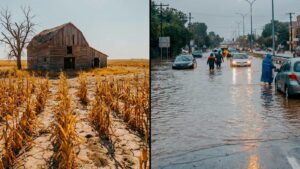
Recently, China has warned of a rare dual climate threat in 2026, with severe flooding expected in northern regions and intense droughts in others, posing risks to agriculture, water resources, and infrastructure.
Climatic Drivers Behind China’s Extreme Weather Patterns
- Monsoon Variability: China’s climate is heavily influenced by the East Asian Summer Monsoon (EASM), which has become increasingly erratic due to warming oceans. A stronger summer monsoon brings intense rainfall and floods, while weakened circulation leads to prolonged dry spells, creating simultaneous flood–drought conditions.
- Global Warming: Global warming has intensified China’s climate instability, with temperatures crossing +1.5°C above pre-industrial levels, altering atmospheric energy balance. Warmer air holds more moisture, increasing extreme rainfall events while simultaneously accelerating evaporation, leading to drought conditions in other regions.
- Regional Climatic Diversity: China’s vast geography—from humid south to arid north—creates natural climatic contrasts. This diversity makes it highly vulnerable to simultaneous extreme events, where one region floods while another faces water scarcity.
- Influence of ENSO (El Niño–Southern Oscillation): ENSO cycles significantly affect China’s climate. El Niño years often bring reduced rainfall and drought, especially in northern China, while La Niña increases heavy rainfall and flood risks, creating alternating extreme conditions.
- Recent forecasts indicate a shift from La Niña to neutral/El Niño conditions in 2026, which destabilizes atmospheric circulation. Such transitions are known to amplify climate anomalies, increasing the likelihood of simultaneous floods and droughts.
- Ocean-Atmosphere Interactions: Changes in Sea Surface Temperatures (SSTs) in the Pacific and Indo-Pacific Oceans alter wind circulation and moisture transport. These anomalies disrupt rainfall patterns across China, leading to regional imbalances in precipitation.
- Pacific Decadal Oscillation (PDO) Effects: The Pacific Decadal Oscillation (PDO) operates over longer timescales and modifies the intensity of ENSO impacts. It influences decadal rainfall variability, contributing to prolonged droughts or repeated flooding cycles in China.
- Atmospheric Circulation Changes: Shifts in mid-latitude jet streams and upper-air circulation systems affect temperature and rainfall distribution. These changes lead to blocking patterns, causing persistent rainfall (floods) or prolonged dry spells (droughts).
Flood and Drought Regions in China
- Flood-Prone Yangtze River Basin: The Yangtze River Basin (covering 1.8 million km²) is highly vulnerable to floods due to heavy monsoon rainfall (1067 mm annually) and dense river networks. The middle and lower reaches are especially prone to waterlogging and overflow events.
- Eastern Plains and Delta Regions: Flooding is concentrated in eastern low-lying plains such as the Yangtze River Delta, Pearl River Delta, and Jianghan Plain. These areas have flat terrain, dense population, and poor drainage, making them highly susceptible to urban and riverine floods.
- Southern Coastal Flood Zones: South China’s coastal provinces (e.g., Guangdong) face intense flooding due to torrential rainfall, typhoons, and river overflow. Rainfall often exceeds 300 mm in short periods, triggering flash floods and landslides.
- Yellow River Basin: The Yellow River Basin experiences both floods and droughts due to its semi-arid climate (223–1115 mm rainfall range) and seasonal concentration of rainfall (over 70% between May–October). This creates high variability and risk.
- North China Plain: The North China Plain (Henan, Hebei, Shandong) is highly drought-prone due to low rainfall, high temperatures, and overuse of groundwater. Recent data shows persistently low precipitation and heatwaves, severely affecting agriculture.
- Northwest Arid and Semi-Arid Regions: Regions like Inner Mongolia, Gansu, Ningxia, and Xinjiang receive 30–70% below-normal rainfall and have desert and steppe climates, making them extremely vulnerable to long-term hydrological droughts and water shortages.
- Northeast and Inland Basin: The Songliao Basin and Northeast China show increasing localized drought intensity, while inland basins and mountainous regions have uneven rainfall distribution, leading to alternating drought and flood risks depending on seasonal shifts.
Effects of Climate Extremes in China
- Agricultural Production Losses: Extreme floods and droughts directly disrupt crop cycles of rice, wheat, and maize, especially during critical growth stages. Studies (2025) highlight increased yield variability and crop failure risks, threatening China’s food security despite a record 714.88 million tonnes grain output in 2025.
- Rising Economic Losses: Climate-induced disasters are causing massive financial damage. In July 2025 alone, natural disasters including floods led to 52.2 billion yuan losses, while extreme rainfall damaged infrastructure worth 16 billion yuan (~$2.2 billion), increasing fiscal pressure.
- Pressure on Water Resources: Agriculture consumes about 62.2% of China’s total water usage, making it highly vulnerable to water scarcity and droughts. Uneven rainfall and over-extraction are intensifying water stress, reducing irrigation efficiency and threatening long-term sustainability.
- Food Security Risks: Frequent climate shocks threaten stable food supply, prompting government intervention. In 2024–25, over CNY 3 billion was allocated for flood relief, crop recovery, and irrigation, alongside insurance subsidies increased by 19% to protect farmers’ incomes.
- Regional Economic Disruptions: Droughts and floods create regional economic imbalances, severely affecting rural economies. Research (2025) shows droughts disrupt both supply and demand, leading to output contraction, especially in agriculture-dependent regions.
China Disaster Response and Preparedness
- Institutional Framework: China has developed a centralized disaster management system led by the Ministry of Emergency Management (MEM) (established 2018). It ensures unified command, rapid response, and inter-agency coordination, forming an integrated “all-hazards approach” under the 14th Five-Year Plan (2021–2025).
- Legal and Policy Framework: China has institutionalized disaster response through laws like the Emergency Response Law (2007) and policies such as the National Flood Control and Drought Relief Plan (2006, updated periodically). These frameworks define preparedness, prevention, response, and recovery mechanisms.
- Early Warning Systems: Advanced early warning systems led by the China Meteorological Administration (CMA) provide real-time alerts. For instance, in August 2022, an orange drought warning triggered nationwide emergency responses, enabling timely evacuation and preparedness measures.
- Flood Control Infrastructure: China has heavily invested in flood control infrastructure, including dams, embankments, and reservoirs. As of 2025, 329 rivers exceeded warning levels, prompting large-scale interventions and reinforcing river basin-level disaster management systems aimed at modernization by 2035.
- Emergency Response: During disasters, China deploys National Fire and Rescue Forces and specialized teams for search, rescue, and evacuation. Recent flood responses (2025) supported over 30,000 affected people with equipment, shelter, and rehabilitation assistance.
- Financial Support: The government allocates significant funds for disaster relief. In 2025, over 1 billion yuan was released for flood and drought recovery, including crop replanting, infrastructure repair, and irrigation support, ensuring quick economic recovery and livelihood restoration.
China Climate Impact on India
- Regional Food Security: China and India are two of the world’s largest food producers and consumers. Extreme floods and droughts in China can disrupt crop yields, affecting export‑import linkages and pushing global grain prices upward. Such volatility impacts India’s food inflation and procurement strategies as supply stress in one major producer affects overall Asian food availability.
- Transboundary Climatic Stress: Climate extremes in China often reflect broader Himalayan climatic shifts affecting both countries. Glacier melt and irregular monsoon flows can alter river discharge patterns in shared basins like the Indus and Brahmaputra systems, increasing flood risk in Indian flood plains and drought stress in dry seasons.
- Influence on Asian Monsoon: Erratic extremes in China signify changes in the East Asian monsoon system, which interacts with the Indian monsoon. More intense rainfall events interspersed with dry spells destabilize cropping calendars in India, raising agricultural risk and production uncertainty.
- Water Security Challenges: India already faces severe water stress — 18% of world population but only 4% of water resources, with nearly 600 million people under water stress. Increased irregularity in neighbouring China’s hydrology can intensify regional water competition, complicating India’s own water allocation and drought relief efforts.
- Economic and Trade Disruptions: China’s climate‑induced agricultural disruptions can affect India’s import costs for commodities, influence input supply chains (e.g., fertilisers, machinery), and cause price instability that affects both manufacturing and farm sectors in India, impacting GDP growth and inflation targets.
|
Also Read: Indian Monsoon – Why Rainfall Increases and Decreases |