



India Withdraws COP33 Hosting Bid
|
General Studies Paper II: Groupings & Agreements Involving India and/or Affecting India’s Interests |
Why in News?
India has officially withdrawn its bid to host the 33rd Conference of Parties (COP33) Summit to the UNFCCC, scheduled for 2028. The decision, communicated to the UNFCCC, followed a review of 2028 commitments.
What is Conference of the Parties (COP)?
-
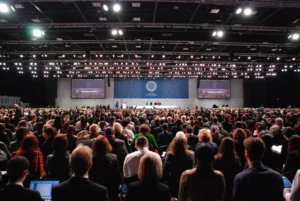
- About: The Conference of the Parties (COP) is the supreme decision-making body of the United Nations Framework Convention on Climate Change (UNFCCC).
- It brings together countries (Parties) that have ratified the convention to assess progress in tackling climate change and negotiate global responses.
- Origin: The COP mechanism was established under the 1992 Rio Earth Summit, where the UNFCCC was adopted.
- The convention entered into force in 1994, making COP a legally backed platform.
- The first COP (COP1) was held in Berlin in 1995, marking the beginning of annual global climate negotiations.
- Objectives: COP aims to stabilize greenhouse gas (GHG) concentrations to prevent dangerous climate impacts.
- It reviews national reports, promotes climate mitigation and adaptation, facilitates technology transfer, and mobilizes climate finance for developing countries.
- Parties: There are currently 198 Parties to the UNFCCC, comprising 197 countries and the European Union.
- These members are organized into five regional groups: Africa, Asia, Eastern Europe, Latin America and the Caribbean, and Western Europe and Others.
- Nature: COP meetings are held annually in different host countries. Each session is numbered (e.g., COP21, COP26).
- The responsibility of hosting the summit rotates among the five UN regional groups each year. The host nation provides the venue and appoints a COP President, who is usually a senior minister who leads the negotiations.
- It includes plenary sessions, negotiations, side events, and participation from governments, scientists, NGOs, and businesses, making it a multi-stakeholder platform.
- Countries submit Nationally Determined Contributions (NDCs) and periodic reports, which are reviewed under mechanisms like the Global Stocktake.
- Principle: A central concept in COP negotiations is Common But Differentiated Responsibilities and Respective Capabilities (CBDR-RC).
- It recognizes that while all countries must act, developed nations bear greater responsibility due to historical emissions and must support developing nations.
- About: The Conference of the Parties (COP) is the supreme decision-making body of the United Nations Framework Convention on Climate Change (UNFCCC).
- Structure: The COP is supported by two permanent subsidiary bodies: the SBSTA (Scientific and Technological Advice) and the SBI (Implementation). These bodies provide the technical and administrative data needed for leaders to make informed choices.
-
- The UNFCCC Secretariat (Bonn, Germany) facilitates coordination, reporting, and negotiations.
- This is divided into two main areas. The Blue Zone is for official government negotiators and the UN. The Green Zone is for the public, businesses, and young activists.
- COP operates through multiple bodies: the Conference of Parties (COP), CMP (Kyoto Protocol Parties), and CMA (Paris Agreement Parties).
- Major Outcomes: Several summits have changed history through landmark treaties. COP3 (1997) led to the Kyoto Protocol, the first agreement with legally binding emission targets for developed nations.
- COP21 (2015) resulted in the Paris Agreement, a universal pact involving almost all countries in a collective effort to curb emissions. This aims to limit global warming to well below 2°C, preferably 1.5°C.
- COP28 (2023) in Dubai produced the “UAE Consensus,” the first-ever agreement to “transition away” from fossil fuels.
- Finance and Equity: COP emphasizes financial support for developing countries through mechanisms like the Green Climate Fund (GCF) and Loss and Damage Fund (formalized at COP27).
- Developed nations pledged $100 billion annually, though delivery gaps persist.
- Equity principles like CBDR-RC (Respective Capabilities) remain central to negotiations.
|
Note: COP29 (2024) was held in Baku, Azerbaijan, COP30 (2025) was held in Belém, Brazil and COP31 (2026) will be held in Antalya, Türkiye. |
India’s COP Engagements
India has been actively engaged in climate diplomacy since the 1992 Rio Earth Summit, contributing to the creation of the UNFCCC framework.
- COP8 New Delhi (2002): India first demonstrated its logistical and diplomatic capability by hosting COP8 in New Delhi in 2002.
- Under the leadership of then-Prime Minister Atal Bihari Vajpayee, the conference produced the Delhi Ministerial Declaration, which was a landmark for the developing world.
- This document firmly integrated sustainable development into the climate agenda, arguing that poverty eradication and economic growth were the primary goals for nations like India.
- COP21 Paris Agreement (2015):: During COP21 in Paris, India moved from a defensive posture to a proactive one by announcing its first Nationally Determined Contributions (NDCs).
- It committed to reducing its emissions intensity by 33-35% by 2030 and ensuring that 40% of its electricity capacity came from non-fossil sources.
- At the same COP21 summit, India and France co-founded the International Solar Alliance (ISA). Headquartered in Gurugram, India, this alliance focuses on bringing affordable solar energy to “sunshine countries” located between the Tropics.
- It marked India’s evolution into a global rule-setter, providing a collaborative platform for clean energy beyond just the UN framework.
- COP26 Glasgow (2021):: At COP26, Prime Minister Modi introduced the Panchamrit (five nectar) targets, including a Net-Zero goal for 2070. India also committed to reaching 500 GW of non-fossil energy capacity by 2030.
- A critical moment occurred when India led the push to change the wording of the final agreement from “phasing out” to “phasing down” of coal, reflecting its unique energy security needs.
- India introduced Mission LiFE (Lifestyle for Environment) at COP26, which was formally adopted into the global agenda at COP27. It emphasizes circular economy principles, moving from a “use and throw” culture to one of mindful utilization.
- COP28 Dubai (2023): During the high-level segment of COP28, Prime Minister Modi officially proposed that India host COP33 in 2028. This move was intended to showcase India’s green energy triumphs and position it as a bridge between the Global North and South.
- India launched the Green Credit Initiative to reward pro-planet actions like afforestation.
- COP29 Baku (2024): At COP29, India acted as a vocal advocate for the New Collective Quantified Goal (NCQG) on climate finance. India insisted on a target of $1.3 trillion annually by 2035 from developed nations.
|
Note: On 25 March 2026, the Union Cabinet approved India’s Nationally Determined Contribution (NDC) for the period 2031–2035. These updated targets for 2035 represent an increase in ambition from the previous goals set for 2030:
|
Reasons Behind India Withdrawing COP33 Hosting Bid
- Review of National Commitments: The primary reason cited in the official letter to the Asia-Pacific Group was a “review of its commitments for the year 2028”. This suggests a recalibration of national priorities where the administrative and financial burden of a massive 75,000-person summit might conflict with other major domestic goals planned for that year.
- Geopolitical Stability and Security: Climate experts suggest that the US-Iran conflict has forced nations to adopt a “cautious approach”. India is reportedly prioritising short-term energy security and regional stability over hosting high-stakes international conferences that could involve complex diplomatic friction during a global crisis.
- Avoiding Excessive Climate Pressure: Hosting a COP presidency requires the nation to champion ambitious global emission cuts. Analysts believe India feared that being in the “hot seat” would bring additional pressure to enhance its own Nationally Determined Contributions (NDCs) beyond what is currently feasible for its developing economy.
- Focus on Large-Scale Infrastructure: The government is currently diverting significant administrative resources toward massive projects and other “big-ticket” events. For instance, Gujarat is undergoing inspections for a potential 2030 Commonwealth Games bid in Ahmedabad, requiring high-level coordination that may overlap with the multi-year preparation needed for a COP.
|
Also Read: 2025 Could Be One of the Hottest Years Globally Says WMO |