Major Ports Cargo Hits 915 MT Growth
|
General Studies Paper III: Infrastructure, Growth and Development, Government Policies & Interventions |
Why in News?
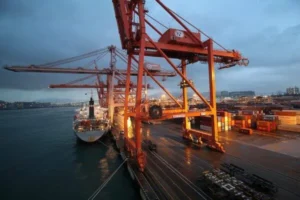
Recently, India’s major ports handled a record 915 million tonnes of cargo in FY 2025–26, surpassing targets and growing over 7% year-on-year, reflecting improved infrastructure and rising trade activity across the country’s maritime sector.
India’s Major Ports Cargo Performance FY 2025–26
- Total Cargo Throughput: India’s major ports collectively handled 915.17 million tonnes (MT) of cargo in FY 2025–26, marking the highest-ever throughput recorded.
- This performance exceeded the annual target of 904 MT, indicating an absolute surplus of 11.17 MT over projections.
- Year-on-Year Growth: The cargo handled reflects a 7.06% year-on-year (YoY) growth compared to FY 2024–25. In the previous fiscal, major ports handled approximately 855 MT, highlighting a significant increase of over 60 MT in absolute cargo volume within one year.
- Leading Ports: Among all major ports, Deendayal Port Authority (Kandla) emerged as the largest cargo handler with 160.11 MT, followed by Paradip Port Authority at 156.45 MT and Jawaharlal Nehru Port Authority (JNPA) at 102.01 MT. These three ports together contributed a substantial share of total cargo throughput.
- Visakhapatnam Port Authority, Mumbai Port Authority, Chennai Port Authority, and New Mangalore Port Authority also registered strong performances.
- Port-wise Growth: In terms of growth rates, Mormugao Port Authority recorded the highest growth of 15.91%, followed by Kolkata Dock System at 14.28% and JNPA at 10.74%.
- Visakhapatnam Port Authority handled 91.17 MT cargo, registering a 10.35% increase from 82.62 MT in the previous year.
- Similarly, Chennai Port crossed 50 MT cargo during the fiscal year, reflecting steady growth in throughput.
Key Drivers Behind the Growth
- Infrastructure Modernisation: Continuous capacity augmentation and mechanisation allowed ports to handle larger vessels. Investments in port-led development under the Maritime Amrit Kaal Vision 2047 expanded cargo handling capacities and upgraded aging infrastructure.
- This achievement was driven by infrastructure modernization and reforms under the Indian Ports Act, 2025, which replaced colonial-era laws to boost operational efficiency and trade.
- Digital Transformation: Implementation of “Smart Port” initiatives, including National Logistics Portal (Marine) and Digital Twins, significantly reduced vessel turnaround times. V.O. Chidambaranar Port became the first to implement a Digital Twin for real-time operational monitoring.
- Implementation of the National Logistics Portal (Marine) and the Sagar Setu platform enabled unified trade facilitation and digital maritime services from a single point.
- Reforms like “One-Nation-One-Document” (ONOD) and “One-Nation-One-Process” (ONOP) standardized documentation, eliminating redundant procedures.
- Multimodal Connectivity: Enhanced rail and road linkages under the PM Gati Shakti National Master Plan strengthened hinterland connectivity. This integration streamlined cargo movement from production centres to port terminals.
- First and Last Mile Connectivity ensured that the “gaps” between main highways or rail lines and the port gates were closed.
- The synergy with Dedicated Freight Corridors (DFCs) allowed for faster, higher-capacity rail movement, moving massive volumes of coal and containers.
- Multi-Modal Logistics Parks (MMLPs) acted as consolidation points where cargo from smaller production centers could be efficiently transferred to rail or large trucks for direct port delivery.
- Strategic Commodity Mix: Sustained demand for key commodities such as bulk cargo (coal, iron ore), liquid cargo (crude oil, POL), and container traffic (measured in TEUs) drove the bulk of the throughput, Container traffic alone saw a notable surge, with JNPA handling 102.01 MT.
- Operational Efficiency: Improvements in port productivity and faster processing times boosted overall throughput. Average vessel turnaround time dropped from roughly 4 days in 2013–14 to under 1 day in FY 2025–26, significantly accelerating port throughput.
- Policy Reforms: Government initiatives like Sagarmala promoted port-led development and ease of doing business. These reforms attracted private participation and investments in green port technologies.
- Sagarmala Programme focused on port-led industrialization and connectivity. It successfully implemented port modernization projects worth over ₹1,000 crore.
- Investments in green port technologies and sustainability initiatives under Vision 2047 attracted higher private participation and eased global trade compliance.
|
Ports in India:
|
|
Also Read: VOC Port Becomes First in India to Deploy Advanced Anti-Drone System |