Rajnath Singh-Japan Defence Minister Talks to Boost Defence Ties
| General Studies Paper II: Groupings & Agreements Involving India and/or Affecting India’s Interests |
Why in News?
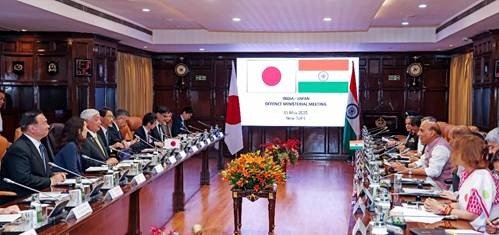
Recently, Indian Defence Minister Rajnath Singh and Japanese Defence Minister Shinjiro Koizumi advanced talks on defence technology and Indo-Pacific stability, strengthening interoperability.
Rajnath Singh–Japan Defence Minister Talks: Key Outcomes
- Bilateral Meeting: On 20 August 2026, both countries’ Defence Ministers held bilateral talks in New Delhi.
- The discussions come after the 8th Defence Policy Dialogue (July 2026) and ahead of the planned 4th 2+2 Ministerial Dialogue.
- The discussions strengthened the broader India–Japan Special Strategic and Global Partnership, with defence cooperation positioned as an important pillar.
- Defence Cooperation:
- Both sides emphasised cooperation for a free, open and rules-based Indo-Pacific, reflecting their shared interest in regional peace, stability and security.
- Japan and India have signed a Memorandum of Arrangement on Maritime Security Cooperation to strengthen their maritime security cooperation and deepen operational ties.
- It establishes a framework to deepen ties between the Indian Navy and the Japan Maritime Self-Defense Force.
- This enhances collaboration through Maritime Domain Awareness (MDA) information sharing, alongside boosted coordination in Search and Rescue (SAR) and Humanitarian Assistance and Disaster Relief (HADR) operations.
- The two defense ministers strongly opposed any unilateral actions or coercion that threaten freedom of navigation, overflight, or the existing status quo.
- India and Japan agreed to further strengthen joint exercises, helping improve operational coordination and practical understanding between their armed forces.
- The partnership will deepen through personnel exchanges and Subject Matter Expert (SME) exchanges, facilitating institutional learning for specialised defence cooperation.
- The two countries are advancing defence equipment and technology cooperation, particularly under the Make in India framework.
- The evolving relationship increasingly emphasises co-development, co-production and industrial collaboration, supporting India’s objective of greater defence self-reliance.
- The two Ministers agreed to boost defense research and development cooperation between DRDO and ATLA for advanced defense technologies.
- They also plan to launch a new Defence Industry Forum to strengthen these ties.
- The two ministers agreed to boost disaster relief cooperation through the Indo-Pacific Logistics Network (IPLN).
- They also welcomed the upcoming second IPLN tabletop exercise at the Japan Ministry of Defense this September.
- Both ministers agreed to form a Joint Working Group to boost cooperation in operations, intelligence, equipment, technology, and industry.
- Led by Director-General/ Joint Secretary level officials, this group will coordinate efforts, maximize synergies, and speed up implementation while respecting each nation’s sovereignty.
India–Japan Defence Cooperation
- Background:
- India–Japan defence ties began with the Global Partnership (2000).
- gained formal security orientation from the 2008 Joint Declaration on Security Cooperation.
- In September 2014, bilateral ties were upgraded to a Special Strategic and Global Partnership, alongside the shared vision of a Free and Open Indo-Pacific (FOIP).
- Agreements:
- The 2015 Defence Equipment and Technology Cooperation Agreement framework and Agreement on Protection of Classified Military Information created a legal basis for industrial defence cooperation.
- The 2016 Agreement on Transfer of Defence Equipment and Technology created the basis for practical defence-industrial cooperation.
- The Reciprocal Provision of Supplies and Services Agreement (RPSS/ACSA) subsequently strengthened logistical interoperability.
- The Japan–India Joint Working Group on Defence Equipment and Technology Cooperation provides a mechanism for identifying concrete technology projects.
- The 7th JWG was noted in 2024, demonstrating institutionalisation of defence-industrial cooperation.
- Institutional Dialogue:
- The two nations coordinate their defense cooperation through several key high-level channels:
- 2+2 Ministers’ Dialogue: Anchored by Foreign and Defence Ministers since 2018.
- Defence Ministerial Dialogue: Convened annually to set strategic priorities.
- National Security Adviser Dialogue: Focused on top-level strategic coordination.
- Defence Policy Dialogue: Shapes bilateral defense frameworks.
- Staff Talks: Facilitates direct military-to-military engagement.
- Coast Guard Consultations: Enhances maritime security and cooperation.
- The two nations coordinate their defense cooperation through several key high-level channels:
- Military Exercises:
- Cooperation spans all three services through Dharma Guardian (Army), JIMEX (Navy) and Veer Guardian (Air Force).
- The upcoming Veer Guardian 26 air exercise will mark the first time that Japan Air Self-Defence Force fighter aircraft visit and participate in a joint drill hosted in India.
- Both countries also participated in Malabar, while Japan joined PASSEX (Trilateral naval exercise involving Japan, India and Indonesia), MILAN and participated in India’s Tarang Shakti multilateral air exercise.
- The first Joint Service Staff Talks were welcomed in 2024, while both countries agreed to make exercises progressively more complex and sophisticated.
- Cooperation spans all three services through Dharma Guardian (Army), JIMEX (Navy) and Veer Guardian (Air Force).
- Maritime Security:
- Naval cooperation is strategically important for the Indian Ocean–Western Pacific continuum.
- The 2018 Implementing Arrangement between the Indian Navy and the Japan Maritime Self-Defense Force (JMSDF) strengthened Maritime Domain Awareness (MDA).
- India and Japan are exploring ship-maintenance cooperation in India, potentially improving Japanese naval operational flexibility and bilateral interoperability.
- Projects:
- India and Japan are co-developing the UNICORN (Unified Complex Radio Antenna) mast system, marking their first-ever joint defense manufacturing and technology project.
- It integrates multiple antennas into one system, reducing the antenna footprint and improving ship stealth.
- Consolidating exposed arrays significantly lowers a warship’s radar cross-section, making it harder for enemy radar to track.
- Following a 2024 initial implementation memorandum, the formal co-development was highlighted at the 16th India-Japan Annual Summit in New Delhi.
- India’s Bharat Electronics Limited (BEL) will manufacture the masts domestically in partnership with Japanese firms like NEC Corporation.
- India becomes the second Asian nation after the Philippines to receive advanced Japanese defense technology.
- The partnership has extended beyond conventional platforms into Unmanned Ground Vehicles (UGVs) and robotics.
- In 2024, both sides noted successful completion of cooperation in this field, signalling greater emphasis on emerging military technologies.
- India and Japan are co-developing the UNICORN (Unified Complex Radio Antenna) mast system, marking their first-ever joint defense manufacturing and technology project.
Significance of India–Japan Defence Cooperation
- For India:
- Countering China: Helps India balance China’s growing assertiveness along its Himalayan borders and the Indian Ocean Region (IOR).
- Strategic Autonomy: Strengthens India’s “Act East” policy and solidifies its position as a net security provider in South Asia.
- Global Alignment: Enhances India’s leverage within the Quadrilateral Security Dialogue (Quad) alongside the US and Australia.
- Indian Ocean Security: Secures critical Sea Lines of Communication (SLOCs) through which massive volumes of Indian trade pass.
- MAHASAGAR-FOIP Initiative: India’s MAHASAGAR compliments Japan’s FOIP initiative.
- MAHASAGAR (Mutual and Holistic Advancement for Security and Growth Across Regions) is India’s trans-regional, development-led maritime doctrine focusing deeply on the Global South and Indian Ocean littoral states.
- FOIP (Free and Open Indo-Pacific) is Japan’s foundational geopolitical vision aimed at preserving a rules-based international order across the entire Indo-Pacific expanse.
- Choke Point Monitoring: Facilitates tracking of foreign naval movements near the Malacca Strait and eastern Indian Ocean.
- Island Diplomacy: Enables joint development and logistics access near India’s strategic Andaman and Nicobar Islands.
- Military Modernization: Offers India access to advanced Japanese engineering, robotics, and dual-use technologies.
- Co-development: Opens pathways for joint research in Artificial Intelligence (AI), unmanned systems, and cyber security.
- Infrastructure Upgrades: Benefits India’s domestic defence manufacturing ecosystem through potential technology transfers.
- Economic Security: Secures supply chains (Supply Chain Resilience Initiative) to reduce dependence on single-source nations.
- Disaster Response: Enhances capacity for joint Humanitarian Assistance and Disaster Relief (HADR) operations in the region.
- For Japan:
- Free and Open Indo-Pacific (FOIP): India acts as the western anchor for Japan’s FOIP vision to maintain a rules-based order.
- Strategic Diversification: Reduces Japan’s absolute reliance on its security alliance with the United States.
- Diplomatic Weight: Provides Japan with a powerful, nuclear-armed democratic partner in continental Asia to counter regional threats.
- Energy Lifelines: Protects Japan’s economic lifelines, as the majority of its oil imports pass through the Indian Ocean.
- Maritime Domain Awareness (MDA): Expands Japan’s surveillance reach far beyond the East China Sea into the wider Indo-Pacific.
- Base Access: Grants reciprocal access to Indian naval bases for logistics, refueling, and maintenance via the ACSA (Acquisition and Cross-Servicing Agreement).
- Defence Export Market: Provides Japan’s nascent defence export sector with a massive potential market for military hardware.
- Joint Production: Helps Japan distribute high R&D costs by co-developing security tech with India’s large engineering pool.
- Space and Cyber: Integrates Japanese satellite capabilities with Indian space expertise for better situational awareness.
- Alternative Investments: Allows Japan to counter China’s Belt and Road Initiative (BRI) by co-financing high-quality infrastructure in South Asia and Africa.
Frequently Asked Questions (FAQs):
1. Why is Rajnath Singh meeting Japan’s Defence Minister?
To deepen defence ties, strengthen strategic trust, expand cooperation, and promote Indo-Pacific stability and security.
2. When will Rajnath Singh hold bilateral talks with Japan’s Defence Minister?
The bilateral talks were held on 20 August 2026 in New Delhi with Shinjiro Koizumi.
3. What are the key areas of India-Japan defence cooperation?
Key areas include maritime security, defence technology, equipment cooperation, military exercises, logistics, and personnel exchanges.
4. How important is Japan for India’s defence strategy?
Japan is a key strategic partner, strengthening India’s maritime capabilities, defence technology ecosystem, and strategic posture across the Indo-Pacific.
5. What is the significance of India-Japan defence ties in the Indo-Pacific?
They support a free, open, resilient and prosperous Indo-Pacific, enhancing regional stability, maritime security and strategic cooperation.
Disclaimer: Information in this article is based on official announcements and public records. Regulations and implementation details may evolve over time.