



Turkey-Qatar Mutual Defence Pact, Key Highlights and Strategic Implications
| General Studies Paper II: International Relations |
Why in News?
Recently, Turkey and Qatar signed a landmark mutual defence pact in Istanbul on 13 November 2026, pledging unified military deterrence against external attacks, strengthening regional strategic deterrence.
What is the Turkey-Qatar Mutual Defence Pact?
- About: The Turkey-Qatar Mutual Defence Pact is a landmark bilateral security treaty designed to formalize collective defense and military solidarity.
- It aligns with Türkiye’s broader regional defense network.
- Objective: The primary objective is to strengthen collective deterrence, protect national sovereignty, and safeguard territorial integrity amid escalating Gulf tensions.
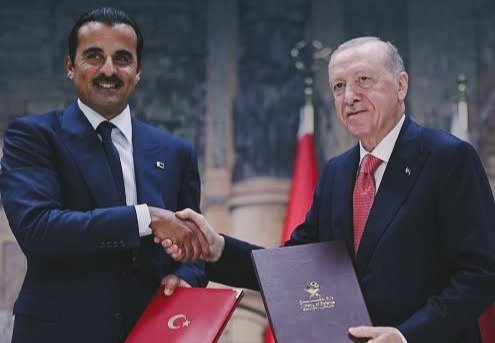
- Signatories: The pact was signed on November 13, 2026, at the Presidential Dolmabahçe Office in Istanbul, Türkiye.
- It was inked by Turkish President Recep Tayyip Erdoğan and Qatari Emir Sheikh Tamim bin Hamad Al Thani following the 12th session of the Türkiye-Qatar Supreme Strategic Committee.
- Provisions:
- Unified Stance Against External Attacks: Both nations pledge to adopt a unified position if an external armed attack targets either country.
- It establishes clear political and strategic solidarity against foreign aggression.
- Joint Security Consultations: The agreement mandates regular bilateral consultations regarding emerging security threats, regional instability, and global defense policies.
- Expanded Military Exercises and Training: Both countries committed to deepening operational interoperability through joint military exercises and structured personnel training exchanges.
- Defence-Industry Collaboration: The treaty prioritizes co-development and procurement within the defence industry.
- Both countries will expand technology sharing and weapons manufacturing partnerships, complementing parallel energy cooperation in liquefied natural gas (LNG) trade.
- Unified Stance Against External Attacks: Both nations pledge to adopt a unified position if an external armed attack targets either country.
Türkiye–Qatar Defence Relations
- Background and Evolution: Diplomatic ties between Türkiye and Qatar began in 1973, though deep strategic alignment accelerated after the 2011 Arab Spring.
- Both countries shared foreign policy visions. When the 2017 Gulf blockade isolated Qatar, Türkiye rapidly deployed troops to Doha.
- This decisive intervention transformed bilateral ties into a vital security and political alliance, shielding Qatar’s sovereignty and expanding Turkish influence in the Persian Gulf.
- The two countries signed an Economic and Technical Cooperation Agreement on 11 March 1985, establishing an institutional framework for trade, investment and technical collaboration.
- Defence Agreements: The cornerstone of bilateral security is the 2014 Defense Cooperation Agreement, ratified in 2017.
- The first meeting took place in Doha on 2 December 2015.
- The agreement established the Tariq bin Ziyad Military Base in Doha—Türkiye’s first overseas base in the Middle East.
- Over a dozen Supreme Strategic Committee summits have produced dozens of accords covering intelligence sharing, logistics, and training.
- Operational Cooperation: Armed forces from both nations conduct frequent bilateral and multilateral drills, such as the Ferocious Falcon and Al-Adheed exercises, alongside naval maneuvers in the Gulf.
- These operations enhance interoperability, crisis response, and combined arms readiness across land, air, and maritime domains.
- The Turkish-Qatari Combined Joint Force Command coordinates continuous personnel exchanges, officer training programs, and counter-terrorism strategy.
- Bilateral Trade: Defense industrial ties thrive through joint ventures between Qatar’s Barzan Holdings and Turkish firms like Baykar, BMC, ASELSAN, ASFAT, and TAIS.
- Qatar has procured Bayraktar TB2 drones, 1,500 BMC armored vehicles, and Istif-class frigates, while co-developing local defense manufacturing capabilities.
- In 2026, both nations joined Pakistan and Indonesia in the Badr defense industrial pact.
- Overall bilateral trade reached $1.3 billion in 2025, backed by a free trade accord targeting $5 billion annually.
- Shared Religion: Shared Sunni Islamic heritage and historical Ottoman-Qatari ties provide a strong ideological and cultural foundation for trust.
- Both governments promote Islamic solidarity, moderate political Islam, and coordinated humanitarian diplomacy across Muslim-majority regions like Gaza, Syria, and Somalia.
- Religious affinity legitimizes their brotherhood domestically and strengthens their joint diplomatic mediation across the Muslim world.
Turkey-Qatar Mutual Defence Pact Significance
- Amid 2026 regional hostilities involving Iran, Israel, and Houthimilitants, the pact introduces a potent non-Western deterrence layer to prevent a resurgence of Gulf warfare.
- It complements the August 2026 Mecca Joint Defence Agreement between Turkey, Saudi Arabia, and Pakistan.
- The accord shifts Gulf security from unilateral reliance toward multilateral regional burden-sharing and diplomatic conflict resolution.
- Cooperation in training, defence production and military technology can improve Qatar’s indigenous defence capabilities.
- The pact reflects growing Gulf skepticism toward United States security guarantees, prompting states to hedge strategically.
- For NATO, Ankara’s expanding bilateral commitments—despite possessing the alliance’s second-largest military—create complex diplomatic friction if regional conflicts entangle a member state outside Article 5.
- Within the Gulf Cooperation Council (GCC), Doha’s bilateral treaty runs parallel to the newly approved Kuwait-based Unified Military Command.
- This network challenges Western monopoly over Gulf security and alters strategic calculations for Iran and Israel.
- For India, the agreement stabilizes a vital region tied directly to energy security, and maritime trade through the Strait of Hormuz.
- Enhanced Gulf deterrence protects vital Qatari LNG supplies and the safety of its large expatriate diaspora in Qatar.
- Stable Gulf security supports India’s trade, investment, and economic connectivity.
- India shares warm ties with Qatar, elevating relations to a Strategic Partnership in February 2025 with a $28–30 billion trade target by 2030, $10 billion QIA investment pledge, and a 20-year LNG supply deal.
- India–Türkiye ties remain strained due to Ankara’s vocal stance on Kashmir and growing defence nexus with Pakistan.
- The emerging Turkey-Qatar-Pakistan defence nexus warrants close strategic monitoring by New Delhi.
- India must carefully navigate this evolving alignment and strengthen counter-balancing partnerships with nations like the UAE, Israel, and Greece.
Important Facts About Qatar and Turkey
| Feature | Qatar | Türkiye (Turkey) |
| Location | Peninsula jutting into the Persian Gulf | Transcontinental (Anatolia in Asia & Thrace in Europe) |
| Borders | Land border only with Saudi Arabia; maritime borders with Bahrain, UAE, Iran | Borders 8 countries (Greece, Bulgaria, Georgia, Armenia, Azerbaijan, Iran, Iraq, Syria) |
| Key Water Bodies | Persian Gulf, Gulf of Bahrain | Black Sea, Aegean Sea, Mediterranean Sea, Sea of Marmara |
| Strategic Straits | Relies on Strait of Hormuz for LNG exports | Controls Turkish Straits (Bosphorus & Dardanelles) via the Montreux Convention (1936) |
| Groupings | GCC, OIC, Arab League, Gas Exporting Countries Forum (GECF) | NATO, G20, OIC, Turkic Council (OTS), D-8 |
Frequently Asked Questions (FAQs):
1. Why did Turkey and Qatar sign a mutual defence agreement?
To strengthen collective defence, safeguard sovereignty and territorial integrity, and promote regional security and stability.
2. When was the Turkey–Qatar defence agreement signed?
It was signed on 13 November 2026 in Istanbul, Türkiye.
3. Which leaders attended the Turkey–Qatar meeting in Istanbul?
Turkish President Recep Tayyip Erdoğan and Qatar’s Emir Sheikh Tamim bin Hamad Al Thani.
4. What does the mutual defence agreement say about an external armed attack?
Both countries pledged to adopt a unified position against any external armed attack targeting either or both countries.
Disclaimer: Information in this article is based on official announcements and public records. Details may evolve over time.
| Also Read: Badr Defence Pact |