


Badr Defence Pact: Turkey, Qatar, Pakistan, and Indonesia Sign Defence Agreement
| General Studies Paper II: Effect of Policies & Politics of Countries on India’s Interests |
Why in News?
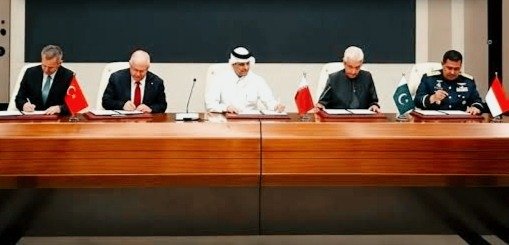
Recently, Turkey, Qatar, Pakistan, and Indonesia signed the Badr Defence Pact in Doha, establishing a strategic multilateral framework for joint military production and defense research.
What is the Badr Defence Pact?
- About: The Badr Defence Pact, officially known as the Badr Memorandum of Understanding (MoU), is a multilateral defense-industrial framework established between four Muslim-majority nations: Türkiye (Turkey), Qatar, Pakistan, and Indonesia.
- The agreement is named after the historic Battle of Badr of 624 CE.
- The word “Badr” translates to “full moon” in Arabic, symbolizing the complementarity of the participating countries’ capabilities.
- Objectives: It aims to pool regional manufacturing capabilities.
- It seeks to lower reliance on Western weapons suppliers by co-developing advanced technologies.
- Signing Details: The pact was signed on October 21, 2026, in Doha, Qatar.
- It was executed by Turkish National Defence Minister Yasar Guler, Qatari Deputy Prime Minister Sheikh Saud bin Abdulrahman Al Thani, Pakistani Defence Minister Khawaja Muhammad Asif, and Indonesian Deputy Defence Minister Yusuf Jauhari, alongside Haluk Gorgun from Turkey’s Presidency of Defence Industries.
- Provisions:
- Joint Military Production: The signatory nations will integrate their defense industrial capacities to facilitate the joint production of military hardware, such as drones, armored vehicles, and modern defense systems, leveraging the specific industrial strengths of each member country.
- Research and Development: The parties agree to co-fund and collaborate on joint R&D initiatives to innovate and manufacture next-generation technological solutions, reducing costs and accelerating development timelines for modern weapons systems.
- Technical Military Training: The agreement establishes a framework for shared military exercises and technical training programs, ensuring that personnel from all four nations are fully proficient in operating and maintaining newly co-developed hardware.
- Supply Chain Integration: The accord provides for the close integration of defense supply chains, facilitating smoother technology transfers, shared technical expertise, and the fulfillment of defense resource needs for both member and friendly allied nations.
Strategic Interests of These Countries
- Turkey: Possessing NATO’s second-largest military, Turkey boasts an advanced domestic defense sector that exports billions annually, specializing in Bayraktar drones, air defense, and naval corvettes.
- Ankara aims to expand its defense footprint across West, South, and Southeast Asia.
- It secures profitable commercial markets for its hardware while deepening geopolitical ties through technology sharing.
- Turkey and Pakistan co-develop MILGEM corvette-class maritime vessels, while Turkey and Qatar collaborate on drone technology.
- Turkey and Indonesia jointly produce medium tanks.
- Qatar: As a high-income nation, Qatar brings massive financial capabilities and capital investment alongside its strategically located military facilities.
- It hosts a Turkish military base and seeks to bankroll joint military hardware manufacturing.
- Doha seeks to diversify security partners and reduce extreme reliance on Western suppliers amidst the volatile regional landscape. It actively funds joint projects to secure local defensive shielding.
- Pakistan: A nuclear-armed nation with massive, battle-hardened manpower and established manufacturing facilities like Pakistan Aeronautical Complex.
- Islamabad aims to access advanced technologies and diversify its procurement pipeline.
- It leverages partnerships to boost regional stability and counter neighborhood security imbalances.
- On August 7, 2026, Pakistan signed the Mecca Joint Defence Agreement (also known as the Mecca Defence Alliance or Makkah Alliance) with Saudi Arabia and Turkey.
- Indonesia: A massive Southeast Asian economy with expanding maritime infrastructure and an emerging industrial manufacturing base.
- Jakarta wants defense-industrial modernization through global co-development rather than standard buyer contracts.
- Indonesia’s accession aligns with its independent, active, and non-aligned bebas-aktif foreign policy.
- It bridges Southeast Asian interests with Islamic defense economies while preserving open procurement strategies.
- Its agreement to acquire 48 Turkish KAAN fighter aircraft, signed in July 2025, illustrates its expanding defence-industrial relationship with Türkiye.
- Jakarta wants defense-industrial modernization through global co-development rather than standard buyer contracts.
Implications of Badr Pact
- Unlike the earlier NATO-style mutual defense clause of the Mecca Pact, the Badr Accord focuses on joint hardware production and technology transfer.
- This enables Pakistan to diversify arms procurement and accelerate military modernization, tilting the conventional balance of power and aggravating the security dilemma in South Asia.
- In West Asia, the pact solidifies a rising Islamic defence axis amid intense regional theater volatility, notably the US-Iran war.
- Compounded by Western weapons shortages, West Asian partners are prioritizing self-reliant military production ecosystems.
- The inclusion of Indonesia extends this defense network into the Indo-Pacific, signaling a push by mid-tier Muslim-majority states for greater strategic autonomy.
- It bridges multi-regional security dependencies across the Indian Ocean Region (IOR).
- However, signatories maintain it is strictly an industrial co-development framework, rather than the birth of a unified, hostile maritime combat alliance.
- The core threat is a better-connected Pakistani military gaining access to superior Turkish unmanned aerial systems (drones), electronic warfare, and naval platforms.
- On the foreign policy front, it tests India’s ties with Jakarta. However, security experts affirm India’s $630 million BrahMos and Astra missile contracts with Indonesia remain entirely secure due to rigorous data protection and intellectual property safeguards.
- India faces the direct challenge of Pakistan’s diplomatic out-reach through overlapping alliances.
- In response, New Delhi is actively leveraging its Comprehensive Strategic Partnerships with Gulf heavyweights like Saudi Arabia and the UAE.
- India is scaling up its own defence exports and technology user-agreements across Southeast Asia to preserve its geopolitical footprint.
- India must deepen its minilateral security partnerships and enhance maritime domain awareness in the IOR.
- Accelerating domestic indigenization (Aatmanirbharta) in drone counter-measures is vital to offset Pakistan’s industrial gains.
Frequently Asked Questions (FAQs):
1. What is the Badr Defence Pact 2026, and which countries signed it?
Badr is a multilateral defence-industry MoU signed by Pakistan, Türkiye, Qatar, and Indonesia in Doha on 21 October 2026.
2. What is the main objective of the Badr Agreement among Pakistan, Türkiye, Qatar, and Indonesia?
Its objective is to strengthen joint defence manufacturing, research and development, technical training, industrial integration, and participating countries’ defence capabilities.
3. What role will defence manufacturing and technology transfer play in the Badr Pact?
They aim to promote joint production, research, technological cooperation, expertise-sharing, and stronger domestic defence industries, subject to subsequent arrangements.
4. How does the Badr Defence Pact differ from the Makkah Joint Defence Agreement?
Badr focuses on multilateral defence-industrial cooperation; Makkah links Saudi Arabia, Türkiye, and Pakistan through a collective-defence commitment.
5. What could the Badr Pact mean for India’s national security and defence strategy?
India should monitor potential Pakistani defence-industrial gains, strengthen indigenous manufacturing and surveillance, and pursue regional diplomacy without assuming an established anti-India alliance.
6. Does the Badr Agreement require members to provide military assistance to one another?
No publicly announced Badr provision establishes mandatory collective military defence; it is a defence-cooperation MoU, unlike Makkah’s collective-defence clause.
Disclaimer: Information in this article is based on official announcements and public records. Details may evolve over time.
| Also Read: Pakistan and Saudi Arabia Defence Agreement |