


HAL HTT-40 Trainer Aircraft Delivery, IAF to Retire HPT-32 Deepak
| General Studies Paper III: Defence Technology, Indigenization of Technology |
Why in News?
Recently, Hindustan Aeronautics Limited (HAL) handed over its first three indigenous HTT-40 basic trainer aircraft to the Indian Air Force.
Highlights of HAL HTT-40 Trainer Aircraft Deal
- Contract Approval: On 1 March 2023, the Union Cabinet approved the procurement of 70 HTT-40 basic trainer aircraft from Hindustan Aeronautics Limited (HAL) for the Indian Air Force (IAF), at a cost of ₹6,828.36 crore.
- The Ministry of Defence formally signed the contract with HAL on 7 March 2023.
- The agreement covers 70 aircraft, associated equipment and training aids, including simulators, with deliveries scheduled over five years.
- Certification: The HTT-40 made its maiden flight on 31 May 2016 and achieved system-level certification on 6 June 2022. In September 2023, the Deputy Chief of the Air Staff flew the aircraft.
- Delivery: In September 2023, the Ministry of Defence stated that induction would begin on 15 September 2025 and continue until 15 March 2030.
- Engine-supply difficulties subsequently disrupted the initial delivery schedule.
- HAL handed over the first three HTT-40 aircraft on 18 September 2026. The initial batch comprises aircraft manufactured at Bengaluru and Nashik.
- Engine Supply: The aircraft uses the American Honeywell TPE331-12B turboprop engine.
- A reported US$100-million arrangement covers 88 engines and kits, with 16 supplied directly by Honeywell and the remaining units planned through HAL production under technology transfer.
- Production: HAL’s combined production capacity is reported at 20 aircraft annually, subject to engine availability.
- Training and Induction: The first aircraft are intended to support instructor training at the Flying Instructors’ School, Tambaram.
- The IAF plans to build a fleet of 25–30 aircraft and develop sufficient instructor capacity before commencing full-scale ab-initio training at the Air Force Academy.
- Full-scale rookie pilot instruction will take up to two years to become fully operationalized.
What is HTT-40 Aircraft?
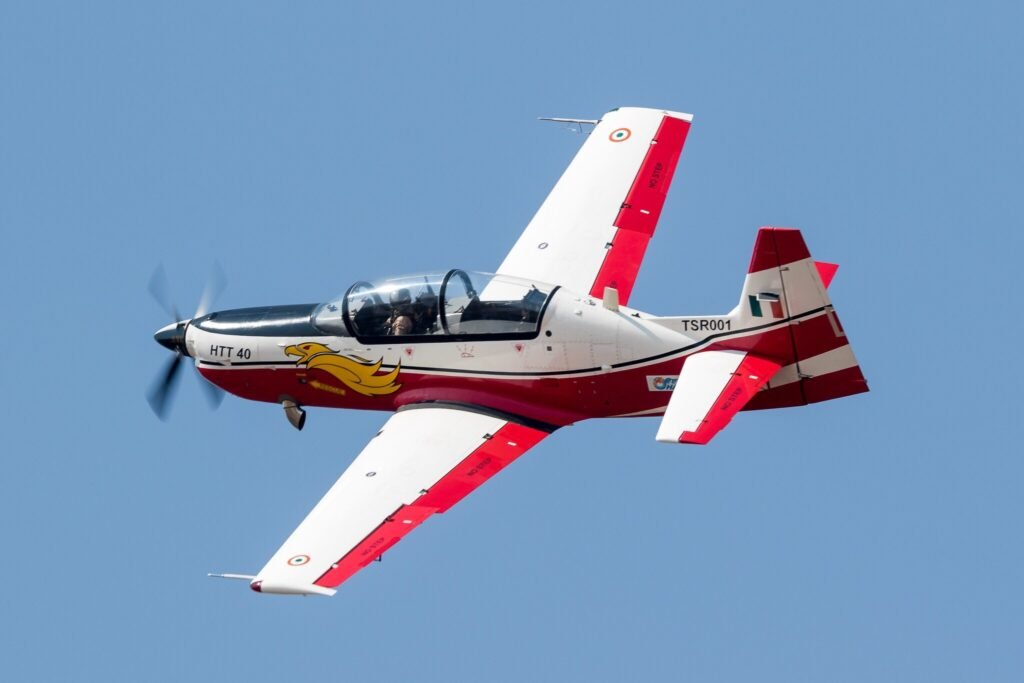
- About: The Hindustan Turbo Trainer-40 (HTT-40) is an indigenous, fixed-wing, all-metal basic trainer aircraft (BTA). It has been named Ankur.
- It features a tandem-seat configuration and is designed specifically to provide ab-initio (primary) flight training to newly inducted rookie pilots.
- Developed By: The aircraft is designed, engineered, and manufactured by the government-owned aerospace giant Hindustan Aeronautics Limited (HAL).
- It was conceptualized by the Aircraft Research & Design Centre (ARDC) of HAL based on the military aviation operational requirements of the Indian Armed Forces.
- Objective: In 2013, HAL initiated the project internally to replace the aging and grounded fleet of HAL HPT-32 Deepak trainers.
- It was an indigenously developed prop-driven primary trainer aircraft manufactured by HAL.
- It was inducted in 1984 (Replaced the older HAL HT-2 trainer).
- Following a fatal crash in July 2009 near Dundigal Air Force Academy, the IAF completely grounded the entire fleet on July 31, 2009.
- The Comptroller and Auditor General (CAG) strictly classified the HPT-32 fleet as “technologically outdated and beset by flight safety hazards”.
- Throughout its active lifecycle, the aircraft suffered 17 crashes leading to 19 pilot fatalities.
- Features:
- The aircraft is powered by a high-performance turboprop engine generating 1,100 shaft horsepower (shp).
- This gas-turbine engine drives a four-bladed propeller, optimizing low-speed handling qualities and giving the aircraft highly efficient fuel economy during training maneuvers.
- The aircraft is equipped with a modern digital glass cockpit integrated with multi-function displays (MFDs).
- The cockpit environment is fully air-conditioned, and features an expansive single-piece bubble canopy that offers excellent all-round visibility for both the instructor and trainee.
- The jet incorporates a robust network of indigenous avionics developed internally by India.
- Essential electronics include an Integrated Standby Instrument System (ISIS), advanced radio communication, VOR-ILS navigation, and an Identification Friend or Foe (IFF) defense mechanism.
- For maximum flight crew survivability, the tandem cockpit is fitted with advanced Martin-Baker Mk16 zero-zero ejection seats.
- This technology allows safe, rocket-assisted emergency exit even when the aircraft is at zero airspeed and zero altitude (stationary on the ground).
- The platform boasts operational agility through hot refueling capability, allowing ground crews to refuel the tanks while the turboprop engine is completely running.
- Coupled with running pilot changeover support, these systems guarantee rapid turnaround times.
- The aircraft is fully aerobatic and certified under international FAR-23 standards.
- It has a maximum speed of 450 km/h, a service ceiling of 6 km, a maximum range of 1,000 kilometers, and structural G-load thresholds ranging from +6g to -3g.
- The aircraft is powered by a high-performance turboprop engine generating 1,100 shaft horsepower (shp).
- Significance: The HTT-40 is a landmark for India’s self-reliance in defense, closely aligning with the “Atmanirbhar Bharat” initiative.
- Initially containing approximately 56% indigenous content, the aircraft is intended to exceed 60% through further localisation.
- Its induction addresses critical structural shortages of Basic Trainer Aircraft within the Indian Air Force (IAF).
- By serving as Stage-I training infrastructure, it breaks India’s reliance on costly foreign imports like the Swiss Pilatus PC-7, while injecting high-tech assembly roles into over 100 domestic private MSMEs.
- Initially containing approximately 56% indigenous content, the aircraft is intended to exceed 60% through further localisation.
Frequently Asked Questions (FAQs):
1. What is the HTT-40 Trainer Aircraft, and who developed it?
The HTT-40 is an indigenous basic trainer aircraft designed and developed by Hindustan Aeronautics Limited (HAL).
2. Why did HAL hand over HTT-40 aircraft to the Indian Air Force?
HAL handed over HTT-40 aircraft to strengthen indigenous pilot training, reduce import dependence, and meet the IAF’s basic training requirements.
3. What are the key features of the HTT-40 Basic Trainer Aircraft?
Key features include a turboprop engine, tandem seating, a glass cockpit, aerobatic capability, ejection seats, and modern training systems.
4. What role will HTT-40 play in the Indian Air Force’s pilot training programme?
It will provide foundational flying training, helping trainee pilots develop essential skills before progressing to advanced military aircraft.
5. How does the HTT-40 differ from the Pilatus PC-7 MkII aircraft?
The HTT-40 is an indigenous HAL-developed trainer, whereas the PC-7 MkII is Swiss-designed by Pilatus and already serves the IAF.
Disclaimer: Information in this article is based on official announcements and public records. Details may evolve over time.