


DRDO Indigenous 20mm Gun: SSS Defence & Kalyani Group Shortlisted for Its Development
| General Studies Paper III: Defence Technology |
Why in News?
Recently, the Defence Research and Development Organisation (DRDO) shortlisted SSS Defence and Kalyani Group to develop indigenous 20mm helicopter guns.
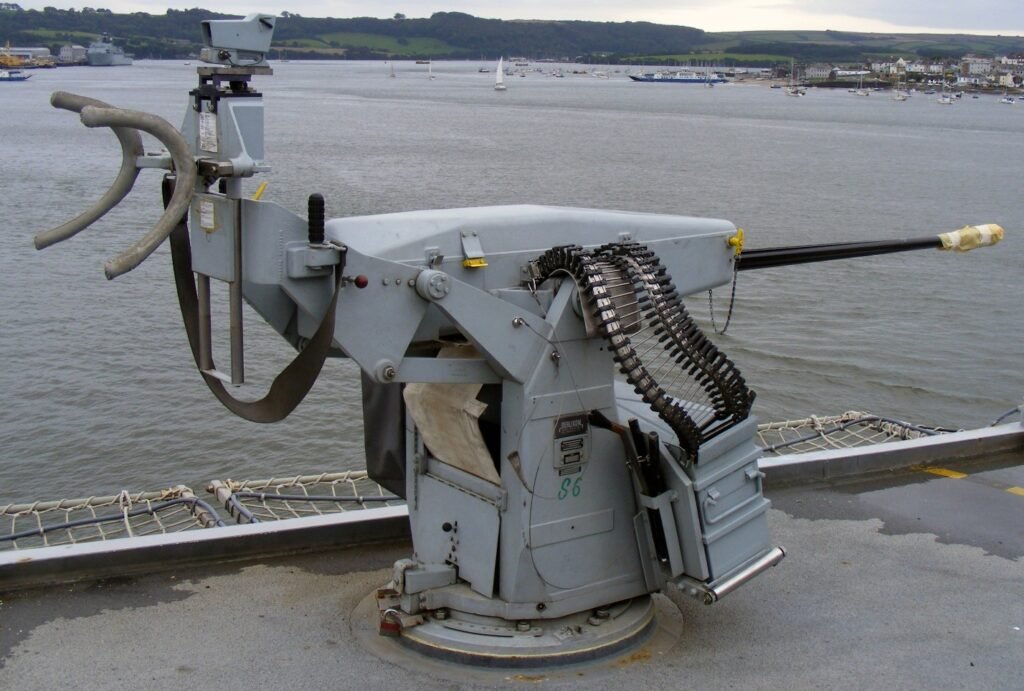
Highlights of DRDO’s Indigenous 20mm Gun Development
- Initiative: The Defence Research and Development Organisation’s (DRDO) specialist lab, the Armament Research and Development Establishment (ARDE), has launched an initiative in collaboration with Hindustan Aeronautics Limited (HAL).
- ARDE and HAL signed MoU in 2025 to collaborate on critical helicopter weapon systems.
- The collaboration aims to design and build India’s first fully indigenous 20mm aviation gun and turret system.
- Need: Currently, India’s Advanced Light Helicopter (ALH Mk-IV Rudra) and the Light Combat Helicopter (LCH Prachand) rely entirely on imported French-origin KNDS THL20 turrets and 20M621 cannons.
- Developing a domestic weapon system is critical to secure tactical military supply chains, and eliminate dependence on foreign manufacturers for spare parts, ammunition, and future upgrades.
- Developers: DRDO’s ARDE (Pune) is spearheading the technology development.
- They have shortlisted private sector defense companies, SSS Defence and Kalyani Group (Kalyani Strategic Systems), as Development-cum-Production Partners (DcPP).
- Both companies possess strong engineering credentials; the Kalyani Group has previously co-developed DRDO’s Advanced Towed Artillery Gun System (ATAGS) 155mm artillery system, while SSS Defence brings extensive experience in domestic small arms manufacturing and weapon optics.
- Specifications: The weapon is designed as a medium-caliber 20mm aviation cannon integrated with a highly responsive turret system.
- The program features a strict two-year development timeline followed by operational acceptance testing.
- Production orders will utilize a 60:40 split strategy, where the lowest bidder (L1) secures 60% of the manufacturing contract and the runner-up secures 40%.
- The indigenous gun will natively fire NATO-standard 20×102mm ammunition.
- This design choice ensures seamless interoperability with current stockpiles while ensuring close-range destructive firepower against hostile ground fortifications.
- Platform Integration: The gun system is explicitly tailored to modernize the Rudra and Prachand combat fleets.
- It will be structurally integrated with the helicopters’ nose-mounted targeting systems, enabling day and night firing capability.
- Significance: Developing a sovereign medium-caliber aviation weapon structurally upgrades the overall combat readiness of the Indian Armed Forces.
- By owning the end-to-end blueprint of the aviation gun, India insulates its military operations from geopolitical export controls.
- The programme advances Atmanirbhar Bharat by involving Indian private-sector manufacturers in advanced defence development.
- The partnership model can deepen private-sector participation, encourage specialised suppliers and build domestic manufacturing capacity.
Advanced Light Helicopter (ALH Mk-IV Rudra)
- About: The HAL Rudra, designated as ALH Mk-IV, is the indigenously designed Weapon System Integrated (WSI) armed variant of the HAL Dhruv utility helicopter.
- Developed by Hindustan Aeronautics Limited (HAL), it represents India’s first indigenous armed helicopter.
- It was conceived alongside the Light Combat Helicopter (LCH) to provide immediate, rapid airborne firepower.
- Features:
- The platform features a 5.5 to 5.8-ton class twin-engine design powered by Safran-HAL Shakti-1H turboshaft engines.
- Managed by a Full-Authority Digital Engine Control (FADEC) system, it hits a maximum speed of 280 km/h.
- Its high-altitude performance permits a service ceiling of 20,000 feet (6 km), enabling operations in extreme terrains like the Siachen Glacier.
- Primarily operated by the Indian Army Aviation Corps and Air Force, it bridges critical gaps in tactical combat power.
- The offensive armament of the Mk-IV includes a nose-mounted 20mm Nexter M621 turret gun.
- Its composite stub wings carry a mix of 70mm FZ rocket pods, short-range MBDA Mistral air-to-air missiles, and indigenous Helina (Dhruvastra) anti-tank guided missiles (ATGMs).
- This configuration makes it ideal for close air support and anti-armor warfare.
- The helicopter is equipped with an Integrated Architecture Display System (IADS) featuring a night-vision-compatible glass cockpit.
- Targeting relies on an Israel-sourced Elbit CoMPASS optoelectronic suite integrating forward-looking infrared (FLIR), thermal imaging sights, and laser designators.
- Pilots utilize a Helmet Mounted Sight for rapid target acquisition.
- For structural safety, the aircraft includes a crashworthy airframe, landing gear, and self-sealing fuel tanks.
- Crew seats feature Kevlar armor protection resilient against 12.7mm rounds. Its primary defensive layer is the Saab IDAS-3 self-protection suite, linking radar, laser, and missile approach warning sensors directly to automatic chaff/flare dispensers.
- The platform features a 5.5 to 5.8-ton class twin-engine design powered by Safran-HAL Shakti-1H turboshaft engines.
Light Combat Helicopter (LCH Prachand)
- About: The HAL Prachand, meaning “Fierce,” is India’s first indigenously designed multi-role Light Combat Helicopter (LCH).
- Its development by Hindustan Aeronautics Limited (HAL) was conceptualized immediately after the 1999 Kargil War, which exposed the critical lack of an armed rotorcraft capable of operating effectively in high-altitude environments.
- Features:
- It holds the unique distinction of being the only attack helicopter globally that can take off and land at altitudes of 5,000 meters (16,400 feet) with a full combat load of fuel and weapons.
- It features a peak service ceiling of 6,500 meters (21,300 feet), allowing it to perform operations seamlessly over the Siachen Glacier and Ladakh sectors.
- The chopper is powered by twin Shakti engines, which were co-developed by HAL and France’s Safran (Turbomeca).
- This 5.8-tonne class propulsion system generates roughly 1,430 shp each, providing an exceptional power-to-weight ratio tailored specifically to maintain lifting efficiency in thin mountain air.
- Prachand achieves a maximum speed of 268 km/h (with peak variants touching 280 km/h) and a combat radius of 500 km.
- It delivers an overall operational range of 550 km and a continuous flight endurance exceeding three hours.
- The helicopter features a chin-mounted 20mm M621 turret gun firing at 800 rounds per minute.
- It is equipped to deploy 70mm rocket pods, Mistral-2 air-to-air missiles, and anti-tank guided missiles like the Dhruvastra or Helina to neutralize armor and aerial threats.
- Engineered with a narrow tandem cockpit fuselage, the aircraft boasts a low Radar Cross Section (RCS) and high digital agility.
- It incorporates crashworthy landing gear, armored shielding, an infrared signature suppressor, a Countermeasure Dispensing System (CMDS), and full protection against Nuclear, Biological, and Chemical (NBC) threats.
- Induction: Formally inducted into the Indian Air Force and the Indian Army starting in October 2022, the government approved a massive order for 156 series-production units worth approximately ₹62,000 crore.
Frequently Asked Questions (FAQs):
1. What is the DRDO Indigenous 20mm Gun Project?
DRDO’s initiative to develop a domestically manufactured 20mm helicopter gun and turret system, reducing reliance on imported armament.
2. Why did DRDO shortlist Kalyani Group and SSS Defence?
Their defence-engineering and weapons-manufacturing capabilities support indigenous development, production and reduced dependence on foreign suppliers.
3. Which Indian military helicopters will use the Indigenous 20mm Gun?
The ALH Mk-IV Rudra and LCH Prachand are the intended platforms, subject to successful integration and qualification.
4. What role will Kalyani Group and SSS Defence play?
They are shortlisted development-cum-production partners, responsible for developing and manufacturing the indigenous gun system with DRDO.
5. Why is the 20mm Gun System important for Rudra and Prachand?
It could provide locally supported cannon capability, strengthen combat readiness and reduce imported weapon-system dependence.
6. When is the DRDO Indigenous Gun Project expected to be completed?
Reports indicate approximately two years of development.
Disclaimer: Information in this article is based on official announcements and public records. Details may evolve over time.