




HAL Su-30MKI Production Revives at Nashik Facility
| General Studies Paper III: Defence Technology, Indigenization of Technology |
Why in News?
Recently, Hindustan Aeronautics Limited (HAL) has revived its assembly line at the Nashik facility in Maharashtra to manufacture 12 new Su-30MKI fighter aircraft for the Indian Air Force (IAF).
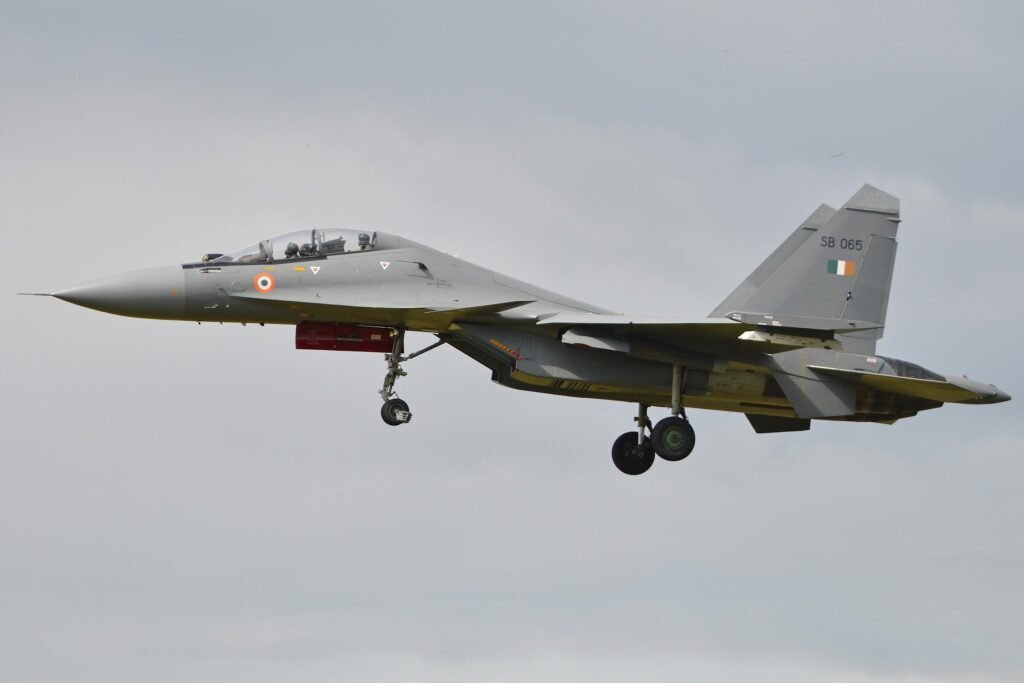
HAL Nashik Su-30MKI Production Revival Highlights
- Revival: HAL is reviving Su-30MKI production at Nashik to manufacture 12 additional fighters for the Indian Air Force.
- The first aircraft is expected around 2027–28, with deliveries extending to 2029.
- Nashik Facility: The Aircraft Manufacturing Division (AMD), Nashik, is located at Ojhar, about 24 km from Nashik and 200 km from Mumbai.
- Established in 1964, it originally produced MiG-21FL aircraft and K-13 missiles under licence.
- The complex covers 1.482 crore sq m, with 1.739 lakh sq m built-up area, equipped for aircraft design, manufacturing, overhaul and modification.
- Its trained workforce provides specialised aerospace manufacturing expertise.
- Nashik subsequently manufactured MiG-21M, MiG-21 BIS and MiG-27M, before becoming central to Su-30MKI production.
- It also undertakes Su-30MKI repair, overhaul and lifecycle support, preserving critical technical expertise.
- HAL’s Nashik division built 222 licensed Su-30MKI jets. After pausing the line is focused on repairs and Light Combat Aircraft production.
- Su-30MKI Programme: India and Russia concluded the Su-30MKI Inter-Governmental Agreement on 4 October 2000.
- It provided transfer of licence and technical documentation for production of 140 aircraft, engines and aggregates at HAL’s Nashik facility.
- Planned production capacity was 12 aircraft annually. The programme represented a major Technology Transfer (ToT) initiative.
- Government data in 2018 recorded 153 Su-30MKIs produced against an ongoing programme involving 182 aircraft, with an annual capacity of 12.
- On 12 December 2024, the Ministry of Defence signed a ₹13,500-crore contract, including taxes and duties, with HAL for 12 Su-30MKIs and associated equipment.
- The new aircraft will contain 62.6% indigenous content, according to the Ministry of Defence. Indigenous component production strengthens the programme’s Aatmanirbhar Bharat dimension.
- A separate ₹60,000-crore modernisation plan is being prepared for the existing Su-30MKI fleet.
- The upgrade programme (often called the Super Sukhoi program) is led by HAL and the Defence Research and Development Organisation to equip the Indian Air Force fleet with advanced local technologies and close to 78% indigenous content.
What is Su-30MKI?
- About: The Su-30MKI is a Russian-origin, twin-engine, twin-seat, supersonic, multi-role fighter developed specifically for India.
- MKI stands for Modernizirovanny Kommercheskiy Indiskiy (Modernized Commercial Indian).
- It belongs to the Sukhoi Su-30 family, itself derived from the Su-27 air-superiority fighter.
- Sukhoi Su-30 (NATO reporting name: Flanker-C/G/H) is a heavy multirole 4th-generation fighter aircraft.
- HAL classifies it as a long-range fighter/bomber and air-superiority aircraft.
- Developed By: The aircraft was designed by Russia’s Sukhoi Design Bureau during the late Soviet era.
- It is produced under license in India by Hindustan Aeronautics Limited (HAL).
- It is a unique hybrid aircraft integrating Russian airframe and engines with Indian avionics, plus specialized subsystems sourced from Israel, France, and South Africa.
- Deal: India signed an initial US$1.462-billion agreement in 1996 for 50 aircraft, followed by the 2000 technology-transfer agreement for licensed Indian production.
- Features:
- It is powered by twin AL-31FP engines with Thrust Vector Control (TVC) and aerodynamic canards.
- This allows post-stall maneuvers like “Pugachev’s Cobra” and “Frolov’s Chakra,” enabling it to change direction rapidly during dogfights.
- It features 12 hardpoints capable of carrying up to 8,000 kg (17,600 lbs) of armaments.
- Standard range of 3,000 km, extendable via mid-air refueling.
- The front cockpit houses the pilot, while the rear cockpit accommodates a Weapon Systems Officer (WSO) to manage complex radar tracking.
- Originally fitted with the N011M Bars Passive Electronically Scanned Array (PESA) radar. It is presently undergoing a multi-billion-dollar modernization program to integrate the indigenous Virupaksha Active Electronically Scanned Array (AESA) radar.
- It is uniquely modified to carry the BrahMos-A, a 2.5-tonne supersonic cruise missile, making it a highly feared maritime and deep-land strike weapon.
- It also fires the indigenous Astra Beyond-Visual-Range (BVR) missile.
- Its multi-role architecture enables air-to-air, air-to-ground and maritime strike operations.
- It is powered by twin AL-31FP engines with Thrust Vector Control (TVC) and aerodynamic canards.
- India’s Fleet: The IAF’s sanctioned Su-30MKI fleet is 272 aircraft. Around 50 were supplied from Russia, while 222 were manufactured under licence by HAL.
- Significance: The Su-30MKI forms the backbone of India’s fighter fleet.
- It provides long-range air superiority, deep-strike, maritime deterrence and heavy weapons carriage.
- The aircraft has participated in major exercises including Red Flag (US), Garuda (France) and Indradhanush (UK).
- This provides valuable exposure against Western fighter doctrines and platforms such as the F-15, Eurofighter Typhoon and Rafale.
- The Su-30MKI has been operationally significant during India’s modern air operations.
- It participated in the 2019 Balakot air-operation context, while its long-range strike role became particularly important during Operation Sindoor in 2025, when Su-30MKIs were employed alongside India’s broader air-power architecture.
- It represents both a major combat platform and a foundation of India’s indigenous aerospace-industrial capability.
Frequently Asked Questions (FAQs):
1. Why has HAL revived Su-30MKI production at Nashik?
To manufacture 12 additional Su-30MKIs, strengthen IAF capability, and advance 62.6% indigenous content.
2. Where is the Su-30MKI aircraft manufactured in India?
At HAL’s Aircraft Manufacturing Division, Nashik, Maharashtra, under licensed production arrangements.
3. What is the role of HAL in Su-30MKI production?
HAL undertakes licensed manufacturing, assembly, integration, overhaul, repair and lifecycle support for Su-30MKI.
4. Why is Su-30MKI production important for the Indian Air Force?
It strengthens combat capability, fleet availability, indigenous manufacturing and defence preparedness.
5. How many Su-30MKI fighter jets does India operate?
India’s sanctioned fleet comprises 272 Su-30MKIs, including aircraft manufactured domestically by HAL.
Disclaimer: Information in this article is based on official announcements and public records. Regulations and implementation details may evolve over time.
| Also Read: India-France 114 Rafale Fighter Jets Deal |