




India-France 114 Rafale Fighter Jets Deal
| General Studies Paper III: Defence Technology, Defence Deal |
Why in News?
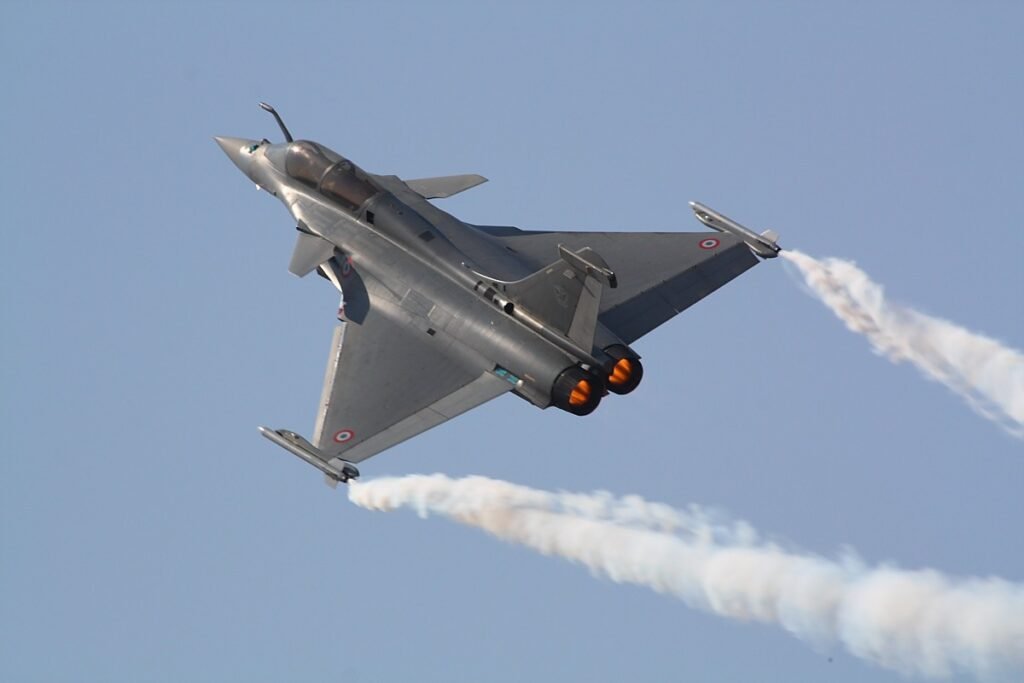
Recently, France submitted to India a detailed technical and commercial proposal for 114 Rafale fighter jets under government-to-government deal.
India-France 114 Rafale Fighter Jets Deal Highlights
- Procurement Status: The Defence Acquisition Council (DAC) granted Acceptance of Necessity (AoN) for the capital procurement of 114 Rafale Fighter Jets in February 2026.
- India sent a formal Letter of Request to France in May 2026 under Inter-Governmental Agreement (IGA).
- France has submitted a technical and commercial proposal to India, on 29 July 2026.
- The Acquisition Wing of the Ministry of Defence began reviewing the proposal in August 2026.
- Estimated Value: The proposed package is reported at around ₹3.25 lakh crore.
- This would make it one of India’s largest defence procurement programmes.
- Procurement of Rafale is linked to India’s Multi-Role Fighter Aircraft (MRFA) Programme.
- Proposal Details: The aircraft will meet the advanced F4 standard, featuring secure data links, enhanced satellite communications, and active electronically scanned array (AESA) radars.
- France has agreed to a comprehensive Transfer of Technology (ToT) covering the airframe, avionics, and Safran M88 engines.
- The contract mandates the digital architecture be unlocked to integrate indigenous weaponry like the Astra BVR and BrahMos-NG missiles.
- Manufacturing & Deployment:
- Initial Fly-Away Batch: 18 to 20 aircraft will be supplied directly from Dassault’s production lines in France to address immediate combat capabilities.
- Indigenisation Phase: 94 fighter jets will be built domestically via a Joint Venture.
- Safran is linked with engine-related transfer, and Thales with avionics.
- Tata Advanced Systems Limited (TASL) will build major components like the fuselage in Hyderabad.
- Target Delivery Windows: If the contract concludes by early 2027, the initial fly-away aircraft are projected to arrive by 2030.
- Local industrial assembly will scale up in the early 2030s.
What is Rafale Fighter Jet?
- About: Rafale is a French twin-engine, multirole/“omnirole” fighter aircraft developed by Dassault Aviation.
- Rafale is a 4.5-generation fighter aircraft.
- Its first flight took place in 1991.
- The French word Rafale broadly means “gust of wind”.
- Purpose: It is designed to perform air-defence, air-superiority, reconnaissance, ground-attack and maritime missions.
- It is designed for both land bases and aircraft carriers.
- It was designed as a highly versatile fighter for both the French Air and Space Force and French Navy.
- Variants: The principal variants are Rafale C (single-seat land-based), Rafale B (two-seat land-based) and Rafale M (single-seat carrier-based). India currently operates the C/B versions and is acquiring Rafale M for the Navy.
- Features:
- Rafale is an “omnirole” fighter, meaning one aircraft can perform multiple missions.
- These include air superiority, air defence, ground attack, reconnaissance, anti-ship operations and nuclear deterrence.
- It has a 15.3-metre length, 10.9-metre wingspan and approximately 10-tonne empty weight.
- Its maximum take-off weight is 24.5 tonnes, with a service ceiling of 50,000 feet.
- Two SNECMA M88-2 turbofan engines delivering supercruise capability (supersonic flight without engaging afterburners).
- Its two engines provide 2 × 7.5 tonnes of thrust.
- Its maximum speed is approximately Mach 1.8. The aircraft can withstand +9g and −3.2g load factors, supporting demanding high-speed combat manoeuvres.
- Rafale has 14 external weapon/store stations, including five heavy-wet stations.
- Its external load capacity reaches about 9.5 tonnes, enabling diverse weapons configurations.
- Its combat architecture supports air-to-air, air-to-ground and anti-ship weapons, while advanced sensors and electronic warfare enhance survivability.
- It combines AESA radar, electronic warfare, sensor fusion, precision weapons, networking and aerial refuelling.
- RBE2 AESA Radar, active Electronically Scanned Array radar providing high-resolution multi-target tracking and long-range threat detection.
- SPECTRA System, integrated electronic warfare suite offering self-protection, threat warning, radar jamming, and decoy management.
- FSO (Front Sector Optronics), passive electro-optic system providing covert long-range detection and identification.
- Meteor Missile, active radar-guided beyond-visual-range (BVR) air-to-air missile with a range over 150 km.
- MICA Missile, short-to-medium-range infrared and active radar-guided engagement system.
- SCALP Cruise Missile, standoff deep-penetration weapon capable of hitting heavily defended targets beyond 300 km.
- HAMMER Smart Weapon, modular, all-weather precision-guided munition suite.
- Its F4 standard represents an important technological evolution.
- F4.1 introduced enhanced data exchange, passive-threat detection, helmet-mounted systems and collaborative air combat capabilities.
- Rafale is an “omnirole” fighter, meaning one aircraft can perform multiple missions.
- Global Users: By 2026, Rafale has been selected by eight export countries: Egypt, Qatar, India, Greece, Croatia, UAE, Indonesia and Serbia.
- It is combat-proven through French operations, including missions in the Middle East against Daesh under Operation Chammal.
- India: India’s first Rafale acquisition was the 2016 Inter-Governmental Agreement for 36 aircraft in fly-away condition. The package included weapons, simulators and long-term maintenance support.
- India’s 36 IAF Rafales are organised into two squadrons—17 Squadron “Golden Arrows” at Ambala and 101 Squadron at Hasimara.
- The first five aircraft arrived in India in July 2020; the second squadron was inducted in July 2021.
- The Indian configuration includes AESA radar, advanced EW equipment and mid-air refuelling capability.
- India also signed a 26-Rafale-M contract for the Navy in April 2025, becoming the first country besides France to operate both Rafale Air and Rafale M.
- India needs more Rafale because the Indian Air Force faces a major shortage, holding only 29 active squadrons against a required sanctioned strength of 42.
- India’s 36 IAF Rafales are organised into two squadrons—17 Squadron “Golden Arrows” at Ambala and 101 Squadron at Hasimara.
Significance for India
- Two-Front Deterrence: The 4.5-generation jet offsets the depleting squadron strength of the Indian Air Force. It provides a decisive technological edge against Chinese J-20 and Pakistani J-10C fleets.
- Beyond Visual Range (BVR) Dominance: Equipped with Meteor air-to-air missiles, the jet commands a no-escape zone exceeding 100 km.
- This allows the IAF to neutralize enemy platforms from standoff distances safely.
- Deep Precision Strike: Integrating SCALP cruise missiles provides a 300+ km land-attack range. It ensures pinpoint destruction of fortified high-value infrastructure without crossing enemy borders.
- High-Altitude Cold Start: Engineered with 13 India-specific enhancements, it operates effortlessly at -30°C in Leh. This capability guarantees rapid deployment across the mountainous Line of Actual Control (LAC).
- Blue-Water Security: Deploying Rafale-M on INS Vikrant secures critical Indian Ocean Sea Lines of Communication (SLOCs). It effectively checks aggressive foreign naval expansions.
- Strategic Nuclear Triad: Its airborne nuclear delivery capability ensures credible deterrence. The platform significantly enhances the survivability of India’s second-strike options.
- Electronic Warfare Edge: The onboard SPECTRA Electronic Warfare suite protects the aircraft via radar jamming and laser warning systems. This ensures high survivability in heavily contested airspaces.
- Tactical Interoperability: The platform integrates smoothly with Indian military satellites, AWACS, and IL-78 tankers. This creates a synchronized network-centric warfare environment.
- Indo-French Bilateral Synergy: The deal bypasses volatile geopolitical alignments, anchoring the India-France Joint Strategic Vision. France remains a veto-reliable, non-interfering defense partner.
Frequently Asked Questions (FAQs):
France offered 114 Rafales to strengthen IAF air dominance, deterrence and long-range strike capabilities.
It is a new procurement programme, building on India’s existing Rafale acquisitions, not an extension of the 2016 contract.
Rafale is an omnirole fighter featuring advanced sensors, 14 weapon stations, 9.5-tonne external payload and Mach 1.8 speed.
Additional Rafales address combat-capability requirements, strengthen air dominance and support long-range offensive operations.
Dassault Aviation leads Rafale manufacturing, with French companies including Thales and Safran contributing major systems.
Disclaimer: Information in this article is based on official announcements and public records. Regulations and implementation details may evolve over time.
| Also Read: MiG-21 Fighter Jets Retirement |