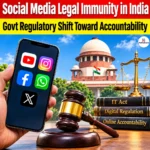



Social Media Legal Immunity in India, Gov Regulatory Shift Toward Accountability
| General Studies Paper III: Security, Role of Media & Social Sites |
Why in News?
The Ministry of Electronics and Information Technology (MeitY) initiated discussions to revoke “safe harbour” legal immunity for social media platforms such as Facebook, Instagram, YouTube and X.
- Under the proposed changes, social media companies may also be held responsible for users’ posts, videos and comments.

Social Media Legal Framework & Immunity in India
- Framework:
- Section 79 of Information Technology Act, 2000 grants “safe harbour” legal immunity to internet intermediaries.
- This insulation ensures that platforms like Meta, YouTube, and X are not held directly liable for illegal content, videos, or comments uploaded by third-party users.
- Under Section 79(3), protection is unavailable in specified circumstances, including failure to expeditiously remove or disable access to unlawful material after legally recognised knowledge or notification, subject to statutory requirements.
- The government notified the Information Technology (Intermediary Guidelines and Digital Media Ethics Code) Rules, 2021, establishing due-diligence obligations, grievance redressal and additional responsibilities for social media intermediaries.
- Platforms crossing the prescribed user threshold must appoint an India-based Chief Compliance Officer, Nodal Contact Person and Resident Grievance Officer. They must also publish monthly compliance reports.
- Users can complain to platform grievance officers and subsequently approach the Grievance Appellate Committee (GAC) against specified decisions or inaction. Access to judicial remedies remains available.
- Platforms must remove non-consensual explicit imagery within 2 hours, take down government or court-ordered illegal material within 3 hours, and resolve standard user grievances within 36 hours.
- Digital Personal Data Protection Act 2023 enacted to secure user privacy. It regulates how social media entities process personal data.
- Platforms acting as Data Fiduciaries must obtain explicit, verifiable, and revocable user consent before gathering information.
- The law imposes severe financial penalties for data breaches and mandates heightened protection standards for children’s data, strictly banning targeted behavioral advertising aimed at minors.
- The Information Technology (Intermediary Guidelines and Digital Media Ethics Code) Amendment Rules, 2026 define synthetically generated information (SGI) under Rule 2(1)(wa) as artificially or algorithmically created, modified, or altered audio, visual, or audio-visual content that appears real and is likely to be perceived as indistinguishable from a natural person or actual event.
- Section 79 of Information Technology Act, 2000 grants “safe harbour” legal immunity to internet intermediaries.
- Consideration:
- The Indian government is considering changes to the IT Rules that could scale back or remove “safe harbour” protection.
- The government is considering to restrict safe harbour to basic transmission services, such as internet service providers (ISPs), telecom service providers (TSPs), and peer-to-peer messaging apps.
- Under the proposed changes, social media companies may also be held responsible for users’ posts, videos and comments.
Why Government Initiated Discussions to Revoke Safe-Harbour Immunity?
- Changing Nature of Platforms: Social media companies are increasingly more than passive intermediaries.
- Their recommendation engines, algorithms and content-ranking systems influence what users watch, share and believe.
- The government is questioning whether such active participation deserves the same immunity as simple data transmission.
- Proliferation of Severe Digital Harms: The sweeping digital landscape has seen exponential growth in AI-generated deepfakes, misinformation, child sexual abuse material (CSAM), and cyber fraud.
- The Parliamentary Standing Committee on Communications and IT emphasized that Section 79’s current framework is fundamentally outdated.
- Safe-harbour creates an incentive for platforms to shirk systemic responsibility, leaving victims of online harm with little recourse.
- Rising Cybercrime Complaints: Parliamentary committee material reported 20,33,316 cybercrime complaints on the National Cyber Crime Reporting Portal between January and 28 November 2024, compared with 15,96,488 in 2023.
- These figures demonstrate the growing scale of reported cybercrime, although they are not exclusively social-media-related cases.
- Persistent Compliance Failures: Platforms have frequently lagged in taking down flagged illegal material or executing government orders under the IT Rules.
- The government seeks to transition from a reactive model (removing text only after notification) to a proactive, preventive model.
- The government seeks to compel strict adherence to local laws, grievance systems, and immediate takedown protocols.
- Judicial Precedent: The Supreme Court’s observations in the Just Rights for Children Alliance case suggested that Section 79 is inadequate for addressing systemic safety failures.
- The court advocated for a graded framework of heavy monetary penalties.
- Narrative Imbalance: Reports highlight that platform recommendation algorithms have disproportionately amplified Opposition-led or anti-establishment narratives, overshadowing official state communications.
- Social media tools, particularly Instagram, served as key channels for organizing online support during major student protests in July.
- Legislative Future: The structural discussions to eliminate default safe-harbour are slated to be integrated into the upcoming Digital India Act (DIA), which is designed to entirely replace the legacy IT Act of 2000.
- Under the DIA, safe-harbour is expected to shift from a default right to an optional, risk-based status that platforms must actively qualify for through strict transparency metrics.
Social Media Liability: Global Regulatory Approaches
- USA: Under Section 230 of the Communications Decency Act, social media platforms are largely shielded from civil liability for content posted by third-party users.
- Platforms remain liable for privacy violations, federal crimes, and child sexual abuse material (CSAM), while ongoing legislative debates target minor safety and Section 230 reform.
- EU Digital Services Act (DSA): Mandates rigorous risk assessments, rapid takedowns of illegal content, enhanced algorithmic transparency, and strict accountability for very large online platforms (VLOPs).
- Under Article 6 of the DSA, hosting providers generally receive liability exemptions when they lack relevant knowledge of illegal content or act expeditiously after obtaining such knowledge.
- UK Online Safety Act (OSA): Imposes a clear “duty of care” enforced by Ofcom, requiring platforms to actively mitigate illegal and harmful content, particularly concerning minors.
- The UK communications regulator, Ofcom, supervises compliance and can enforce statutory obligations.
- The framework covers risk assessments, reporting mechanisms, complaints procedures and content moderation.
Concerns and Challenges
- Freedom of Speech: Removing or significantly restricting safe harbour may encourage platforms to remove controversial content excessively to avoid legal liability.
- This could indirectly restrict legitimate public discussion, criticism and dissent protected under Article 19(1)(a).
- Risk of Over-Censorship: Platforms facing greater legal exposure may adopt automated filtering and precautionary takedowns.
- Such practices can mistakenly remove journalism, satire, political criticism, academic discussions and legitimate user-generated content.
- Privacy and Surveillance: Greater regulatory accountability may increase demands for user identification, content monitoring and data disclosure.
- Excessive collection or sharing of personal information could undermine the Right to Privacy, recognised as a fundamental right in the Puttaswamy judgment, 2017.
- Encryption Concerns: Requirements for traceability or identification of message originators can create tensions with end-to-end encryption. Weakening encryption infrastructure could expose millions of users to surveillance, cyberattacks and privacy violations.
Frequently Asked Questions (FAQs):
1. What is legal immunity for social media platforms?
It protects platforms from liability for users’ third-party content, provided they fulfil statutory conditions and due-diligence obligations.
2. Why is the Indian government considering scrapping Safe Harbour Protection?
To increase accountability for algorithm-driven content amplification, misinformation, deepfakes and harmful material circulated through social media platforms.
3. What is Section 79 of the IT Act?
Section 79 of the Information Technology Act, 2000 provides conditional exemption from liability for intermediaries hosting or transmitting third-party information.
4. How will removing legal immunity affect Facebook, Instagram and X?
They could face greater legal exposure for user-generated content, particularly where algorithms recommend, rank, promote or suppress posts.
5. What changes are expected in India’s social media regulations?
Proposals include restricting safe harbour, advance notification of major product changes and stronger grievance redressal for deepfakes and non-consensual images.
Disclaimer: Information in this article is based on official announcements and public records. Details may evolve over time.