


India’s Debt-to-GDP Ratio Projected to Drop to 75.1% by 2031
| General Studies Paper III: Economics, Fiscal Policy |
Why in News?
EY’s Economy Watch November 2026 report projected India’s general government debt-to-GDP ratio declining from 84.3% to 75.1% by 2031.
India’s Debt-to-GDP Ratio Projections & Findings
- According to the November 2026 edition of EY India’s Economy Watch, India’s general government debt-to-GDP ratio is projected to drop from 84.3% in 2025 to 75.1% by 2031, marking a notable 9.2 percentage point decline.
- EY forecasts India’s real GDP growth for the second quarter of FY27 to be between 7.5% and 7.7%, alongside a nominal GDP growth rate of nearly 11%.
- It will provide strong denominator expansion to steadily reduce the relative debt burden over the medium term.
- The EY report integrates data from national agencies, IMF projections, and World Bank poverty metrics.
- Findings show extreme poverty dropped from 27.1% in 2011 to 2.3% in 2024 (at USD 3/day PPP) alongside narrowing per capita consumption inequality.
- EY forecasts India’s real GDP growth for the second quarter of FY27 to be between 7.5% and 7.7%, alongside a nominal GDP growth rate of nearly 11%.
- At 84.3%, India balances revenue against expenditures. In H1 FY27, the Centre’s gross tax revenues grew by 6.1%.
- Total government expenditure rose by 10.7%, driven partly by a 10.1% surge in major subsidies (food, fertilizer, and petroleum).
- India’s falling debt contrasts with rising global trends. India targets a decline, debt in emerging markets and developing economies is projected to climb from 73.7% in 2025 to 84.2% by 2031.
- China’s ratio is forecast to rise from 98.6% to 122.1%, and the United States’ ratio from 124.4% to 145%.
- Key risks include persistent inflationary pressures and rising subsidy bills.
- With retail inflation at 6.1% and wholesale inflation at 12.3% in October 2026, EY advises the Reserve Bank of India (RBI) to hike its policy repo rate in December, which may tighten borrowing conditions.
- Sustaining government capital expenditure for the rest of FY27 is vital to support domestic demand and growth momentum.
- Through disciplined fiscal consolidation and strong nominal GDP growth, India aims to hit its debt target by 2031.
What is Debt-to-GDP?
- About: The Debt-to-GDP ratio is an economic metric that compares a country’s total government debt to its Gross Domestic Product (GDP), expressed as a percentage.
- It measures a nation’s financial leverage and indicates its ability to pay back sovereign obligations without incurring further debt or triggering economic default.
- Objectives: The primary objective of this indicator is to assess fiscal sustainability and sovereign creditworthiness.
- Central banks, and credit rating agencies monitor it to gauge the risk of default.
- Parameters: The calculation relies on two macroeconomic parameters: Total Public Debt (the numerator) and Nominal GDP (the denominator).
- Total debt includes all internal (domestic) and external (foreign) financial liabilities owed by the government, while Nominal GDP represents the total market value of all finished goods and services produced annually within national borders.
- Calculation: To calculate the ratio, divide the country’s total national debt by its annual nominal GDP, then multiply the result by 100.
- For instance, if a country holds $2 trillion in debt and generates a $2.5 trillion GDP, its ratio stands at 80%.
- Critical Benchmarks: According to World Bank research, a ratio exceeding 77% for an extended period can slow annual economic growth.
- Developed economies like Japan sustain ratios above 200% due to low domestic interest rates and strong investor trust.
Major Drivers Behind India’s Declining Debt Ratio
- Strong nominal GDP growth is a major factor behind India’s improving debt trajectory.
- Nominal GDP growth is projected at approximately 11% annually, exceeding the effective interest rate of around 7% on government debt.
- This favourable growth-interest differential allows the economy’s output to expand faster than debt accumulation, reducing the debt ratio over time.
- The government has progressively reduced its fiscal deficit, limiting additional borrowing requirements.
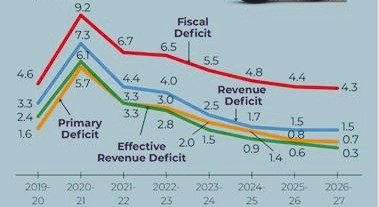
- The Union Government’s fiscal deficit declined from 9.2% of GDP in FY2020–21 to 4.4% in FY2025–26 (RE).
- Fiscal consolidation strengthens investor confidence and reduces the accumulation of fresh liabilities.
- Higher tax collections and improved revenue administration strengthen the government’s capacity to finance expenditure without excessive borrowing.
- GST compliance, digital tax administration, formalisation of economic activities, improved direct-tax collection and a broader tax base can support revenue mobilisation.
- The primary deficit represents fiscal deficit excluding interest payments. India’s primary deficit is projected to remain around 1.7–2.2% of GDP.
- A comparatively contained primary deficit limits fresh borrowing requirements, helping stabilise outstanding liabilities.
- The government has increased spending on roads, railways, infrastructure, logistics and public investment.
- General government capital expenditure increased from approximately 4% of GDP in FY2019–20 to 5.8% in FY2025–26.
- Productive investment improves connectivity, attracts private investment, generates employment and expands future tax-generating capacity.
- A substantial proportion of India’s public debt is long-term, denominated in domestic currency and held by domestic investors.
- This reduces exposure to foreign-exchange volatility and immediate refinancing pressures.
Impact of India’s Declining Debt Ratio
- A declining debt ratio can improve macroeconomic stability by reducing excessive government borrowing and potential demand-side pressures.
- Lower borrowing requirements may also reduce pressure on domestic financial markets.
- EY warns that food and energy supply shocks (such as October 2026 retail inflation hitting 6.1%) can still inflate major budget subsidies.
- Reduced government borrowing can minimise the possibility of crowding out, where government demand for financial resources limits credit availability for private businesses.
- Disciplined debt consolidation earned India three sovereign credit rating upgrades in 2025, lowering risk premiums and attracting cheaper Foreign Direct Investment (FDI).
- Improved fiscal credibility may reduce the government’s risk premium and borrowing costs over time.
- Lower interest expenditure can create additional budgetary space for infrastructure and welfare programmes.
- The government can sustain high capital expenditure across healthcare, and education, accelerating inclusive long-term growth, job creation, and poverty reduction.
- A sustainable public debt trajectory strengthens sovereign creditworthiness and reduces vulnerability to fiscal shocks.
Frequently Asked Questions (FAQs):
1. What is India’s projected debt-to-GDP ratio by 2031?
India’s general government debt-to-GDP ratio is projected to decline to 75.1% by 2031–32, according to EY’s report.
2. What does the debt-to-GDP ratio measure?
It measures outstanding government debt as a percentage of annual GDP, indicating the economy’s capacity to sustain public borrowing.
3. What are the major reasons behind India’s declining debt ratio?
Higher nominal GDP growth, fiscal consolidation, improved tax collections, controlled borrowing and productive capital expenditure support the decline.
4. How does a declining debt ratio benefit the economy?
It can reduce borrowing pressure, strengthen investor confidence, improve financial stability and create greater fiscal space for development.
5. What is the difference between public debt and fiscal deficit?
Public debt is accumulated outstanding government borrowing, whereas fiscal deficit represents the annual gap between government expenditure and receipts excluding borrowings.
Disclaimer: Information in this article is based on official announcements and public records. Details may evolve over time.