




India Conducts Successful Agni 4 Missile Test
| General Studies Paper III: Achievements of Indians in Science & Technology, Defence Technology |
Why in News?
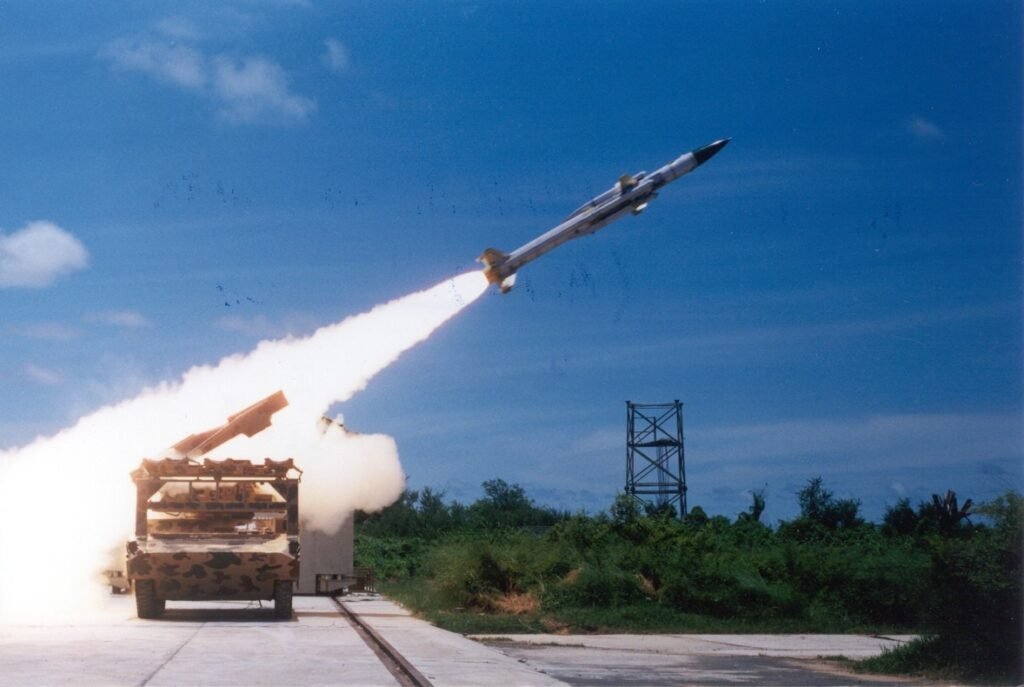
Recently, India successfully test-fired the Agni-4 medium-range ballistic missile from the Integrated Test Range, Chandipur in Odisha, validating operational and technical parameters.
What is AGNI 4 MISSILE?
- About: Agni-4 is an Indian Intermediate-Range Ballistic Missile (IRBM). It is a surface-to-surface, nuclear-capable missile.
- ORIGIN: It is a part of Agni family originated under the Integrated Guided Missile Development Programme (IGMDP).
- This programme was approved in 1983 under Dr A.P.J. Abdul Kalam.
- The programme aimed at indigenous missile capability.
- Agni-4 belongs to the later strategic evolution of this family.
- Devoleper: Defence Research and Development Organisation (DRDO) developed the missile and its critical technologies.
- Control: Operational/user launches are conducted under the Strategic Forces Command (SFC).
- It was created on January 4, 2003.
- It manages the nation’s nuclear stockpile under the Nuclear Command Authority (NCA).
- The NCA’s Political Council, led by the Prime Minister, holds sole authorization power, while the Executive Council, led by the National Security Advisor, advises and executes these directives.
- Dimensions: The missile has an overall length of approximately 20 metres (66 ft) and a total weight of approximately 17 tonnes (17,000 kg).
- Range: Agni-4 has a range of approximately 4,000 km. It fills an important capability space within the Agni family and extends India’s land-based strategic reach.
- Propulsion: It uses two-stage solid propulsion. DRDO introduced composite rocket-motor technology, reducing weight while providing strong propulsion performance.
- Road Mobility: Agni-4 is launched from an indigenous road-mobile launcher. Mobility improves deployment flexibility and contributes to survivability of strategic forces.
- Guidance System: The missile uses a Ring Laser Gyro-based Inertial Navigation System (RINS) supported by redundant Micro Navigation System (MINGS). These systems provide autonomous and highly accurate navigation.
- Avionics and Re-entry: Agni-4 incorporates a fifth-generation onboard computer, distributed avionics, high-speed communication and digital control.
- Its re-entry heat shield withstands temperatures approaching 4,000°C, while protecting internal avionics.
- Payload Capacity: The missile can carry up to 1,000 kg (1 tonne) of conventional and strategic nuclear payloads.
- Earlier Validations: The first test occurred on 15 November 2011, followed by successful trials in September 2012 and January 2014.
- The 2014 developmental trial reached over 850 km altitude, covered the intended range in about 20 minutes, and achieved two-digit accuracy.
- 2022 and 2024 launches also successfully validated operational and technical parameters.
- Latest Test: India successfully test-fired Agni-4 on 6 August 2026 from the Integrated Test Range, Chandipur, Odisha.
- The test was conducted under the aegis of SFC. The launch validated all operational and technical parameters.
- The test primarily demonstrated continued operational reliability and readiness of an established strategic missile system.
| Agni Series: Agni-I (Short-Range Ballistic Missile, 700 – 900 km, Agni-II (Medium-range ballistic missile, 2,000 – 2,500 km, Agni-III (Intermediate Range Ballistic Missile, 3,000 – 3,500 km, Agni-V (Intercontinental ballistic missile, over 5,000 km, equipped with MIRV technology) and Agni-Prime (Agni-P: New generation canisterised ballistic missile, 1,000 – 2,000 km). |
SIGNIFICANCE OF AGNI-4 MISSILE
- Credible Minimum Deterrence: Agni-4 adds credibility to India’s doctrine of Credible Minimum Deterrence.
- A dependable retaliatory capability makes the cost of nuclear aggression unacceptable. This supports India’s stated No First Use posture.
- Second-Strike Capability: Its strategic value lies in retaliation after a first strike, rather than battlefield use.
- A mobile land-based missile increases the possibility of preserving retaliatory forces after an adversary’s attack.
- Contribution to Nuclear Triad: Agni-4 represents the land-based component of India’s nuclear triad.
- The other components are air-delivered nuclear systems and sea-based SSBNs/SLBMs.
- INS Arihant’s first deterrence patrol in 2018 marked the establishment of India’s survivable nuclear triad.
- Strategic Force Diversification: A diversified nuclear force reduces excessive dependence on one delivery platform. Agni-4 therefore complements aircraft and submarine-based systems, creating multiple avenues for retaliation.
- Geopolitical Leverage: A credible long-range missile capability strengthens India’s position in the regional strategic balance.
- It signals that India possesses the technological and military capacity to protect its strategic interests and national sovereignty.
- Technological Sovereignty: Agni-4 demonstrates indigenous mastery of strategic missile technologies.
- Its development contributes to India’s long-term Atmanirbhar defence ecosystem, reducing technological dependence in a highly sensitive strategic domain.
India’s Major Missile Tests and Defence Milestones 2026
- MPATGM: The Man Portable Anti-Tank Guided Missile (MPATGM) successfully engaged a moving target with top-attack capability.
- Its indigenous Imaging Infrared seeker, tandem warhead and fire-control system strengthen infantry anti-armour capability.
- VSHORADS: Three successive VSHORADS trials intercepted and destroyed high-speed aerial targets. The tests used final deployment configuration, validating the system for all three Services and strengthening very-short-range air defence.
- NASM-SR: India conducted the maiden salvo launch of two Naval Anti-Ship Missile–Short Range missiles from a naval helicopter.
- It demonstrated waterline-hit capability and rapid sequential firing against maritime targets.
- Agni MIRV: An advanced Agni missile with MIRV technology successfully carried multiple payloads towards geographically separated targets.
- The test demonstrated India’s ability to engage multiple strategic targets using one missile.
- Agni-1: The Short-Range Ballistic Missile Agni-1 was successfully test-launched from Chandipur.
- The trial under Strategic Forces Command validated operational and technical parameters.
- RudraM-II: The air-to-surface RudraM-II successfully completed flight tests from an airborne platform.
- Extreme-release conditions and precision guidance validated its subsystems and strengthened indigenous stand-off strike capability.
- BMD & NASM-MR: Three consecutive trials demonstrated multi-layered Ballistic Missile Defence and the maiden Naval Anti-Ship Missile–Medium Range flight test. BMD interceptors successfully engaged their targets.
- LRLACM: The Long Range Land Attack Cruise Missile completed a successful flight test with all objectives met.
- Its indigenous subsystems represent progress towards long-range precision land-attack capability.
- Pinaka LRGR: The Pinaka Long Range Guided Rocket successfully struck its target at a user-defined minimum range of 60 km.
- It demonstrated a precise trajectory following while using the existing Pinaka launcher.
- Kusha: India conducted the maiden flight test of the Kusha Long-Range Surface-to-Air Missile.
- It successfully intercepted a simulated high-speed, high-altitude aerial target, marking a major step towards indigenous long-range air defence.
Frequently Asked Questions (FAQs):
-
What is the Agni-4 ballistic missile?
Agni-4 is an intermediate-range, nuclear-capable, surface-to-surface ballistic missile developed for India’s strategic deterrence.
-
Where was the Agni-4 missile test conducted?
The Agni-4 was test-fired from the Integrated Test Range at Chandipur, Odisha.
-
What is the range of the Agni-4 missile?
Agni-4 has an officially stated range of approximately 4,000 kilometres.
-
Who developed the Agni-4 missile?
The Defence Research and Development Organisation (DRDO) developed the Agni-4 missile.
-
Is Agni-4 capable of carrying nuclear warheads?
Yes, Agni-4 is nuclear-capable and forms part of India’s strategic nuclear deterrence capability.
Disclaimer: Information in this article is based on official announcements and public records. Regulations and implementation details may evolve over time.