Indian UN Peacekeepers Receive Prestigious UN Medals
| General Studies Paper II: Groupings & Agreements Involving India and/or Affecting India’s Interests |
Why in News?
Recently, 210 Indian peacekeepers, including six women and seven staff officers, received UN Medals in South Sudan, recognising India’s enduring leadership in global peacekeeping.
Highlights of UN Medal Ceremony Happened in South Sudan
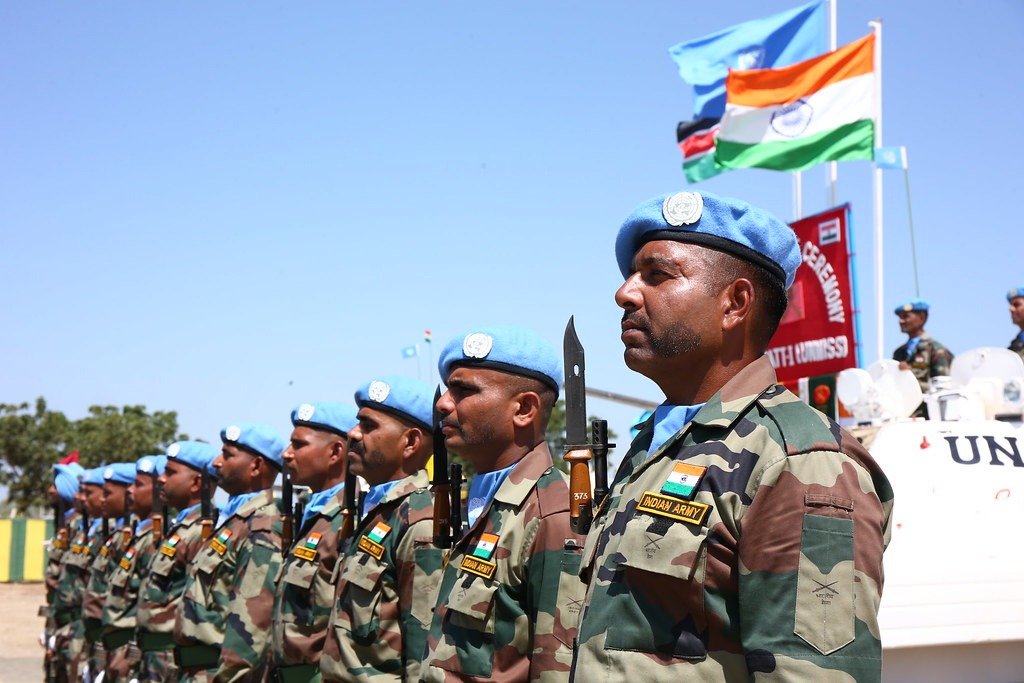
- Venue: On 17 August 2026, a UN medal ceremony was held in Juba, South Sudan, for Indian personnel serving with the United Nations Mission in South Sudan (UNMISS).
- UNMISS is a UN peacekeeping force. It was established on July 9, 2011, following South Sudan’s independence.
- It was established under Security Council Resolution 1996 to consolidate peace, protect civilians, and humanitarian support.
- It is headquartered in Juba. Its mandate was extended through April 30, 2027.
- It facilitates implementation of the 2018 Revitalized Agreement on the Resolution of the Conflict in South Sudan (R-ARCSS).
- Awardees: A total of 210 Indian peacekeepers received the UN Medal.
- The group specifically included six women peacekeepers and seven Staff Officers.
- It highlights both operational contribution and increasing women’s participation in UN peacekeeping.
- Note that the Indian Battalion of United Nations Interim Security Force for Abyei (UNISFA) was awarded UN medals during an Independence Day (15 August 2026) parade.
- UNISFA operates in the Abyei Area, a disputed region between Sudan and South Sudan.
- Note that the Indian Battalion of United Nations Interim Security Force for Abyei (UNISFA) was awarded UN medals during an Independence Day (15 August 2026) parade.
- Recognition: The ceremony recognised their exceptional peacekeeping service in one of the world’s challenging conflict environments.
- The medal recognises personnel for meritorious service under UN peace operations.
- UNMISS highlighted Indian personnel’s contribution during crises, medical emergencies and lifesaving missions, particularly their courage, compassion, civilian protection and peace-support efforts.
| Note: The United Nations (UN) Medal is a circular bronze-colored medallion, 35mm in diameter. Its front side features the official UN emblem (a global world map surrounded by olive branches) beneath the letters “UN”, while the back is inscribed with the words “IN THE SERVICE OF PEACE“. It hangs from a colorful fabric ribbon specific to each mission. |
What is UN Peacekeeping?
- About: UN Peacekeeping is a United Nations (UN) mechanism for helping conflict-affected countries restore stability and sustainable peace.
- It facilitates peace, protects civilians, and supports the restoration of stable governance structures.
- UN Peacekeeping deploys military, police, and civilian personnel globally to help countries transition from conflict to peace.
- They normally retain their national uniforms, while the distinctive UN blue helmet/beret and badge identify them as UN personnel.
- The United Nations Security Council (UNSC) authorizes missions, while the General Assembly manages the budget.
- It is managed by the Department of Peace Operations (DPO). It provides political and executive direction.
- First Mission: It began in May 1948, when the Security Council created the United Nations Truce Supervision Organization (UNTSO) to monitor the Arab-Israeli armistice—the first UN peacekeeping operation.
- Principles: Interconnected principles are established by the UN to ensure legitimacy and effectiveness:
- Consent of the parties: Operations require the political agreement of the main parties involved in the conflict.
- This provides the necessary freedom of action to carry out the mission.
- Impartiality: Peacekeepers must execute their duties without bias toward any party.
- Impartiality is crucial for maintaining the trust and cooperation of all factions.
- Non-use of force except in self-defense and defense of the mandate: Peacekeepers do not use force to enforce compliance.
- They only use it as a last resort to protect themselves, civilians, and the mission’s objectives.
- Consent of the parties: Operations require the political agreement of the main parties involved in the conflict.
- Mandates: Mandates are legal authorizations and vary by conflict:
- Protecting civilians: Preventing violence against innocent individuals and creating safe zones.
- Preventing conflicts: Monitoring ceasefires, border lines, and peace agreements to stop the resumption of hostilities.
- Supporting political processes: Assisting host governments with elections, institutional reforms, and dialogue.
- Promoting human rights: Investigating abuses and strengthening local judicial systems.
- Disarmament and reintegration: Helping ex-combatants lay down their weapons and reintegrate into society.
- Achievements: The UN operates 11 peacekeeping missions across three continents.
- UN Peacekeeping spans critical regions across Africa, the Middle East, Europe, and Asia.
- These operations deploy around 68,000 personnel consisting of military, police, and civilian workers from 117 countries.
- The largest personnel deployments are led by Nepal, Rwanda, Bangladesh, India, and Pakistan.
- Since its inception in 1948, the UN has managed 72 peacekeeping operations, deploying more than two million individuals to stabilize conflict areas.
- The UN factsheet records 51,317 uniformed personnel as of 30 April 2026.
- The UN led successful peacekeeping missions in Cambodia (UNTAC, 1992–1993), El Salvador (ONUSAL, 1991–1995), Mozambique (ONUMOZ, 1992–1994), and Namibia (UNTAG, 1989–1990).
- Active Missions:
- Africa: This region holds the largest operations, including UNMISS in South Sudan, MONUSCO in the Democratic Republic of the Congo, MINUSCA in the Central African Republic, UNISFA in Abyei, and MINURSO in Western Sahara.
- Middle East: Operations focus on volatile borders, including UNIFIL in Lebanon, UNDOF in the Golan Heights, and the foundational observer mission UNTSO.
- Europe & Asia: Active deployments include UNFICYP in Cyprus, UNMIK in Kosovo, and UNMOGIP monitoring India and Pakistan.
- India’s Contribution: India is the second-largest contributor of uniformed personnel to UN peacekeeping operations.
- India is a long-standing major UN peacekeeping contributor.
- Guided by its foundational philosophy of “Vasudhaiva Kutumbakam” (the world is my family), India has maintained global peace stabilization.
- India has deployed nearly 300,000 peacekeepers across more than 50 UN missions since its independence.
- India deployed personnel to 49 of the 71 missions established since 1948.
- In 2026, India had personnel across nine missions, with more than 4,200 military and police personnel, including 155 women.
- It was the largest military contributor to UNMISS, with 1,775 personnel as of April.
- Over 180 Indian personnel have lost their lives while serving under the UN flag.
- In 2007, India made history by deploying the first-ever all-female Formed Police Unit to the United Nations Mission in Liberia.
- India actively stationed Female Engagement Teams (FET) and Women Military Police in active conflict zones worldwide.
- Multiple Indian women officers, including Major Suman Gawani, Major Radhika Sain, and Major Abhilasha Barak, have received the prestigious UN Military Gender Advocate of the Year award.
- Indian Army officer Major Swathi Shanthakumar won the prestigious UN Secretary-General’s Award for her outstanding leadership.
- The Centre for United Nations Peacekeeping (CUNPK) in New Delhi is a premier, UN-certified institution.
- It was established by the Indian Army in 2000 to train domestic and international troops in tactical peacekeeping and niche operations.
- It hosts prominent international events, such as the Conference on Women Peacekeepers from the Global South.
- Indian contingents are recognised for discipline, medical assistance, civilian protection and humanitarian service, strengthening India’s multilateral and Global South credentials.
- Indian officers have also been lauded for gender-inclusive grassroots initiatives like “Equal Partners, Lasting Peace“.
Frequently Asked Questions (FAQs):
1. How many Indian peacekeepers received UN medals in South Sudan?
210 Indian peacekeepers, including six women and seven Staff Officers, received UN Medals in Juba.
2. Why were over 200 Indian peacekeepers awarded UN medals?
They were recognised for exceptional service, courage, compassion, lifesaving missions and protecting lives during crises.
3. What is the UN Medal awarded to peacekeepers?
It is a United Nations service medal recognising personnel for meritorious service while serving under a UN peacekeeping mission.
4. Which UN mission are the Indian peacekeepers serving with in South Sudan?
They are serving with the United Nations Mission in South Sudan (UNMISS).
5. What is UNMISS?
UNMISS is the UN peacekeeping mission supporting civilian protection, peace consolidation and durable peace in South Sudan.
6. What role do Indian peacekeepers play in South Sudan?
Indian personnel support civilian protection, crisis response, medical assistance, lifesaving operations and peacebuilding efforts.
7. Why does India contribute troops to UN peacekeeping missions?
India contributes to global peace and security, strengthens multilateral diplomacy, and demonstrates commitment to UN-led conflict resolution.
8. What is the significance of the UN Medal ceremony?
The ceremony recognises India’s peacekeeping contribution, honours exceptional service, and highlights the sacrifices and humanitarian role of UN Blue Helmets.
Disclaimer: Information in this article is based on official announcements and public records. Regulations and implementation details may evolve over time.