



ISRO Gaganyaan Astronaut Cadre to Civilians
|
General Studies Paper III: Space Technology |
Why in News?
Recently, ISRO’s Committee on astronaut selection and management recommended opening its Gaganyaan astronaut cadre to civilians for the first time alongside military pilots, marking a major shift for future Gaganyaan missions.
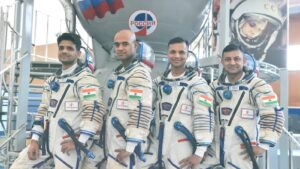
Highlights of ISRO Committee on Astronaut Selection and Management Report
- Selection Recommendation: The committee proposed a pool of 10 candidates for the upcoming Gaganyaan Mission’s second batch.
- This group will consist of six mission pilots from military backgrounds and four civilian specialists.
- This marks the first official inclusion of civilians in the astronaut cadre.
- The four civilian members will be recruited from STEM fields. However, the official selection criteria have not been announced yet.
- Experts in science, technology, engineering, and mathematics are preferred.
- These individuals will focus on scientific research and experiments during orbital flights.
- For the third batch, the committee recommends 12 astronauts. The ratio will shift drastically to include ten civilian specialists and only two pilots.
- Pilot Expansion: The military intake will also be broadened beyond fighter pilots. The committee recommends including combat helicopter pilots from the Indian Air Force. This expansion aims to utilize a wider range of aviation experience.
- Readiness Timeline: A full cycle of selection and training is estimated to take 4.5 years or 72 months. The committee targets readiness for the second batch within this timeframe. A third batch is projected to be ready within 96 months.
- Cadre Strength: The committee envisages creating a total astronaut cadre of up to 40 individuals. As per the project 26 individuals will be selected.
- A large pool helps manage attrition and long-term uncertainties. It also allows for international mission opportunities.
- Flight Priority: Mission pilots will lead early safety-critical flights to ensure system maturity.
- Civilian specialists are tentatively scheduled to fly starting from the fourth mission.
- Mission Frequency: Planning assumptions suggest a target of two human spaceflight missions every year.
- Individual astronauts may return to space after a gap of approximately two years. This requires a sustained and growing pool of active personnel.
- Crew Augmentation: The crew size is proposed to increase from two to three astronauts.
- This change is planned to take effect from the seventh mission onward. It will be enabled by upgrades to the crew module capacity.
|
ISRO’s Gaganyaan Astronaut Cadre
|
Significance of Civilian Inclusion
- Scientific Specialisation: Civilian inclusion can bring domain experts into the mission profile. The inclusion of STEM specialists may bring deep expertise in biotechnology and fluid physics.
- These civilians could focus entirely on microgravity research while pilots handle flight systems.
- These specialists improve in orbit experiments and system analysis. It enhances mission output beyond piloting functions.
- Station Operations: India plans to launch the Bharatiya Antariksh Station by 2035. A permanent station needs Mission Specialists for maintenance and research.
- Civilians can serve as the primary residents of this orbital laboratory. They can manage complex payloads and perform long-duration experiments.
- Sustaining Cadre: ISRO aims for a total cadre of 40 astronauts. Relying only on IAF test pilots is not sustainable for long-term needs.
- Adding civilians expands the recruitment base significantly. It ensures a steady supply of Gaganyatris for future annual missions.
- Diversity Benchmarks: The civilian track opens more opportunities for women scientists in space. Currently the military pilot pool has very few eligible candidates.
- Civilian recruitment allows ISRO to achieve better gender representation. This aligns with global standards set by NASA and ESA.
- Economic Potential: Civilian astronauts can represent private industries or research institutes. This encourages commercial participation in the space sector.
- It paves the way for space tourism and private research missions. This will eventually reduce the financial burden on the national budget.
- Global Integration: Most international missions involve multidisciplinary teams. Including civilians makes India a better partner for joint missions.
- It allows Indian researchers to participate in projects on the International Space Station. This can foster deeper international cooperation in space exploration.
Challenges
- Environmental Control & Life Support (ECLSS): Civilians have lower physiological tolerance for the extreme temperature variations and radiation of space compared to trained military pilots. Developing reliable, earth-like life support systems remains a critical technological gap.
- Infrastructure & Facility Gaps: India currently operates only temporary training centers and lacks advanced domestic facilities like human centrifuges or zero-gravity simulators. This necessitates continued reliance on international partners for rigorous preparation.
- Medical & Bioastronautics Challenges: Civilians are more susceptible to the psychological and physical stresses of zero-gravity, including depression, radiation exposure, and psychiatric disorders.
- Technical Benchmarking: ISRO must establish clearer cognitive and physical benchmarks to transition from training highly specialized test pilots to broader civilian researchers.
- Space Debris & Safety: The increasing threat of space debris poses a risk of cabin depressurisation. Ensuring the reliability of Crew Escape Systems (CES) is paramount for civilians who may lack the rapid emergency response instincts of fighter pilots.
|
Gaganyaan Mission:
|
|
Also Read: Gaganyaan Service Module Propulsion System |