National Study Report on Low Participation in Gram Sabha: MoPR
| General Studies Paper II: Local Self Governance, Co-operative Federalism, Government Policies & Interventions |
Why in News?
Recently, the Ministry of Panchayati Raj (MoPR) released the National Study Report on Low Participation in Gram Sabha Across States/UTs.
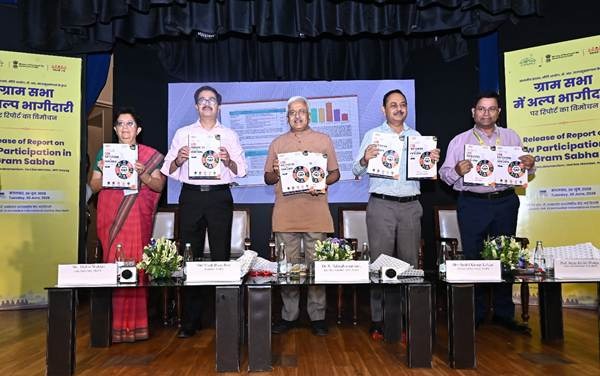
Highlights of Gram Sabha Study Report (National) on Low Participation in Gram Sabha Across States/UTs
- Assessment: The National Institute of Rural Development and Panchayati Raj (NIRDPR) conducted one of India’s largest field-based studies on low participation in Gram Sabha (LPGS) across 26 States/UTs.
- Researchers covered around 400 Gram Panchayats, including 50 PESA Gram Panchayats and 130 Women-Friendly Gram Panchayats.
- Respondent Base: Nearly 7,800 respondents participated, including Gram Sabha members, elected representatives, Panchayat officials, Self-Help Group members, community leaders, and stakeholders.
- Low Participation: The report concludes that low participation results from socio-economic, institutional, governance and behavioural factors, indicating no single cause behind declining attendance.
- Livelihood and time constraints (55.5%) emerged as the largest obstacle, showing that daily employment pressures significantly reduce citizens’ ability to attend Gram Sabha meetings.
- Awareness and communication issues (16.22%) formed the second-largest barrier, highlighting inadequate publicity and weak citizen outreach before meetings.
- Among livelihood barriers, busy work schedules (41.74%) and agricultural activities (30.26%) were the most significant reasons preventing participation during meeting periods.
- Participation remained lowest among migrant households (17.61%), youth (16.73%), elderly citizens (15.80%), and women (13.40%), indicating persistent inclusivity challenges.
- While awareness about meeting dates was generally high, understanding of citizen rights, quorum requirements, decision-making procedures and Gram Sabha’s institutional role remained comparatively weak.
- The study identifies “Gram Sabha Participation Fatigue”, where repeated meetings without visible outcomes gradually reduce public enthusiasm and attendance.
- Major causes include transparency concerns (45.46%), irrelevant discussions (42%), repetitive deliberations (33.4%), trust deficit (32.7%), political interference (27.9%), and weak grievance redressal (16.2%).
- Citizen Expectations: Citizens increasingly judge Gram Sabha effectiveness through responsive institutions, transparent decision-making, relevant discussions and implementation of resolutions, rather than merely conducting meetings.
- Improvement Measures: Respondents prioritised awareness campaigns (48.2%), door-to-door mobilisation (22.2%), convenient meeting timings (10.6%), and interactive Gram Sabha sessions (7%) to improve participation.
- Recommendations: The report recommends greater transparency, effective grievance redressal, women’s participation, accessibility, regular official attendance.
- It documents successful models such as SHG-led mobilisation, Bal Sabhas, thematic Gram Sabhas and digital communication systems which provide practical models to refer to.
- The government should launch a National Gram Sabha Awareness, Procedural Literacy and Mobilisation Mission to strengthen citizen awareness, and overall democratic participation.
- Structured pre-Gram Sabha mobilisation should be institutionalized through Ward Members, Self-Help Groups, frontline workers, youth groups, and community institutions.
- Livelihood-sensitive scheduling of Gram Sabha meetings must be promoted by carefully considering agricultural cycles, local work patterns, migration realities, and community preferences.
- Inclusive participation platforms such as Mahila Sabhas, Ward Sabhas, and Youth Sabhas must be strengthened to improve the representation of women, Scheduled Castes, Scheduled Tribes, youth, and other vulnerable groups.
- Transparency, accountability, and public trust should be improved by institutionalizing Action Taken Reports, grievance tracking systems, public review mechanisms, and follow-up processes.
- Advance public disclosure of Gram Sabha agendas, beneficiary lists, budgets, development priorities, and implementation status must be ensured through both physical and digital platforms.
- Convergence between Panchayati Raj Institutions and line departments needs to be strengthened to improve service delivery, grievance redressal, and responsiveness to community concerns.
- Digital technologies—including SMS alerts, WhatsApp groups, Interactive Voice Response Systems (IVRS), Panchayat digital notice boards, and eGramSwaraj-linked communication systems—should be leveraged.
What is Gram Sabha?
- About: Gram Sabha is a constitutional body defined under Article 243(b) of the Constitution.
- It comprises all persons registered in the electoral rolls of a village within a Gram Panchayat area, making it the foundation of rural self-governance.
- Gram Sabha is regarded as the foundation of Panchayati Raj, connecting citizens directly with local governments.
- Constitutional Status: The 73rd Constitutional Amendment Act, 1992 inserted Part IX (Articles 243–243O), granting constitutional recognition to Panchayati Raj Institutions and establishing Gram Sabha as the basic democratic institution in villages.
- Universal Membership: Every adult citizen (18 years or above) whose name appears on the village electoral roll automatically becomes a Gram Sabha member.
- No election or nomination is required for membership.
- Unlike elected Panchayats, Gram Sabha represents direct democracy.
- Meeting Structure: Every registered voter is a member of this sabha.
- Meetings are generally presided over by the Sarpanch (Head) or Pradhan of the Gram Panchayat.
- In their absence, a member is chosen by the assembly.
- The Panchayat Secretary (a government-appointed official) is responsible for coordinating the meetings, preparing the agenda, and recording the minutes.
- The Gram Sabha is required to meet at least two to four times a year, depending on State Panchayati Raj Acts.
- Many states align these with major national and international holidays like Republic Day, Labor Day, Independence Day, and Gandhi Jayanti.
- To conduct an official and legally binding meeting, a minimum attendance—the quorum—is mandatory.
- A meeting must be convened by the Sarpanch if a written request is submitted by at least 10% of its members or 50 members, whichever is greater.
- The request must typically be submitted at least 5 days prior to the proposed meeting date.
- Meetings are held in public spaces to encourage open debate.
- The assembly reviews the previous year’s performance and discusses local community issues.
- Meetings are generally presided over by the Sarpanch (Head) or Pradhan of the Gram Panchayat.
- Roles & Powers: Under Article 243A, State Legislatures empower Gram Sabhas to perform functions relating to planning, governance, monitoring and local development through State Panchayat laws.
- Gram Sabha discusses and approves village development plans, welfare programmes, infrastructure priorities and socio-economic projects before implementation by the Gram Panchayat.
- It can review Panchayat expenditure, monitor public services, conduct social audits, and ensure accountable implementation of government schemes.
- Gram Sabha identifies eligible beneficiaries for poverty alleviation and welfare schemes, reducing exclusion and improving fairness in public resource distribution.
- It promotes participation of women, Scheduled Castes, Scheduled Tribes, youth and marginalized communities, ensuring inclusive grassroots governance.
- In tribal regions, the PESA Act of 1996 grants the Gram Sabha supreme authority to protect customs, traditions, and ensure that the consent of the people is obtained prior to local land acquisition.
- It functions to safeguard communal harmony and can facilitate the resolution of minor local disputes and grievances through customary community dialogues.
- Significance: It empowers rural citizens to question Panchayat officials, raise grievances, monitor projects and demand corrective action, strengthening democratic accountability.
- Regular community monitoring improves implementation of schemes related to drinking water, sanitation, roads, education, health and rural livelihoods.
- It keeps elected Panchayat members and the Sarpanch accountable by having the power to seek clarification on all administrative and income-expenditure activities.
Government Initiatives to Strengthen Gram Sabha Participation
- Revamped Rashtriya Gram Swaraj Abhiyan (RGSA): The Revamped RGSA (2022–26) is the flagship Centrally Sponsored Scheme for strengthening Panchayati Raj Institutions (PRIs) through capacity building, infrastructure development, digital governance and improved service delivery.
- eGramSwaraj Digital Platform: The eGramSwaraj portal integrates planning, budgeting, accounting, asset management and work monitoring for over 2.7 lakh PRIs across 28 States and 6 UTs, enhancing transparency and financial accountability.
- Gram Panchayat Development Plan (GPDP): Under the GPDP framework, Gram Sabhas prepare participatory annual development plans by identifying local priorities across 29 subjects, ensuring community-driven rural development.
- People’s Plan Campaign: The People’s Plan Campaign (PPC) mobilises Gram Sabhas annually to prepare inclusive Panchayat Development Plans, encouraging convergence of Central and State schemes with active public participation.
- SVAMITVA Scheme: The SVAMITVA scheme uses drone surveys to prepare accurate village maps and issue property cards in rural inhabited areas, reducing land disputes, improving property ownership records.
- Gram Manchitra: The Gram Manchitra GIS platform enables spatial planning by integrating geographical data with Gram Panchayat Development Plans, supporting scientific infrastructure planning.
- Digital Financial Governance: Integration of eGramSwaraj with the Public Financial Management System (PFMS) facilitates digital payments, expenditure tracking, online accounting and transparent utilisation of Panchayat funds.
- National Panchayati Raj Day: Observed every 24 April, National Panchayati Raj Day promotes awareness of Gram Sabha, decentralised governance and citizen participation through nationwide outreach and best-practice dissemination.
- Gramoday Sankalp Initiative: The Gramoday Sankalp initiative disseminates best practices, innovations, policy updates and governance reforms among Panchayati Raj Institutions, encouraging stronger grassroots governance.
IMPORTANT POINTS TO KNOW:
- Rural local administration in India operates through the Panchayati Raj Institutions (PRIs), constitutionalized by the 73rd Amendment Act of 1992.
- It institutionalizes grassroots democracy through a mandatory three-tier structure.
- It was recommended by the Balwant Rai Mehta Committee (1957).
- Three-Tier Framework:
- Gram Panchayat (Village Level): The Gram Panchayat is the executive body at the village level.
- Headed by a Sarpanch/Pradhan, it implements development schemes, provides civic services, collects local taxes, and executes Gram Sabha decisions.
- The Panchayat Secretary is the appointed administrative link to the state government.
- Panchayat Samiti (Block Level): The intermediary executive body that coordinates between the Gram Panchayat and the Zilla Parishad.
- It comprises directly elected members, ex-officio members (local MLAs and MPs), and associate members.
- The Block Development Officer (BDO) serves as the administrative head.
- Zilla Panchayat / Parishad (District Level): The apex body responsible for district-level planning and consolidating block-level plans.
- It is headed by an elected President and includes directly elected members, MPs, and MLAs of the district.
- The Chief Executive Officer (CEO) (usually an IAS officer) handles the administrative execution.
- Gram Panchayat (Village Level): The Gram Panchayat is the executive body at the village level.
FAQs:
1. Who conducted the National Study on low Gram Sabha participation?
The Ministry of Panchayati Raj commissioned NIRDPR, Hyderabad, to conduct the nationwide study.
2. How many States and Union Territories were covered?
The study covered 26 States and Union Territories across diverse rural governance contexts.
3. What was the biggest barrier to Gram Sabha participation?
Livelihood and time constraints (55.5%) emerged as the largest participation barrier.
4. Which groups were least represented in Gram Sabha meetings?
Migrant households, youth, elderly citizens and women were identified as least represented.
5. What key reform did the study recommend?
It recommended a National Gram Sabha Awareness, Procedural Literacy and Mobilisation Mission.
Disclaimer: Information in this article is based on official announcements and public records. Regulations and implementation details may evolve over time.