



Delegation of Financial Powers to DRDO (DFP-2026) Launched
| General Studies Paper III: Defence, Government Policies & Interventions |
Why in News?
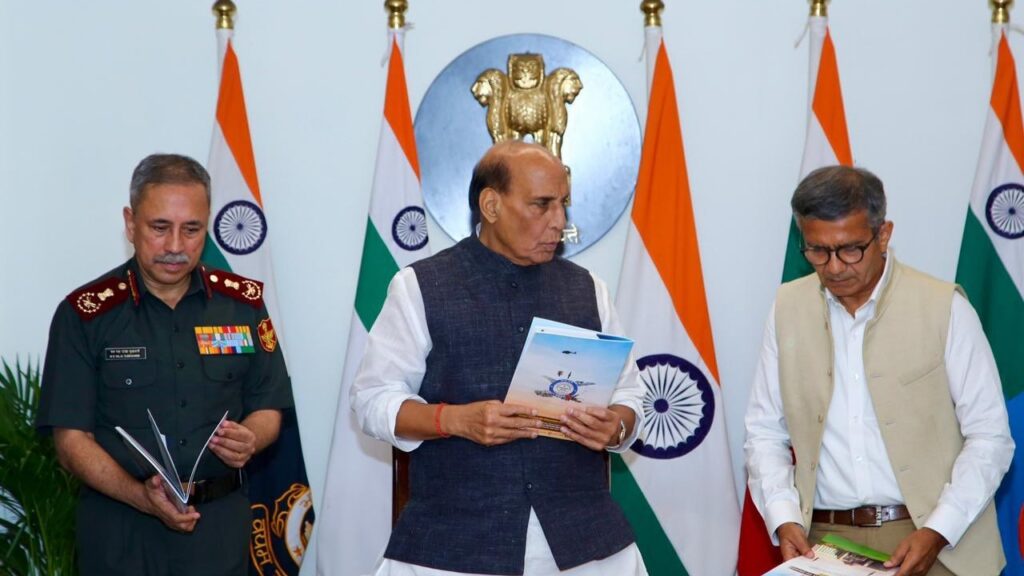
Recently, Defence Minister Rajnath Singh unveiled the Delegation of Financial Powers to DRDO (DFP-2026) on June 29, 2026.
What is Delegation of Financial Powers to DRDO (DFP-2026)?
- About: The Delegation of Financial Powers to DRDO (DFP) is an administrative Ministry of Defence framework aimed at granting enhanced financial autonomy to the Defence Research and Development Organisation (DRDO).
- It decentralizes fiscal approvals to fast-track strategic research and quickly deliver critical defence technologies.
- Objective: The primary goal is to improve accountability, efficiency, and the timely execution of strategic R&D projects.
- It ensures advanced weapon systems reach the Armed Forces faster while supporting Aatmanirbhar Bharat.
- Launched By: It is managed by the Department of Defence R&D (DDR&D) and officially released by the Union Raksha Mantri in New Delhi.
- Features:
- Increased Secretary Powers: For project sanctions and competitive procurement, the financial authority of the Secretary, DRDO has been enhanced from Rs 75 crore to Rs 150 crore, significantly speeding up major decision-making.
- Enhanced Director General (DG) Limits: The financial powers of DG (DRDO) have been raised from Rs 25 crore to Rs 75 crore.
- Additionally, DG-level limits for sanctioning R&D projects at universities have grown to Rs 5 crore.
- Upgraded Laboratory Director Limits: The financial powers of individual Laboratory Directors have been elevated from Rs 2 crore to Rs 5 crore, empowering local facility heads to manage regional testing and resource requirements.
- Dedicated Trial and Testing Provisions: It introduces dedicated financial provisions specifically for trial campaigns, performance tests, and evaluation activities, removing bottlenecks during field-validation stages.
- Pre-Project R&D Sanctions: The framework explicitly authorizes the sanctioning of pre-project R&D initiatives, giving scientists immediate access to funding for early-stage innovation before formal project approval.
- Segregated Grants-in-Aid Structure: It clearly segregates grants-in-aid under separate schedules.
- Independent financial schedules have been created for Extra-Mural Research (EMR) projects, Defence Innovation Accelerator–Centres of Excellence (DIA-CoEs) and the Technology Development Fund (TDF).
Need for Modernising DRDO’s Financial Delegation Framework
- Rising Complexity of Defence Technologies: Modern defence systems increasingly integrate artificial intelligence, autonomous platforms, cyber capabilities, quantum technologies and hypersonic research.
- Earlier financial delegation rules were framed before many of these high-cost, multidisciplinary programmes became priorities, making an updated framework necessary.
- Escalation in Project Costs: The cost of defence research has risen significantly due to advanced materials, imported testing equipment and sophisticated laboratories.
- Older financial ceilings no longer reflected present-day expenditure requirements.
- Expansion of DRDO’s Research Network: DRDO today manages 50+ laboratories, numerous test facilities and a wide portfolio of strategic programmes.
- A larger organisational structure required financial authority to be distributed across multiple administrative levels.
- Alignment with Aatmanirbhar Bharat: India’s expanding emphasis on indigenous defence technologies increased the number of research and prototype development programmes.
- Updated financial rules became essential to support the growing domestic defence innovation ecosystem.
- Greater Industry Participation: The previous framework was designed when government laboratories dominated defence research.
- Today, private industry, MSMEs, start-ups and academic institutions participate extensively through collaborative programmes, requiring more flexible financial administration.
- Synchronisation with National Procurement Reforms: The Ministry of Defence has progressively modernised acquisition procedures through reforms such as the Defence Acquisition Procedure (DAP) 2020.
- Updating DRDO’s financial delegation ensured that research governance remained consistent with broader defence procurement reforms.
Institutional Reforms to Enhance DRDO’s Efficiency
- DRDO 2.0 Model: The DRDO 2.0 strategy redefines the organisation’s role by focusing on disruptive technologies such as Artificial Intelligence (AI), quantum technologies, hypersonics, directed-energy weapons and advanced materials.
- Development-cum-Production Partner (DcPP) Model: The DcPP Model integrates public and private industries from the initial development stage.
- By March 2026, 134 companies had become DcPPs or Production Agencies, reducing the gap.
- Technology Transfer: DRDO has significantly expanded technology commercialisation.
- By March 2026, it had signed over 2,180 Technology Transfer Agreements and made 2,780+ Intellectual Property Rights (IPRs) available to Indian industries.
- Technology Development Fund (TDF): The Technology Development Fund now provides grants of up to ₹50 crore for critical defence technologies.
- As of June 2026, 80 projects worth ₹334 crore were under implementation, while an additional ₹500 crore corpus was sanctioned to support emerging deep-tech innovations by MSMEs and startups.
- DRDO Industry-Academia Centres: DRDO has established 15 Defence Industry Academia–Centres of Excellence (DIA-CoEs) across leading institutions, conducting research in nearly 82 technology verticals.
- DRDO Testing Infrastructure: To improve innovation, DRDO has opened testing facilities of 24 laboratories through the Defence Testing Portal.
- Private companies, startups and MSMEs can now validate indigenous technologies using advanced defence infrastructure.
- Human Resource: DRDO has strengthened scientific capacity through five Young Scientist Laboratories, with a sixth laboratory planned in 2026.
- Newly recruited scientists undergo a two-year M.Tech programme at the Defence Institute of Advanced Technology, while over 3,500 apprentices receive annual practical training.
- Industry Interaction Groups (IIGs): Dedicated Industry Interaction Groups have been created across DRDO laboratories to improve communication with manufacturers, startups and MSMEs.
- These groups simplify industrial engagement, and accelerate collaborative research and product development.
- R&D Budget Reform: Since 2022–23, 25% of the Defence R&D budget has been earmarked for industry, startups and academia. This structural reform broadens India’s defence innovation ecosystem and promotes co-development.
IMPORTANT FACTS:
- The Defence Research and Development Organisation (DRDO) was established in 1958 through the merger of the Technical Development Establishment (TDE), the Directorate of Technical Development and Production (DTDP), and the Defence Science Organisation (DSO).
- DRDO functions under the Department of Defence Research and Development (DDR&D) in the Ministry of Defence (MoD), serving as India’s premier defence research organisation.
- The headquarters of DRDO is located in New Delhi.
- DRDO’s vision is to establish world-class science and technology capabilities that enable India to achieve self-reliance in critical defence technologies.
- The organisation is headed by the Chairman, DRDO, who also serves as the Secretary, Department of Defence R&D, ensuring policy coordination.
- DRDO has developed landmark systems including the Agni and Prithvi missile series, Akash air defence system, BrahMos (jointly developed), Light Combat Aircraft technologies, Arjun Main Battle Tank, and indigenous radar systems.
FAQs:
1. What is Delegation of Financial Powers to DRDO (DFP-2026)?
DFP-2026 is a revised Ministry of Defence framework decentralising financial powers to accelerate DRDO’s strategic R&D projects.
2. Why was Delegation of Financial Powers to DRDO (DFP-2026) introduced?
DFP-2026 was introduced to improve efficiency, accountability, and timely execution of defence research projects by reducing approval delays.
3. Who launched Delegation of Financial Powers to DRDO (DFP-2026)?
DFP-2026 was launched by Defence Minister Rajnath Singh on 29 June 2026.
4. What are the key features of Delegation of Financial Powers to DRDO (DFP-2026)?
DFP-2026 expands financial authority, funds trials, enables pre-project R&D, and streamlines grant approvals.
5. How will Delegation of Financial Powers to DRDO (DFP-2026) benefit defence research?
DFP-2026 speeds decision-making, technology development, testing and induction, strengthening indigenous defence innovation and preparedness.
Disclaimer: Information in this article is based on official announcements and public records. Regulations and implementation details may evolve over time.