




NASA-ISRO Moon Base Programme Under Artemis Accords
| General Studies Paper III: Space Technology, International Space Agencies |
Why in News?
Recently, NASA invited ISRO to join its Moon Base programme, strengthening India-US cooperation under the Artemis Accords for a sustained lunar presence.
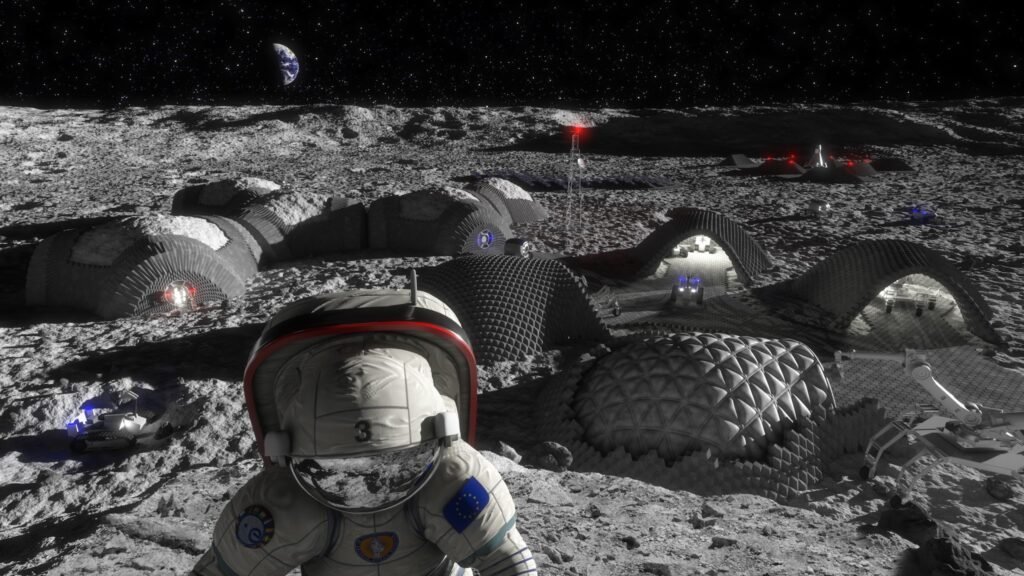
What is NASA’s Moon Base Programme?
- About: NASA’s Moon Base Programme is a phased initiative to establish an enduring human presence near the lunar South Pole, enabling astronauts to live, work and conduct research there.
- The South Pole combines major scientific opportunities with potentially useful resources, particularly water ice in permanently shadowed regions.
- Objective: Its objective is to return humans to the Moon to stay, enabling scientific research, technology demonstrations, and resource utilisation.
- It aims to develop capabilities needed for future human missions to Mars.
- Announcement: NASA announced the programme on 24 March 2026 during its “Ignition” event, presenting a phased strategy aligned with US national space-policy objectives.
- Leadership: The programme operates under NASA’s Human Spaceflight Mission Directorate.
- Carlos García-Galán is the Moon Base Program Manager, responsible for its end-to-end development and execution; Jared Isaacman is NASA Administrator.
- Phases: NASA envisages three broad phases:
- Phase I (2026–2029): NASA will conduct numerous robotic missions, mapping the South Pole, studying resources and testing navigation, power, communications, mobility and other technologies before large-scale construction.
- Phase II (2029–2032): NASA plans to establish early habitation and surface infrastructure, including power, communications, mobility, logistics and systems.
- Phase III (2032 onward): Operations will expand toward routine crew rotations and continuous surface activity, with more advanced habitats and in-situ resource utilisation (ISRU) supporting longer-term human presence.
- Features:
- The programme includes robotic explorers, lunar landers, rovers, habitats, surface communications, reliable power, autonomous systems, dust mitigation and resource-utilisation technologies.
- Phase 1 is scheduled for roughly 25 launches to deliver nearly 4,000 kg of payload, including autonomous instruments and hopping drones.
- Phase 2 will target 27 launches to drop 60,000 kg of cargo, delivering vital early power systems and initial logistics.
- Phase 3 will target 29 launches to carry 150,000 kg of infrastructure; it is intended to introduce fixed habitat modules for regular six-month astronaut rotations.
- The programme adopts a commercial and international model. NASA is also pursuing fission surface power for continuous energy.
- NASA also plans advanced power technologies capable of supporting operations through difficult lunar conditions.
- The Moon Base is closely integrated with Artemis Programme, NASA’s broader programme for sustained lunar exploration.
- Current Developments: In June 2026, NASA selected Astrobotic, Firefly Aerospace and Intuitive Machines for four additional lunar missions targeted for late 2028.
- As of August 2026, the programme is in its early development and mission-deployment stage.
- NASA officially invited the Indian Space Research Organisation (ISRO) to join its lunar outpost initiative during the 9th India-U.S. Civil Space Joint Working Group meeting in Bengaluru.
- Both space agencies initiated formal discussions regarding open scientific data sharing under the Artemis Accords.
What are Artemis Accords?
- About: The Artemis Accords are a set of non-binding principles, guidelines and best practices established in 2020 to promote safe, peaceful, transparent and sustainable civil exploration of the Moon, Mars and beyond.
- Founding: They were established by NASA and the U.S. Department of State, together with seven founding nations: Australia, Canada, Italy, Japan, Luxembourg, the United Arab Emirates, and the United Kingdom.
- The Accords are not a new international treaty.
- They reinforce existing obligations under the Outer Space Treaty, Registration Convention and Rescue and Return Agreement.
- India committed to providing emergency aid to any astronauts or space personnel in distress.
- Expansion: The Artemis Accords have expanded rapidly, growing from 8 initial signatories in 2020 to 70 member nations as of July 2026.
- This framework now includes 32 nations from Europe, 16 from Asia, 8 from South America, 5 from North America, 7 from Africa, and 2 from Oceania.
- India officially signed the Artemis Accords on June 21, 2023, becoming the 27th signatory nation.
- India agreed to a political, non-binding set of principles rooted in the 1967 Outer Space Treaty to ensure peaceful space exploration.
- In 2025, Finland, Bangladesh, Norway, Senegal, Hungary, Malaysia, and the Philippines signed the framework.
- In 2026, Portugal, Oman, Latvia, Jordan, Morocco, Malta, Ireland, Paraguay, Botswana, Serbia, and Mauritius signed this.
- Mauritius became the 70th signatory on 17 July 2026.
- Principles:
- Peaceful Exploration: Signatories affirm that space activities should be conducted for peaceful purposes, consistent with international law and the Outer Space Treaty, which prohibits national appropriation of celestial bodies.
- Transparency: Countries commit to greater transparency by publicly sharing relevant national policies, plans and information about their space activities.
- Non-Interference: The Accords support temporary safety zones around lunar operations to prevent harmful interference.
- These zones must respect the principle of free access and are intended to end when the relevant activity ceases.
- Resource Utilisation: Signatories support open scientific data and responsible space-resource utilisation.
- Resource extraction is treated as compatible with the Outer Space Treaty when conducted consistently with its provisions, rather than as territorial ownership.
- Preservation: The framework promotes preservation of historic lunar sites and artefacts, mitigation of orbital debris, and sustainable exploration practices to protect the space environment for future missions.
ISRO’s Landmark Achievement & Exploration at the Lunar South Pole
- Historic Soft Landing: On 23 August 2023, Chandrayaan-3’s Vikram lander successfully soft-landed at about 69.37°S.
- It makes India the first country to achieve a soft landing in the Moon’s southern polar region and the fourth country to soft-land on the Moon.
- Landing Site: The landing location was subsequently designated Shiv Shakti Point (Station Shiv Shakti).
- The site lies in the southern high-latitude region, providing an important reference location for future lunar scientific and exploration missions.
- Surface Exploration: The Pragyan rover successfully deployed from Vikram and conducted in-situ investigations around the landing site.
- Its mobility demonstrated India’s capability to perform controlled robotic exploration directly on the lunar surface.
- Sulphur Detection: Pragyan’s LIBS instrument achieved the first-ever in-situ measurement confirming sulphur near the lunar south-polar region.
- It also identified aluminium, calcium, iron, chromium, titanium, manganese, silicon and oxygen, with hydrogen investigation undertaken.
- Elemental Composition: The rover’s APXS independently analysed lunar soil and rocks, detecting major and minor elements including sulphur.
- Later analysis associated the composition at Shiv Shakti with the lunar meteorite ALHA 81005, strengthening understanding of regional lunar geology.
- Subsurface Temperature: Chandrayaan-3’s ChaSTE made the first direct in-situ measurements of temperature within the top 10 cm of lunar soil at high southern latitudes.
- It recorded a peak surface temperature of approximately 355 K, revealing substantial metre-scale thermal variability.
- Plasma Environment: The RAMBHA-LP experiment provided first-of-its-kind ground measurements of the near-surface plasma environment at southern higher latitudes, showing that the electrical environment is more dynamic than previously understood.
- Seismic Investigations: The ILSA seismometer recorded seismic activity around the landing region, helping investigate lunar crustal and subsurface characteristics and contributing valuable data about the Moon’s internal structure.
- Reference Marker: The NASA-provided Laser Retroreflector Array (LRA) on Vikram was successfully ranged by NASA’s Lunar Reconnaissance Orbiter.
- It now serves as a durable geodetic reference point, supporting precise lunar positioning and future exploration.
Frequently Asked Questions (FAQs):
1. Why has NASA invited ISRO?
NASA invited ISRO to deepen India–US lunar cooperation, leveraging India’s capabilities and Chandrayaan experience under the Artemis framework.
2. What is NASA’s Moon Base programme?
It is NASA’s initiative to establish a sustained lunar outpost, supporting scientific research, technology development and future deep-space exploration.
3. Where is NASA planning to build the Moon Base?
NASA plans the lunar base near the Moon’s South Pole, an area strategically important because of potential water-ice resources.
4. What role could ISRO play in the Moon Base programme?
ISRO could contribute lunar science, robotic exploration, technologies, scientific data-sharing and mission expertise developed through Chandrayaan missions.
5. How is the invitation connected to the Artemis Accords?
The invitation builds upon India’s Artemis Accords partnership, with both countries also advancing cooperation on open scientific-data sharing.
Disclaimer: Information in this article is based on official announcements and public records. Regulations and implementation details may evolve over time.