



India-Japan Global Green Methanol Marine Fuel Pact
| General Studies Paper II: Growth & Development, Environmental Pollution & Degradation |
Why in News?
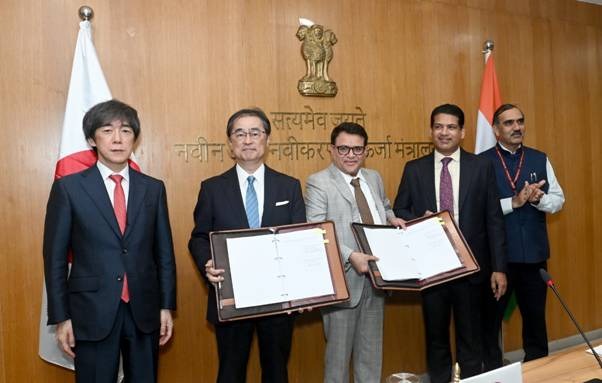
Recently, India signed a landmark $1 billion agreement with Japan to supply green methanol annually, marking India’s first large-scale global partnership for green marine fuel.
Highlights of India–Japan Green Methanol Marine Fuel Pact
- Bilateral Agreement: India’s ACME Green Molecules and Japan’s Mitsubishi Gas Chemical (MGC) signed a binding long-term green methanol supply agreement valued at approximately US$1 billion.
- It is India’s first global RFNBO-compliant green marine fuel partnership.
- It strengthens the India–Japan clean energy partnership, expanding into sustainable maritime fuels.
- Annual Supply: The agreement provides for the export of 100,000 tonnes of green methanol annually from India to Japan.
- The long-term offtake arrangement offers stable demand, investment certainty, and supports the development of a global green fuel value chain.
- Production Hub: The Paradip, Odisha facility will manufacture the green methanol.
- It forms ACME’s third major green-energy investment in Odisha, complementing existing 405,000 TPA and 800,000 TPA green ammonia projects.
- Regulatory Compliance: The fuel will be RFNBO-compliant with ultra-low carbon intensity, meeting European Union FuelEU Maritime requirements and future International Maritime Organization (IMO) emission standards.
- Significance: The pact strengths India’s position as a reliable exporter of green hydrogen derivatives and sustainable marine fuels.
- The agreement aligns with India’s National Green Hydrogen Mission, promoting exports of green hydrogen derivatives such as methanol and ammonia.
- The project is expected to attract large-scale investment, create high-skilled employment, strengthen ancillary industries, and boost exports.
- The partnership supports the decarbonisation of the hard-to-abate shipping sector, helping reduce emissions from international maritime transport while contributing to global net-zero objectives.
What is Green Methanol?
- About: Green Methanol (CH₃OH) is a renewable, low-carbon liquid fuel and chemical produced using renewable energy instead of fossil fuels.
- It is chemically identical to conventional methanol but has a much lower lifecycle carbon footprint.
- Methanol (also known as methyl alcohol or wood alcohol) is the simplest alcohol.
- It is a light, volatile, colorless, and flammable liquid that serves as a vital industrial solvent.
- It can be produced domestically from abundant local resources like high-ash coal, agricultural residue, municipal solid waste, and CO₂ captured from thermal power plants.
- The majority of methanol is used to produce formaldehyde, acetic acid, and other chemicals.
- It is commonly used as a solvent in laboratories and as an additive in automotive antifreeze and windshield washer fluid.
- Ingestion of methanol is highly toxic and often causes blindness or death.
- It has no carbon-carbon bond, meaning it produces zero particulate matter (PM).
- It has three types: Grey/Brown Methanol produced from fossil fuels like natural gas or coal, Green/Blue Methanol produced using fossil fuels with carbon capture and E-Methanol type of green methanol.
- It is chemically identical to conventional methanol but has a much lower lifecycle carbon footprint.
- Production: Green methanol is mainly produced through two routes: Bio-methanol (made from biomass, agricultural residues, forestry waste and municipal solid waste) and e-methanol (produced by combining green hydrogen with captured CO₂).
- Benefits: Green methanol can reduce greenhouse gas emissions by about 65–95% compared with fossil-based methanol.
- It supports net-zero emissions and improves air quality by lowering pollution from fuel production.
- It almost completely eliminates nitrogen and sulfur oxide emissions.
- It can utilise much of the existing liquid-fuel storage, transport and distribution infrastructure, reducing transition costs.
- As a “drop-in” fuel, it can be blended with conventional gasoline or diesel.
- Applications: It is widely used as marine fuel, chemical feedstock, hydrogen carrier, fuel-blending component, and for manufacturing plastics, paints, formaldehyde and solvents.
- It is emerging as an alternative to Heavy Fuel Oil (HFO), Very Low Sulphur Fuel Oil (VLSFO) and Marine Gas Oil (MGO).
- It is liquid at room temperature, easy to transport, and compatible with many existing bunkering systems.
- It is emerging as an alternative to Heavy Fuel Oil (HFO), Very Low Sulphur Fuel Oil (VLSFO) and Marine Gas Oil (MGO).
India’s Green Methanol Economy
- Current Policy: The country has notified a formal Green Methanol Standard under the National Green Hydrogen Mission in February 2026.
- Under this mission, total non-biogenic greenhouse gas emissions must not exceed 0.44 kg CO₂ eq per kilogram of methanol.
- This is calculated as an average over the preceding 12-month period.
- Carbon dioxide for synthesis can be obtained from biogenic sources, Direct Air Capture (DAC), or existing industrial sources.
- The Government has notified standards for M-15, M-85 and M-100 methanol blends under the Ministry of Road Transport and Highways.
- The Bureau of Indian Standards (BIS) has also approved 20% DME blending in LPG, supporting wider methanol adoption.
- Under this mission, total non-biogenic greenhouse gas emissions must not exceed 0.44 kg CO₂ eq per kilogram of methanol.
- Flagship Initiative: The NITI Aayog Methanol Economy Programme is India’s flagship initiative to promote methanol as an alternative fuel.
- It aims to reduce crude oil imports, lower greenhouse gas emissions.
- It aims to produce methanol from coal, biomass, municipal solid waste, natural gas, and captured CO₂.
- First Plant: India’s first green methanol production plant is being developed at Deendayal Port Authority.
- The demonstration facility has an initial capacity of 5 tonnes per day.
- The invasive shrub Prosopis juliflora is set to be used as feedstock for India’s first green methanol production plant.
- It aims to develop about 500,000 tonnes per annum (500 ktpa) of e-methanol supply for international shipping by 2028–29.
- Global Position: India is not yet a leading producer, but it is emerging as a major future supplier.
- China still dominates global methanol production and most Asia-Pacific green methanol capacity.
- India’s annual methanol demand is about 2.8 million tonnes and is rising.
- Future Plan: Under the Strategic Interventions for Green Hydrogen Transition (SIGHT) programme, SECI has launched a tender for 5 lakh tonnes per annum of green methanol.
- Multiple industrial projects, including CO₂-to-methanol initiatives by JSW Steel, are under development.
- Cochin Shipyard is constructing methanol-powered vessels, while RDSO is testing methanol-blended locomotive fuel.
- Potential: The Methanol Economy programme is projected to create nearly 5 million jobs.
- It is projected to reduce crude oil imports and save around ₹6,000 crore annually through 20% DME-LPG blending.
- It can improve urban air quality, and lower emissions of CO₂, NOx, SOx, and particulate matter.
National Green Hydrogen Mission (NGHM)
- Launch: The National Green Hydrogen Mission (NGHM) was approved by the Union Cabinet on 4 January 2023.
- It is implemented by the Ministry of New and Renewable Energy (MNRE).
- Vision: The Mission aims to make India a global hub for the production, usage, and export of green hydrogen and its derivatives such as green ammonia and green methanol.
- Financial Outlay: The Mission has a total outlay of ₹19,744 crore up to 2029–30.
- It includes ₹17,490 crore for the SIGHT Programme, ₹1,466 crore for pilot projects, ₹400 crore for R&D, and ₹388 crore for other components.
- Production Target: India targets production of at least 5 Million Metric Tonnes (MMT) of green hydrogen annually by 2030, supported by about 125 GW of additional renewable energy capacity.
- Economic Impact: The Mission is expected to mobilize over ₹8 lakh crore in investments, create more than 6 lakh jobs, reduce fossil-fuel imports by over ₹1 lakh crore, and cut nearly 50 MMT of greenhouse gas emissions annually by 2030.
- SIGHT Programme: The Strategic Interventions for Green Hydrogen Transition (SIGHT) scheme provides incentives for electrolyser manufacturing and green hydrogen production.
- Demand Creation: The Government will prescribe minimum consumption obligations for designated sectors and promote competitive bidding, exports, and certification.
- Pilot Projects: Pilot projects are supported in steel, shipping, mobility, decentralized energy, hydrogen from biomass, and hydrogen storage.
- The steel sector alone has ₹455 crore allocated for pilot projects.
- Green Hydrogen Hubs: The Mission plans to establish at least two Green Hydrogen Hubs with dedicated infrastructure, storage, logistics, and renewable energy integration.
FAQs:
- What is the India Green Methanol Supply Deal?
India’s ACME will supply 100,000 tonnes of green methanol annually to Japan’s MGC under a $1 billion agreement. - Why is the green methanol agreement significant?
It is India’s first global green marine fuel partnership, boosting exports, clean shipping, and India–Japan energy cooperation. - What is green methanol?
Green methanol is a low-carbon renewable fuel produced from green hydrogen and sustainable carbon sources or biomass. - How is green methanol produced?
It is produced using green hydrogen with captured CO₂ or by converting sustainable biomass into methanol. - How does green methanol help reduce carbon emissions?
It significantly lowers lifecycle CO₂ emissions compared with fossil methanol and conventional marine fuels. - Which sectors will benefit from green methanol?
Shipping, chemicals, aviation, power, heavy industry, and fertiliser sectors will benefit most. - How does the deal support India’s clean energy goals?
It advances the National Green Hydrogen Mission by expanding exports of green hydrogen derivatives. - Why is green methanol important for the shipping industry?
It is a clean marine fuel compatible with existing ships and helps meet future IMO emission standards.
Disclaimer: Information in this article is based on official announcements and public records. Regulations and implementation details may evolve over time.