9,909 Indian WWI Soldiers Added To Official Casualty List
| General Studies Paper I: Indian History, Decolonialisation |
Why in News?
Recently, the Commonwealth War Graves Commission (CWGC) officially added 9,909 previously unrecorded Indian World War I soldiers to its casualty records, correcting a century-old historical omission.
Historic Recognition of 9,909 Indian WWI Soldiers: Major Highlights
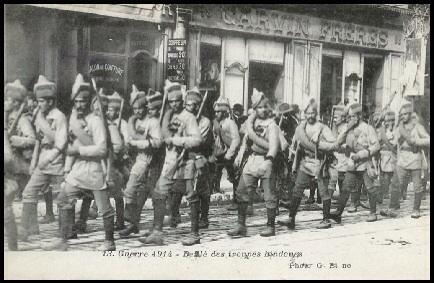
- Casualty Record: The Commonwealth War Graves Commission (CWGC) officially recognised 9,909 previously unrecorded Indian World War I (WWI) soldiers.
- It represents the largest single addition to its casualty database in more than 80 years and the biggest revision since the Second World War.
- In April 2026, CWGC digitally commemorated about 33,000 Indian Army soldiers who died in the WWI but whose names were left off the physical Basra Memorial in Iraq.
- Institutions: The recognition resulted from the five-year Punjab Registers Project, a collaboration between the CWGC, UK Punjab Heritage Association (UKPHA) and the University of Greenwich, combining archival research, digitisation and historical verification.
- Researchers digitised fragile Punjab Registers preserved at the Lahore Museum, containing records of nearly 320,000 Punjabi recruits of the British Indian Army.
- These registers became the primary evidence for identifying forgotten soldiers.
- Verification Process: The team examined 15,935 recorded deaths and cross-verified them against nearly 74,000 existing CWGC Indian Army records through name-by-name archival analysis, confirming 9,909 omitted casualties.
- Reason: Most soldiers died in non-operational areas, from injuries, disease or the 1918–19 influenza pandemic.
- Colonial British Indian Government rules denied them war-graves status, preventing official commemoration.
- Representation: Among the recognised soldiers, around 41% were Muslims, 26% Hindus, 25% Sikhs, less than 1% Christians, while about 8% remain under classification.
- Over 1.4 million soldiers and labourers from the British Indian Army served in World War I. Punjab alone contributed nearly 500,000 personnel.
- The recognised soldiers belonged to villages now located in Punjab, Haryana, Himachal Pradesh and Pakistan’s Punjab, highlighting the shared military heritage of pre-Partition India.
- The list also included Kesar Singh, the great-grandfather of Leicester-based dentist Sunney Palahey.
- Significance: The initiative has enabled descendants to identify ancestors’ villages, regiments, service records and circumstances of death, providing long-awaited historical closure after more than 100 years.
- The recognition strengthens India–UK historical cooperation, promotes evidence-based military history and reinforces the principle of equal commemoration regardless of race or colonial status.
World War I: Causes, Course, Consequences and India’s Role
- About: World War I (WWI) was the first global industrial war, fought from 28 July 1914 to 11 November 1918.
- It involved over 30 nations and transformed a regional European conflict into a worldwide war across Europe, Africa, the Middle East, Asia and the oceans.
- The war introduced trench warfare, machine guns, poison gas, tanks, aircraft and submarines, causing unprecedented destruction.
- More than 70 million military personnel were mobilised, with around 20 million deaths and 21 million wounded, making it one of history’s deadliest conflicts.
- Major Powers Involved: The war was fought mainly between two powers:
- The Allied Powers—Britain, France, Russia (until 1917), Italy (from 1915), Japan and the United States (from 1917).
- The Central Powers—Germany, Austria-Hungary, the Ottoman Empire and Bulgaria.
- Numerous colonies and dominions, including British India, participated under imperial control.
- Causes:
- Germany’s International Expansionist Policy: The new international expansionist policy of Germany named Weltpolitik (World Policy), introduced in 1890 by the new emperor Kaiser Wilhelm II sought to turn his country into a world power. This was seen as a threat to destabilized the international situation.
- Militarism: European powers pursued rapid military expansion, creating massive standing armies and modern navies.
- The Anglo-German naval race, especially the construction of Dreadnought battleships, intensified rivalry.
- Military planning became central to foreign policy, and leaders increasingly believed that war was an acceptable instrument for securing national interests.
- Alliance System: Europe became divided into two hostile alliance blocs.
- The Triple Alliance consisted of Germany, Austria-Hungary and Italy, while the Triple Entente included France, Russia and Britain.
- These alliances transformed a local crisis into a continental war because countries were treaty-bound to support their allies.
- Imperialism: European empires competed fiercely for colonies, raw materials, markets and strategic territories in Africa and Asia.
- Rivalries between Britain, France and Germany generated distrust and repeated diplomatic crises, making international relations increasingly unstable.
- Nationalism: Aggressive nationalism encouraged expansionist ambitions and ethnic tensions.
- In the Balkans, Serbian nationalism challenged Austria-Hungary, while many ethnic groups sought independence from multinational empires.
- National pride and territorial ambitions intensified hostility among European states.
- Immediate Trigger: The immediate cause was the assassination of Archduke Franz Ferdinand, heir to the Austro-Hungarian throne, by Gavrilo Princip, a Bosnian Serb nationalist, on 28 June 1914 at Sarajevo.
- Austria-Hungary declared war on Serbia on 28 July 1914, activating alliance commitments and rapidly escalating into a world war.
- Phases:
- Phase I (1914): Germany launched the Schlieffen Plan by invading Belgium to attack France, prompting Britain’s entry into the war.
- The First Battle of the Marne halted Germany’s advance, leading to entrenched frontlines and the beginning of prolonged trench warfare on the Western Front.
- Phase II (1915–1916): The war became a prolonged struggle marked by trench warfare.
- Major battles included Gallipoli (1915–16), the Battle of Verdun (1916) and the Battle of the Somme (1916).
- New technologies such as poison gas, tanks and aircraft increased casualties without producing decisive breakthroughs.
- Phase III (1917): Two major developments transformed the conflict.
- The Russian Revolution led Russia to withdraw through the Treaty of Brest-Litovsk (1918), while unrestricted German submarine warfare and the Zimmermann Telegram prompted the United States to enter the war in April 1917, strengthening the Allied Powers.
- Phase IV (1918): Germany’s Spring Offensive initially gained territory but ultimately failed.
- The Allied Hundred Days Offensive, supported by fresh American troops, forced German retreat.
- Germany signed the Armistice of 11 November 1918, ending hostilities. The subsequent Treaty of Versailles (1919) imposed territorial losses, military restrictions and reparations on Germany.
- Phase I (1914): Germany launched the Schlieffen Plan by invading Belgium to attack France, prompting Britain’s entry into the war.
- Consequences:
- Human and Economic Loss: WWI caused approximately 20 million deaths, including civilians, and devastated European economies.
- Vast infrastructure was destroyed, public debt soared and millions were displaced, creating severe humanitarian and financial crises.
- Germany and Great Britain spent about 60% of the money their economy produced.
- This led to inflation after the war.
- Collapse of Empires: The German, Austro-Hungarian, Ottoman and Russian Empires collapsed.
- New nations such as Poland, Czechoslovakia, Yugoslavia, Finland, Estonia, Latvia and Lithuania emerged, fundamentally reshaping Europe’s political map.
- Treaty of Versailles: On June 28, 1919, World War I officially ended with the signing of the Treaty of Versailles.
- The treaty declared Germany responsible for the war through the War Guilt Clause (Article 231), imposed heavy reparations, reduced its military strength and redrew borders.
- These harsh terms fostered resentment that later contributed to the rise of extremism.
- League of Nations: The League of Nations was established in 1920 to promote collective security and peaceful dispute resolution.
- However, its inability to prevent aggression by major powers ultimately limited its effectiveness and contributed to the outbreak of World War II.
- Rise of Anti-Colonial Movements: The contradiction between fighting for democracy abroad while maintaining colonial rule intensified nationalist movements across Asia and Africa.
- Colonised peoples increasingly demanded political rights and self-government.
- Human and Economic Loss: WWI caused approximately 20 million deaths, including civilians, and devastated European economies.
- India’s Contribution: Over 1.4 million Indians served as soldiers and labourers, making the British Indian Army one of the largest volunteer forces in history.
- Indian troops fought in France, Belgium, Gallipoli, Mesopotamia, East Africa, Egypt, Palestine and Persia, demonstrating exceptional endurance across diverse theatres.
- India supplied enormous quantities of food grains, cotton, jute, horses, mules, medical supplies and war materials.
- The colonial government also raised substantial financial resources through war loans and taxation, making India a crucial logistical base for the British Empire.
- Around 74,000 Indian soldiers lost their lives during the war, while thousands more were wounded.
- Indian personnel received numerous decorations, including 11 Victoria Crosses, the British Empire’s highest award for bravery.
- Sepoy Khudadad Khan of the 129th Duke of Connaught’s Own Baluchis was the first Indian to be awarded the Victoria Cross.
- Impact on India: Britain’s wartime promise of gradual constitutional reforms raised Indian expectations.
- This led to the Montagu Declaration (1917) and later the Government of India Act, 1919.
- However, limited reforms and post-war repression fuelled widespread political dissatisfaction.
- The economic hardship, inflation and unfulfilled political promises after WWI strengthened India’s freedom struggle.
- Events such as the Rowlatt Act (1919) and the Jallianwala Bagh massacre (1919) accelerated mass nationalism under leaders such as Mahatma Gandhi, linking the war’s legacy directly to India’s independence movement.
IMPORTANT POINTS:
- The Commonwealth War Graves Commission (CWGC) was established on 21 May 1917 as the Imperial War Graves Commission through a Royal Charter, following the efforts of Sir Fabian Ware.
- In 1960, it was renamed the CWGC to reflect the post-colonial Commonwealth.
- The CWGC is an intergovernmental organisation responsible for marking, recording, preserving and maintaining the graves and memorials of Commonwealth military personnel who died during the First and Second World Wars.
- The Commission’s guiding principle is “Equality in Death”, ensuring every war casualty is commemorated individually and equally, irrespective of rank, race, religion, nationality or social status.
- The CWGC commemorates around 1.7 million Commonwealth war dead across 153 countries.
- It maintains approximately 2,500 war cemeteries, over 23,000 burial locations, and more than 200 memorials.
- India is one of the six member governments financing the CWGC alongside the United Kingdom, Canada, Australia, New Zealand and South Africa.
- The Commission maintains numerous First and Second World War cemeteries and memorials in India, honouring soldiers of the British Indian Army.
FAQs:
1. What is the Commonwealth War Graves Commission (CWGC)?
Answer: An intergovernmental organisation that commemorates Commonwealth military personnel who died during the First and Second World Wars.
2. Why has CWGC recognised 9,909 Indian World War I soldiers?
Answer: To correct colonial-era omissions and officially commemorate previously unrecorded Indian World War I casualties.
3. Who were these Indian soldiers?
Answer: They were British Indian Army personnel who died during World War I but remained absent from official records.
4. Why is this recognition historically significant?
Answer: It restores historical justice, equal remembrance and official recognition after more than a century.
5. Where did Indian soldiers serve during World War I?
Answer: They served in France, Belgium, Mesopotamia, Gallipoli, East Africa, Egypt, Palestine and Persia.
6. How does CWGC honour fallen soldiers?
Answer: By maintaining war graves, memorials and casualty records based on the principle of equal commemoration.
7. Why were these soldiers not previously recognised?
Answer: Colonial administrative policies excluded many deaths occurring outside designated operational war zones.
8. What role did India play in World War I?
Answer: India contributed over 1.4 million soldiers and labourers, along with significant financial and material support.
Disclaimer: Information in this article is based on official announcements and public records. Regulations and implementation details may evolve over time.
| Also Read: Indian Cavalry in the Battle of Haifa |