




India Smart Border Plan With Four-Pronged Security Grid
| General Studies Paper II: India and its Neighbourhood, Security Challenges & their Management in Border Areas |
Why in News?
Recently, the Union Home Minister unveiled a four-pronged (quadrangular) Smart Border Security Grid at the Land Border Districts’ Superintendents of Police Conference.
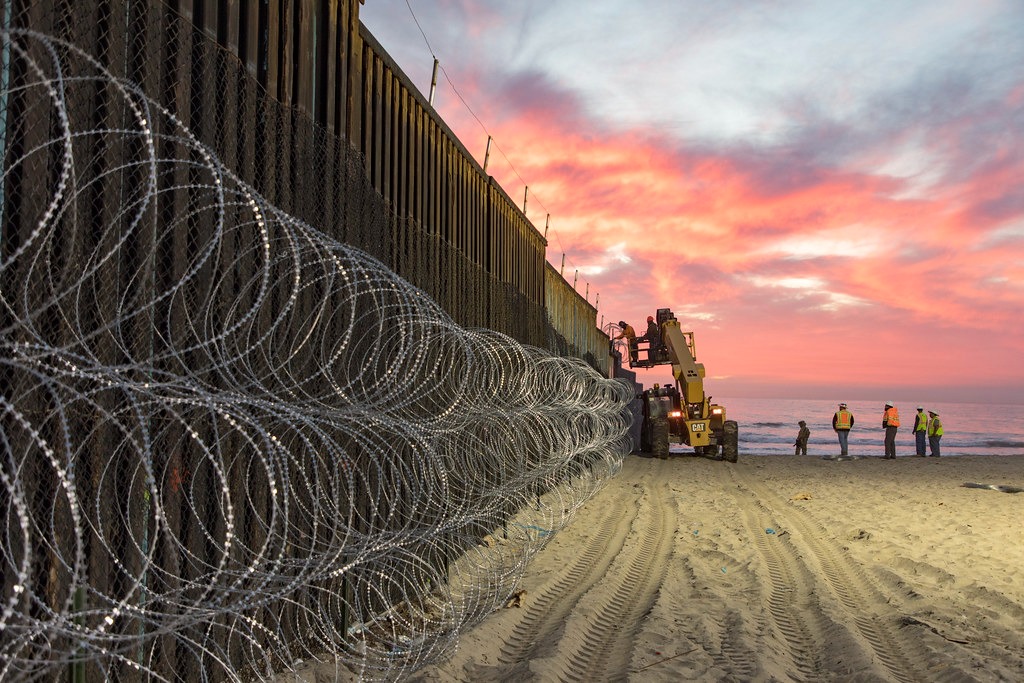
India’s Four-Pronged Smart Border Security Grid
- About: India’s Four-Pronged Smart Border Security Grid is an integrated border management framework.
- It was announced by the Ministry of Home Affairs (MHA) to transform border security from a reactive to a proactive, technology-driven territorial security model.
- Objective: It is a unified operational network to achieve zero infiltration and rapid threat response.
- The primary objective is to build a resilient, and intelligence-led border ecosystem capable of preventing terrorism, cross-border infiltration, and demographic manipulation.
- Framework: The framework establishes a Quadrangular Security Grid.
- It comprises Border Guarding Forces (BSF/ITBP/SSB/Assam Rifles as applicable), State & District Administration (District Magistrates and Superintendents of Police), Central agencies (IB, NCB, CBDT and other ministries), and local border communities.
- Each stakeholder performs complementary responsibilities, creating a multi-layered territorial security architecture.
- Coordination Mechanism: The model institutionalises real-time intelligence sharing, joint planning, unified command during emergencies, and coordinated policing.
- District Superintendents of Police act as key coordinators, ensuring rapid information flow between border forces, intelligence agencies and civil authorities.
- BSF and other border guarding forces remain the first operational layer, responsible for surveillance, interdiction, patrols, border dominance and immediate tactical response against infiltration.
- District administrations and border residents become active security partners through reporting suspicious activities, supporting development programmes, strengthening social resilience.
- Features: The Smart Border Project integrates AI-enabled surveillance, anti-drone systems, radars, smart cameras, sensors, satellite-based monitoring, secure communications and smart fencing, especially across riverine, forested and marshy terrain.
- The project initially targets nearly 6,000 km of vulnerable international borders where technology can significantly improve detection.
- Priority is being given to completing vulnerable fencing, particularly along the India–Bangladesh border.
- In West Bengal, about 1,647.7 km of the 2,216.7 km border (≈74%) had been fenced by August 2025, while 456.2 km remained feasible and 112.8 km non-feasible due to terrain constraints.
- The BSF, NCB, CBDT, Intelligence Bureau, police and district authorities are dismantling networks linking illegal infiltration, narcotics trafficking, terror financing, encroachment, fake identities, shell companies and mule bank accounts, strengthening internal security simultaneously.
- District Magistrates and SPs are implementing a 360-degree security framework, including demolition of unauthorized constructions within 0–15 km of international borders, and verification of businesses.
- It complements projects such as the ₹31,000-crore India–Myanmar border fencing initiative, strengthening India’s long-term internal and external security architecture.
Need for India’s Four-Pronged Smart Border Security Grid
- Securing Pakistan Border: India’s 3,323 km border with Pakistan traverses deserts, marshes, riverine stretches and the Line of Control (LoC), creating persistent surveillance challenges.
- Areas such as Sir Creek and the Rann of Kutch remain difficult to monitor continuously, necessitating AI-enabled surveillance to counter infiltration, cross-border terrorism and drone-based smuggling.
- Managing China Frontier: The 3,488 km Line of Actual Control (LAC) is undemarcated, passes through high-altitude Himalayan terrain, and experiences extreme weather that limits conventional patrolling.
- Smart surveillance, satellite monitoring and real-time inter-agency coordination are essential for rapid response in sensitive sectors like Galwan and Arunachal Pradesh.
- Addressing Bangladesh Border Vulnerabilities: India’s 4,096.7 km border with Bangladesh is the country’s longest land boundary, crossing rivers, floodplains and densely populated areas.
- Large unfenced and riverine stretches facilitate illegal migration, cattle and narcotics smuggling, requiring technology-based monitoring beyond conventional fencing.
- Strengthening Myanmar Border: The 1,643 km India–Myanmar border passes through dense forests and rugged hills.
- Ongoing instability in Myanmar has increased risks of illegal arms, narcotics trafficking and insurgent movement, reinforcing the need for smart fencing, and integrated border governance.
- Monitoring Open Nepal Border: India shares a 1,752 km open border with Nepal, permitting visa-free movement.
- While beneficial for people-to-people ties, it also creates opportunities for fake currency, human trafficking, illegal trade and movement of criminal networks, demanding intelligence-led monitoring.
- Protecting Bhutan Border: The 699 km India–Bhutan border is peaceful but largely mountainous and forested.
- Improved surveillance is required to prevent cross-border wildlife crime, timber smuggling and movement of insurgent groups, while preserving seamless bilateral cooperation.
- Combating Asymmetric Threats: Traditional fencing cannot stop low-flying aerial drones used by adversaries to smuggle weapons, fake currency, and narcotics.
- The new Smart Border Project deploys AI-powered anti-drone systems, high-resolution cameras, and early warning networks to neutralize these modern hazards in real-time.
- Curtailing Illegal Infiltration: Unchecked illegal migration causes unnatural and sudden demographic shifts in border regions.
- Moving away from an isolated outpost strategy ensures that any abnormal population movement is reported immediately from the grassroots level to top command networks.
- Enhancing Trade Security: Security management is no longer strictly about restriction; it is also about facilitating secure trade.
- Integrating the grid with the newly launched Land Port Management System (LPMS – ‘VINIMAY’) provides a single digital platform for cargo, passengers, and vehicles.
- This eliminates 90% of physical paperwork while closing security loopholes during cross-border transit.
Government Initiatives for Smart Border Security
- Comprehensive Integrated Border Management System (CIBMS): The government is expanding the CIBMS, an integrated electronic surveillance architecture that combines ground sensors, infrared cameras, laser barriers, radar and automated command-and-control systems.
- The system provides 24×7 monitoring in difficult terrain where physical fencing alone is inadequate.
- Border Area Development Programme (BADP): It is a Centrally Sponsored Scheme under the Ministry of Home Affairs (MHA).
- Launched in 1986-87, it focuses on developing infrastructure and providing socio-economic opportunities to communities living within a 0 to 10 km aerial distance from the international border.
- It integrates remote, inaccessible border regions with the national hinterland.
- It builds trust and a sense of security among border populations, acting as a force multiplier for national security.
- It is currently implemented in 394 border blocks across 111 districts in 17 States (e.g., Rajasthan, Punjab, Gujarat, and the North-Eastern states) that share international land borders.
- Funds are provided to State Governments as 100% non-lapsable Special Central Assistance and are converged with other central and state schemes.
- BOLD-QIT Smart Fencing: The Border Electronically Dominated QRT Interception Technique (BOLD-QIT) secures riverine stretches of the India–Bangladesh border using laser beams, fibre-optic intrusion sensors, thermal imagers and CCTV surveillance.
- Integrated Check Posts (ICPs): Under the Land Ports Authority of India (LPAI), modern Integrated Check Posts are being developed with electronic cargo management, biometric immigration, customs integration and digital clearance systems.
- The government also launched the Land Port Management System (LPMS), introducing end-to-end digital workflows for cargo slot booking.
- Key ICPs managed by LPAI include:
- India-Pakistan: Attari and Dera Baba Nanak (Punjab)
- India-Bangladesh: Petrapole (West Bengal), Dawki (Meghalaya), Agartala, Sabroom, Srimantapur, Sutarkandi, Golakganj, and Mankachar
- India-Nepal: Raxaul & Jogbani (Bihar) and Rupaidiha (Uttar Pradesh)
- India-Bhutan: Darranga (Assam)India-Myanmar: Moreh (Manipur)
- Vibrant Villages Programme (VVP): The Vibrant Villages Programme develops villages along the northern international border by improving roads, telecom, electricity, healthcare, education and livelihood opportunities, ensuring sustained habitation.
- Its Phase I (2023) initially launched as a Centrally Sponsored Scheme to develop villages along the northern border with China (Arunachal Pradesh, Himachal Pradesh, Sikkim, Uttarakhand, and Ladakh).
- Phase II (VVP-II) was approved by the Union Cabinet and expanded as a 100% centrally funded Central Sector Scheme.
- It now covers 1,954 strategic villages across 17 States and Union Territories, targeting all international land borders (Pakistan, Nepal, Bangladesh, Bhutan, and Myanmar).
- VVP-II has an outlay of ₹6,839 crore (until FY 2028-29), with an allocation of roughly ₹3 crore per village.
FAQs:
1. What is India’s Smart Border Vision?
A technology-driven integrated border management strategy ensuring secure, intelligent and coordinated international borders.
2. What are the four pillars of the Smart Border security grid?
Border forces, central agencies, district administration, and border communities working in coordinated partnership.
3. Why has the government introduced the Smart Border Vision?
To prevent infiltration, terrorism, smuggling and emerging cross-border hybrid threats through integrated security.
4. How will technology improve border security in India?
Through AI, drones, radars, smart fencing, sensors and real-time surveillance.
5. Which border forces will implement the Smart Border strategy?
BSF, ITBP, SSB and Assam Rifles, supported by other security agencies.
6. What role will AI and surveillance systems play in border management?
They enable continuous monitoring, early threat detection and rapid operational response.
7. How will the Smart Border Vision strengthen national security?
By integrating technology, intelligence, governance and communities for proactive border protection.
Disclaimer: Information in this article is based on official announcements and public records. Regulations and implementation details may evolve over time.