Article 142 Supreme Court, SC Utilizes to Resolve Historical Disputes
| General Studies Paper II: Executive and Judiciary |
Why in News?
Recently, the Supreme Court (SC) invoked Article 142 and ordered the complete cancellation of FIRs registered across the country in connection with the student protests that took place between July 20 and July 25, 2026, following the nationwide NEET-UG 2026 paper leak controversy.
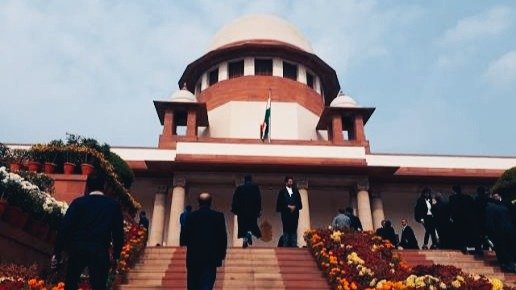
Article 142: Constitutional Basis, Provisions and Scope of “Complete Justice”
- Basis: Article 142 is contained in Part V, Chapter IV, dealing with the Union Judiciary.
- It specifically empowers the Supreme Court of India to pass orders necessary to secure “complete justice” in matters before it.
- It is an extraordinary constitutional power, not an ordinary statutory jurisdiction.
- Provisions:
- Article 142(1) authorises the Supreme Court to make any decree or order necessary for doing complete justice in any cause or matter pending before it.
- Such decrees and orders are enforceable throughout India in the manner prescribed by Parliament or, until then, as prescribed by the President.
- Article 142(2) gives the Supreme Court powers, subject to parliamentary law, concerning attendance of persons, discovery or production of documents, and investigation or punishment of contempt of itself.
- Article 142(1) authorises the Supreme Court to make any decree or order necessary for doing complete justice in any cause or matter pending before it.
- Complete Justice: Complete justice means justice that adequately resolves the particular dispute and prevents an otherwise unjust outcome.
- The Court can mould relief, balance competing equities and provide effective remedies when ordinary legal remedies are insufficient.
- It is therefore wider than merely applying a rigid procedural formula.
- The SC has repeatedly described Article 142 as curative in nature. Its purpose is not to create an unrestricted parallel legal system but to “iron out the creases” in exceptional cases.
- Article 142 cannot be interpreted as a licence to violate Fundamental Rights.
- It does not ordinarily permit the Court to ignore substantive statutory provisions.
- The Constitution Bench in Shilpa Sailesh v. Varun Sreenivasan clarified that Article 142 is bounded by fundamental considerations of general and specific public policy.
- These include Fundamental Rights, secularism, federalism and other basic constitutional features.
- It may sometimes operate where legislation has left a legal vacuum, but the Court cannot permanently assume the legislature’s role.
- In Shilpa Sailesh, the Court’s jurisprudence recognises judicial intervention to address gaps, while constitutional doctrine still requires respect for separation of powers.
| Note: Article 141 makes the law declared by the Supreme Court binding on all courts and Article 144 requires civil and judicial authorities to act in aid of the Supreme Court. |
Article 142 Invoked in Landmark Cases
- Prem Chand Garg v. Excise Commissioner (1963): In this case, the Court held that an order under Article 142 must remain consistent with Fundamental Rights and cannot override substantive statutory law.
- It established that extraordinary power still operates within the constitutional framework.
- A.R. Antulay v. R.S. Nayak (1988): The Constitution Bench emphasised that Article 142, despite its comprehensive language, cannot be exercised in a manner inconsistent with or repugnant to specific statutory provisions. It remains a crucial authority against unrestricted use of Article 142.
- Union Carbide Corporation v. Union of India — Bhopal (1989–1991): Following the 1984 Bhopal Gas Tragedy, the Supreme Court used its extraordinary powers in the settlement process.
- The settlement required Union Carbide to pay US$470 million. In 1991, the Court upheld the settlement but restored the criminal proceedings that had earlier been quashed as part of the settlement.
- Thus, Bhopal demonstrates both the breadth and later correction of Article 142.
- Supreme Court Bar Association v. Union of India (1998): The Court clarified that Article 142 cannot be used to supplant substantive law.
- In particular, the Supreme Court could not use Article 142 to suspend an advocate’s licence to practise law because that power belonged to the statutory disciplinary framework.
- Vishaka v. State of Rajasthan (1997): In the absence of comprehensive legislation dealing with sexual harassment at the workplace, the Supreme Court issued the famous Vishaka Guidelines.
- These operated until Parliament enacted the 2013 workplace sexual-harassment law.
- Parliament finally enacted the Sexual Harassment of Women at Workplace (Prevention, Prohibition and Redressal) Act, 2013 (often called the POSH Act).
- These operated until Parliament enacted the 2013 workplace sexual-harassment law.
- Vineet Narain v. Union of India (1997): The Court issued directions concerning the functioning and institutional independence of investigative agencies, particularly the CBI and related agencies.
- M. Siddiq (D) Thr. Lrs. v. Mahant Suresh Das — Ayodhya (2019): In the Ayodhya title dispute, the Supreme Court awarded the disputed property for the construction of a Ram temple based on its adjudication of the title claims.
- The Court awarded the 2.77-acre disputed land to the deity Ram Lalla after finding that the Hindu side’s evidence of continuous worship and possessory claim to the site was stronger. It directed the government to set up a trust for building a Ram temple.
- Simultaneously, invoking Article 142, it directed allotment of five acres of suitable land in Ayodhya to the Sunni Central Waqf Board for a mosque.
- The Court treated this as an element of restitution and complete justice.
- Shilpa Sailesh v. Varun Sreenivasan (2023): A Constitution Bench held that the Supreme Court can dissolve a marriage on the ground of irretrievable breakdown under Article 142, even without the mutual consent of both spouses, where the marriage is completely unworkable and dissolution is necessary for complete justice.
- NEET-UG Student-Protest FIR Decision (2026): In September 2026, a three-judge Bench headed by Chief Justice Surya Kant, with Justices Joymalya Bagchi and V. Mohana, invoked Article 142 concerning FIRs arising from student protests linked to NEET-UG 2026 examination irregularities.
- The Court quashed the FIRs placed before it and directed that other FIRs concerning the same protest incidents between 20–25 July 2026 should not be pursued or investigated and should be treated as closed.
- The order therefore had a pan-India practical effect concerning the specified incidents.
- The relief was not an unconditional amnesty for every participant. The Court permitted action concerning 2,873 persons identified by Delhi Police as having serious criminal antecedents.
- The Court also recorded the Central Government’s commitment to formulate a pan-India compensation policy/arrangement within 90 days for families of students who died by suicide in connection with the NEET-UG 2026 controversy.
- The Court quashed the FIRs placed before it and directed that other FIRs concerning the same protest incidents between 20–25 July 2026 should not be pursued or investigated and should be treated as closed.
Judicial Activism vs Judicial Overreach: Constitutional Debate
- Judicial Activism:
- Judicial activism refers to a proactive judicial approach in protecting constitutional rights, correcting governmental failures and providing remedies where existing legal mechanisms are inadequate.
- In India, PIL, expansive Fundamental Rights interpretation and remedial directions have contributed significantly to this approach.
- Article 142 permits the Court to address exceptional situations and sometimes fill temporary legal gaps, making it an important constitutional instrument for social justice.
- Where institutional reform remains pending for years, judicial directions can create minimum governance standards, protecting rule of law and administrative accountability.
- The judiciary fills critical vacuums to prevent governance paralysis and ensure institutional accountability.
- Judicial Overreach:
- Judicial overreach arises when judicial intervention moves beyond interpreting and enforcing law into effectively making policy or replacing legislative/executive choices.
- Critics argue that the frequent use of Article 142 results in judicial overreach into the domains of the Executive and Legislature, bypassing statutory procedures and violating the separation of powers.
- By filling legislative silences with broad directives (e.g., environmental guidelines), the Court risks acting as a de facto legislature.
- Recognizing misuse risks, the apex court ruled in Hitesh Bhatnagar vs. Deepa Bhatnagar (2011) that this power must be exercised with extreme care.
Frequently Asked Questions (FAQs):
1. What is Article 142 of the Indian Constitution and why is it important?
Article 142 empowers the Supreme Court to pass orders necessary for “complete justice” in matters pending before it.
2. What are the special powers of the Supreme Court under Article 142?
It can issue decrees or orders enforceable across India, including extraordinary remedies where ordinary legal provisions cannot adequately deliver justice.
3. Why did the Supreme Court use Article 142 to quash the CJP FIRs?
It protected the future prospects of bona fide student protesters, while excluding persons with serious criminal antecedents from blanket relief.
4. What does “complete justice” under Article 142 mean?
It means granting effective, equitable and comprehensive relief necessary to resolve a particular dispute and prevent substantial injustice.
Disclaimer: Information in this article is based on official announcements and public records. Regulations and implementation details may evolve over time.