Turkey Artemis Accords, Turkey Joined Global Space Exploration Group as 71st Member
| General Studies Paper III: Space Collaboration, International Space Agencies |
Why in News?
Recently, Türkiye formally joined the NASA-led Artemis Accords as the 71st member nation, strengthening space cooperation and scientific data-sharing.
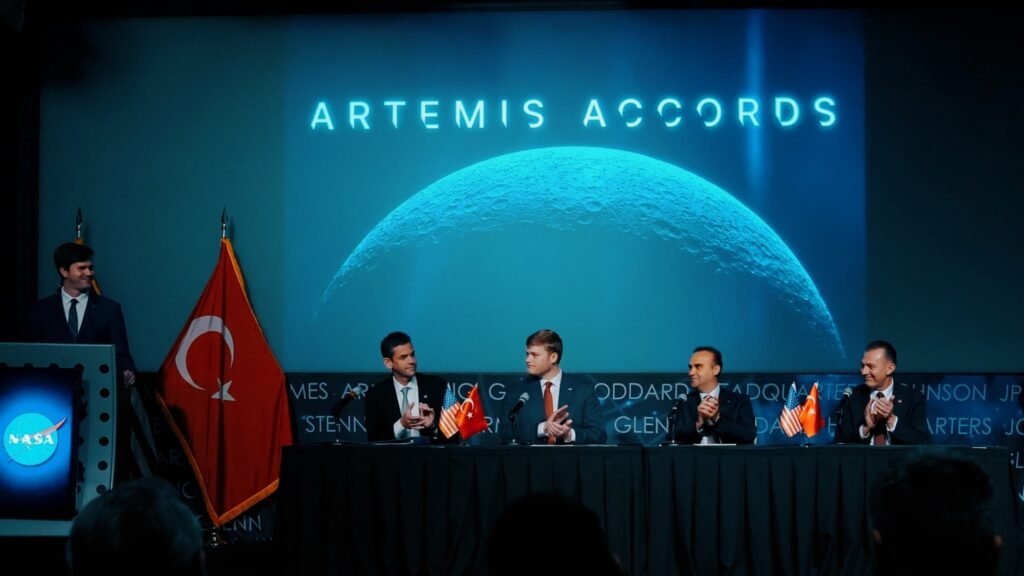
Türkiye Joins Artemis Accords- Highlights
- Signing: On 31 August 2026, Türkiye became the 71st Artemis Accords signatory, marking a significant expansion of the U.S.-led international framework.
- The signing took place at NASA Headquarters, Washington, D.C.
- Türkiye became the 7th Middle Eastern country to join these accords.
- Signatories: Mehmet Fatih Kacır, Türkiye’s Minister of Industry and Technology, signed on behalf of Türkiye.
- The ceremony was hosted by NASA Administrator Jared Isaacman, with U.S. State Department officials and Yusuf Kıraç, President of the Turkish Space Agency, present.
- Space Capability: The accession comes amid rapid development of Türkiye’s national space programme.
- In 2024, Alper Gezeravcı became Türkiye’s first astronaut, travelling to the ISS on Axiom Mission 3 and conducting scientific research.
- A second Turkish astronaut, Tuva Atasever, later participated in Virgin Galactic’s suborbital mission.
- In 2024, Alper Gezeravcı became Türkiye’s first astronaut, travelling to the ISS on Axiom Mission 3 and conducting scientific research.
- Lunar Ambition: Türkiye’s major lunar objective is AYAP-1 (Lunar Research Programme-1).
- The Turkish Space Agency states that the programme aims to send a spacecraft to the Moon using domestically developed technologies.
- It is intended to build national capabilities in deep-space navigation, propulsion, communications and autonomous spacecraft operations.
- Scientific Dimension: AYAP-1 is also developing international scientific cooperation.
- The Swedish Institute of Space Physics is contributing its Lunar Neutrals Telescope, designed to study interactions between the solar wind and lunar surface and investigate aspects of the lunar environment.
- Significance: Türkiye’s membership strengthens its position within the emerging international lunar exploration ecosystem.
- It can facilitate cooperation, technical partnerships and access to a wider network of countries pursuing lunar science and exploration.
- Türkiye is scheduled to host the International Astronautical Congress in Antalya in October 2026.
- Türkiye is a NATO member and has expanding technological relations with the United States.
- Its Artemis accession therefore connects national lunar ambitions and global space diplomacy.
What are Artemis Accords?
- About: The Artemis Accords are a non-binding set of principles governing responsible civil exploration and use of the Moon, Mars, comets and asteroids.
- They aim to make future space exploration peaceful, transparent, safe, sustainable and cooperative, while operating within existing international space law.
- Establishment: The Accords were established in 2020 by National Aeronautics and Space Administration (NASA) and the U.S. Department of State, together with seven other founding nations.
- Legal Foundation: The Accords are not a treaty and do not create legally binding obligations by themselves.
- They represent a political commitment and operationalise principles contained in the 1967 Outer Space Treaty (OST), while reinforcing the Registration Convention and Rescue and Return Agreement.
- Membership: The first eight founding signatories were Australia, Canada, Italy, Japan, Luxembourg, UAE, UK and USA, signing on 13 October 2020.
- Membership expanded rapidly: Ukraine joined in November 2020; South Korea, New Zealand and Brazil joined in 2021; Poland, Mexico, Israel, Romania, Bahrain, Singapore, Colombia, France and Saudi Arabia followed in 2021–22. Nigeria and Rwanda joined in December 2022.
- The membership widened significantly during 2023–24, including India, Ecuador, Argentina, Germany, Iceland, Netherlands, Bulgaria, Angola, Belgium, Greece, Switzerland, Slovenia, Lithuania, Peru, Slovakia, Armenia, Dominican Republic, Estonia, Cyprus, Chile, Denmark, Panama, Austria, Thailand and Liechtenstein. By December 2024, the total had reached 52.
- The expansion continued with Finland, Bangladesh, Norway, Senegal, Hungary, Malaysia and the Philippines in 2025, followed in 2026 by Portugal, Oman, Latvia, Jordan, Morocco, Malta, Ireland, Paraguay, Botswana, Serbia and Mauritius. Türkiye became the 71st signatory on 31 August 2026.
- Principles: The framework covers:
- Peaceful Purposes: All activities must be conducted exclusively for peaceful goals under international law.
- Transparency: Signatories must share their space exploration plans and policies openly to avoid friction.
- Interoperability: Nations should develop compatible systems and shared standards to improve safety.
- Emergency Assistance: Countries commit to rendering aid to personnel in distress, reinforcing the Rescue and Return Agreement.
- Registration of Objects: Signatories must register space objects to maintain clarity under the Registration Convention.
- Scientific Data Sharing: Open and timely public release of scientific data is mandatory.
- Preserving Outer Space Heritage: Historic landing sites, artifacts, and human heritage on celestial bodies must be protected.
- Space Resource Utilization: Extracting and utilizing resources must be sustainable and comply with the 1967 Outer Space Treaty without national appropriation claims.
- Deconfliction & Safety Zones: Nations must notify others of their operations and coordinate to prevent harmful interference.
- Orbital Debris Mitigation: Countries plan for safe spacecraft disposal and limit harmful orbital debris generation.
| Note: NASA’s Artemis Program is a human-spaceflight campaign targeting sustained lunar exploration, scientific discovery and preparation for future human missions to Mars. |
India and Artemis Accords
- Accession: India officially signed the Artemis Accords on 21 June 2023, becoming the 27th nation to join the framework.
- The signing ceremony was held at the InterContinental Willard Hotel in Washington, D.C.
- Taranjit Sandhu, India’s then Ambassador to the United States, signed the Accords on behalf of the Government of India.
- The U.S. side was represented by senior NASA, State Department, National Space Council and White House officials.
- India’s Objective: India’s accession reflects its commitment to sustainable, transparent and peaceful space activity.
- It complements India’s broader effort to expand international cooperation while retaining its emphasis on strategic autonomy and indigenous space capabilities.
- Significance:
- The Accords are particularly relevant to India’s growing lunar exploration programme. India’s Chandrayaan missions, especially Chandrayaan-3’s successful lunar landing, have strengthened its position as a major emerging lunar actor.
- Artemis participation can complement India’s scientific and technological engagement in future lunar exploration.
- India’s Artemis participation also has significance for human-spaceflight cooperation.
- Following the signing, India and the United States worked toward a strategic framework for human-spaceflight cooperation.
- This complements India’s Gaganyaan programme and broader human-spaceflight ambitions.
- India can benefit from cooperation centred on scientific information, interoperability, responsible operations and lunar exploration technologies.
- The framework can also support deeper interaction between ISRO, NASA and international research institutions.
- India’s membership strengthens its space diplomacy, expands cooperation, and gives India a platform to influence evolving norms for lunar activity.
- It also supports India’s ambition to emerge as a major spacefaring nation while maintaining its commitment to peaceful uses of outer space.
- The Accords are particularly relevant to India’s growing lunar exploration programme. India’s Chandrayaan missions, especially Chandrayaan-3’s successful lunar landing, have strengthened its position as a major emerging lunar actor.
Frequently Asked Questions (FAQs):
1. What are the Artemis Accords?
The Artemis Accords are non-binding principles promoting safe, peaceful, transparent and sustainable civil space exploration, especially Moon, Mars and beyond.
2. Why did Türkiye join the Artemis Accords?
Türkiye joined to strengthen international space cooperation, support its lunar ambitions, and participate in the growing global framework for responsible exploration.
3. When did Türkiye become the 71st member?
Türkiye became the 71st signatory on 31 August 2026, during a ceremony at NASA Headquarters in Washington, D.C.
4. What does Türkiye’s membership mean?
It integrates Türkiye more closely into international lunar exploration cooperation, while supporting peaceful, transparent and responsible space activities.
5. How does Türkiye’s space program benefit?
Membership can facilitate international partnerships, technological cooperation and lunar exploration opportunities, supporting Türkiye’s forthcoming AYAP-1 lunar mission.
6. What is NASA’s Artemis Program?
NASA’s Artemis Program is a human-spaceflight campaign targeting sustained lunar exploration, scientific discovery and preparation for future human missions to Mars.
Disclaimer: Information in this article is based on official announcements and public records. Regulations and implementation details may evolve over time.