



World Circular Economy Forum 2026: India’s Leadership in Sustainable Development
| General Studies Paper III: Conservation, Growth & Development |
Why in News?
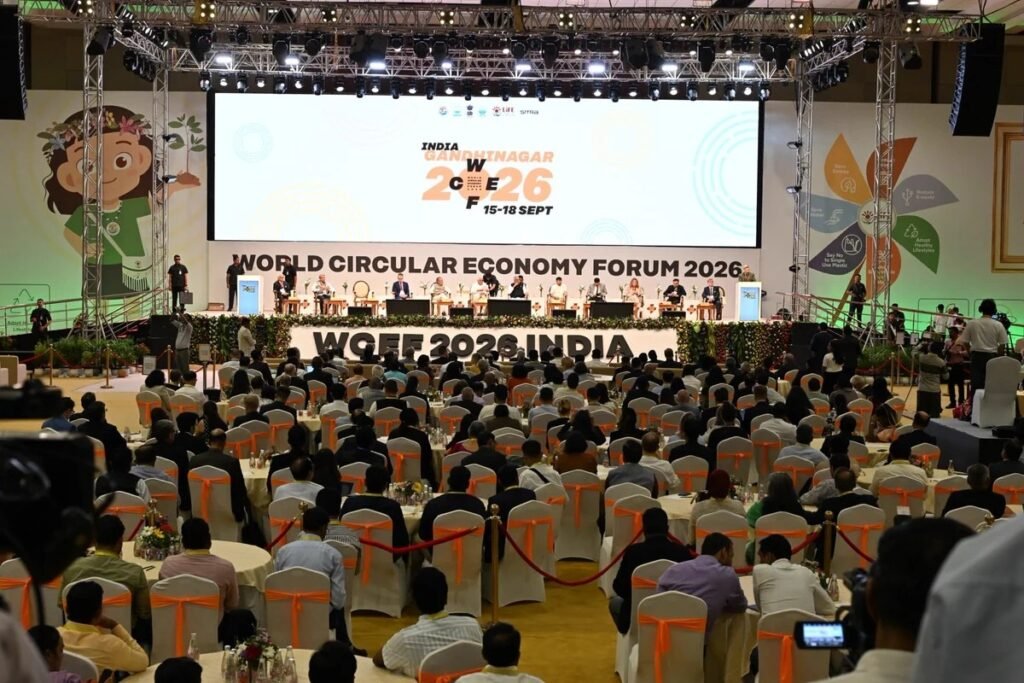
India is hosting the 10th World Circular Economy Forum 2026 (WCEF 2026) in Gandhinagar, Gujarat, from September 15–18, advancing India’s leadership in sustainable development.
World Circular Economy Forum (WCEF) 2026 — Highlights
- WCEF: The World Circular Economy Forum (WCEF) is a global platform bringing together governments, businesses, and innovators to accelerate the transition from a linear “take-make-waste” economy towards circular production and consumption.
- It was initiated by Finland’s Finnish Innovation Fund, Sitra, and has been organised annually since 2017.
- 2026 Edition: The 2026 edition marks the 10th milestone edition of WCEF.
- It is being held from 15–18 September 2026 in India.
- The main forum is being held at the Mahatma Mandir Convention and Exhibition Centre, Gandhinagar, Gujarat.
- It is the first WCEF in South Asia, giving the region greater visibility in global circular-economy discussions.
- Theme: The theme is “Circular Economy: Transition for People and Prosperity.”
- It connects environmental sustainability with economic opportunity, employment, innovation, resource security and inclusive development.
- Organisers: WCEF 2026 is jointly organised by Sitra and India’s Central Pollution Control Board (CPCB), with support from the Ministry of Environment, Forest and Climate Change (MoEFCC), alongside international and Indian partners.
- Participation: The forum has brought together 3,603 registered participants from 62 countries, including 2,293 delegates.
- The exhibition features 135 national and international exhibitors.
- Focus Areas: 10th WCEF is focused on discussions covering circular finance, AI, digitalisation, employment, energy, governance, sustainable products, industrial solutions, start-ups and youth leadership.
- Sessions also address circular value chains, digital product passports and international financing.
- A major emphasis is on helping Global South economies capture greater value from materials.
- Circular industries can strengthen local employment, economic resilience and material security.
- The forum examines how technology, finance, policy, business models and international cooperation can convert circular-economy concepts into scalable solutions.
- Particular attention is given to moving from policy formulation towards market transformation and implementation.
- Updates: The inauguration featured publications on reuse of treated sewage and India’s Circular Economy and Extended Producer Responsibility (EPR) initiatives.
- India is using WCEF 2026 to showcase its waste-management reforms, resource-efficiency initiatives, start-up ecosystem and circular technologies.
- The wider programme is also showcasing practical solutions, including circular models for solar value chains.
- Significance: Hosting WCEF places India and South Asia within a major global circular-economy dialogue.
- It provides opportunities for technology transfer, circular finance, investment, knowledge exchange and cross-border value chains, particularly relevant to developing economies.
What is Circular Economy?
- A circular economy seeks to replace the traditional take–make–dispose model with a system that keeps products and materials useful for as long as possible.
- It aims to design out waste, retain material value and reduce dependence on virgin resources.
- It operates on a hierarchical toolkit known as the 9R Framework (ordered from highest value retention to last-resort waste management):
- Refuse & Rethink: Abandon unnecessary products; make product use intensive via sharing or leasing platforms.
- Reduce: Optimize manufacturing processes to use fewer raw inputs, energy, and water.
- Reuse & Repair: Extend everyday product lifespans before they break down into systemic waste.
- Refurbish & Remanufacture: Restore or rebuild old/defunct parts to full operational status.
- Recycle & Recover: Process baseline materials into secondary raw feeds or harvest locked thermal energy as a final resort.
- Circularity gives priority to preventing waste at the design stage.
- Products should be durable, repairable, modular and recyclable so that their useful life can be extended and material recovery becomes easier.
- Circular business models include product-as-a-service, sharing platforms, repair and refurbishment, resale, industrial symbiosis and material recovery. These models shift attention from selling maximum quantities towards maintaining product and material value.
- In industrial symbiosis, one industry’s waste or by-product becomes another industry’s input.
- This can reduce disposal costs, virgin-resource consumption and industrial environmental impacts.
- Circularity can create new enterprises, employment, innovation and investment opportunities while reducing exposure to volatile raw-material prices and supply-chain disruptions.
- It can reduce resource extraction, waste generation, pollution, energy consumption and greenhouse-gas emissions, while supporting more sustainable production and consumption.
- Shifting to circular infrastructure in the construction sector alone can cut carbon emissions by roughly 40%.
- It stabilizes volatile supply chains, drops domestic production costs by an estimated 10–15%, and insulates resource-importing nations against geopolitical resource shocks.
- It directly advances SDG 12 (Responsible Consumption and Production), SDG 13 (Climate Action), and SDG 11 (Sustainable Cities).
- It can reduce resource extraction, waste generation, pollution, energy consumption and greenhouse-gas emissions, while supporting more sustainable production and consumption.
India’s Circular Economy: Institutional Framework, Policies & Initiatives
- Institutional Framework:
- India runs an expansive circular-economy policy stack managed by the Circular Economy Cell at NITI Aayog.
- It coordinates national strategy and oversees dedicated committees across 11 priority sectors.
- It released a critical trilogy of implementation roadmaps targeting End-of-Life Vehicles (ELVs), Waste Tyres, E-waste, and Lithium-ion batteries.
- NITI Aayog released India’s Resource Efficiency Strategy in 2017 with the objective of improving resource productivity and secondary raw-material utilisation.
- Priority areas included e-waste, steel, aluminium and construction-and-demolition waste.
- The Ministry of Environment, Forest and Climate Change (MoEFCC) is the primary legislative authority. It drafts and updates umbrella waste management mandates, establishes environmental standards, and operates the national Extended Producer Responsibility (EPR) frameworks.
- Central Pollution Control Board (CPCB) & SPCBs serves as the chief enforcement mechanism. The CPCB manages centralized compliance infrastructure, tracks statutory recycling targets, and manages the Unified EPR Registry Portal.
- Sector-specific implementation is distributed across specialized bodies, including the Ministry of Housing and Urban Affairs (MoHUA) for municipal solid waste, the Ministry of Steel for scrap recycling, and the Ministry of Road Transport and Highways (MoRTH) for vehicle scrapping rules.
- India runs an expansive circular-economy policy stack managed by the Circular Economy Cell at NITI Aayog.
- Policies:
- Extended Producer Responsibility (EPR) forms the backbone of India’s circular economy strategy.
- India enforces mandatory EPR under laws like the Plastic Waste Management Rules and the E-Waste Management Rules.
- It shifts the financial and physical burden of waste treatment from municipalities to manufacturers and importers.
- CPCB’s centralized registry issues tradeable EPR Certificates to verified recyclers, allowing producers to purchase compliance credits on the open market.
- The Plastic Waste Management Rules, 2016, together with subsequent amendments and EPR provisions, provide the regulatory framework for plastic waste management.
- The E-Waste (Management) Rules, 2022 introduced a strengthened EPR system, registration through an online mechanism and recycling obligations for producers.
- They also cover solar photovoltaic equipment and provide for EPR certificates and environmental compensation.
- The Battery Waste Management Rules, 2022 apply EPR to battery producers and cover EV, portable, automotive and industrial batteries.
- India has also established EPR frameworks for waste tyres and used oil, expanding circularity beyond conventional municipal waste.
- Extended Producer Responsibility (EPR) forms the backbone of India’s circular economy strategy.
- Initiatives:
- Mission LiFE promotes behavioural changes around resource conservation and sustainable consumption. It complements regulatory measures by addressing the demand side of circularity.
- During India’s G20 Presidency in 2023, resource efficiency and circular economy formed a major track of the Environment and Climate Sustainability Working Group.
- Themes included EPR, circular bioeconomy, circularity in steel and an industry-led Resource Efficiency Circular Economy Industry Coalition.
- Swachh Bharat Mission supports source segregation, waste collection and scientific waste management, creating essential infrastructure for material recovery and recycling.
- Swachh Bharat Mission (Urban) 2.0 focuses heavily on source segregation and remediating over 2,400 massive legacy dumpsites.
- Galvanizing Organic Bio-Agro Resources Dhan (GOBAR-Dhan) Scheme converts farm residue and animal bio-waste into compressed bio-gas (CBG) and organic compost.
- Relevance:
- India is heavily dependent on critical raw material imports. Reclaiming metals and minerals directly reduces macroeconomic vulnerability.
- Transitioning to a circular economy model is projected to unlock a $2 trillion market opportunity in India by 2050.
- Embracing circular practices accelerates India’s efforts to reach its Net-Zero targets by 2070.
Challenges, Opportunities and Way Forward for India
- Challenges:
- India’s expanding population, urbanisation and rising consumption increase demand for materials, energy and infrastructure.
- A predominantly linear consumption pattern can increase waste and resource pressures.
- Poor or inconsistent source segregation reduces the quality of recyclable materials and increases processing costs.
- Up to 80-90% of India’s recycling activities are carried out by informal waste pickers and scrap dealers (kabadiwalas).
- Advanced waste streams such as e-waste, batteries, solar modules and composite materials require specialised recycling technologies.
- Circular projects face difficulties in obtaining affordable finance because revenue models may be uncertain.
- High GST rates on formal recycling inputs often penalize official recyclers compared to informal, un-taxed operations.
- India’s expanding population, urbanisation and rising consumption increase demand for materials, energy and infrastructure.
- Opportunities:
- Circular activities can generate employment in repair, refurbishment, recycling, remanufacturing, logistics, waste processing and digital services, especially when supported by skill development.
- Urban mining and recycling can recover materials from electronic products, batteries and renewable-energy equipment, potentially reducing dependence on imported virgin resources.
- Using secondary materials can improve resource security and supply-chain resilience while reducing exposure to fluctuations in international commodity markets.
- India’s growing start-up ecosystem can develop solutions involving waste-to-value technologies, material marketplaces, repair platforms, recycling technologies and digital traceability.
- Way Forward:
- Formulate a Unified Legislative Framework: Pass a dedicated National Resource Efficiency and Circular Economy Act to bridge fragmented sectoral policies across disparate ministries.
- Formalize the Informal Waste Ecosystem: Create public-private partnership (PPP) models that integrate informal waste workers into modern municipal networks as formal collection partners.
- Deploy Rationalized Fiscal Incentives: Lower GST rates on formal scrap materials and introduce production-linked incentives (PLI) specifically for equipment manufacturers utilizing minimum thresholds of secondary recycled content.
- Mandate Green Public Procurement (GPP): Require state and central government departments to prioritize buying goods made from recycled components, giving eco-friendly manufacturing a guaranteed market base.
Frequently Asked Questions (FAQs):
1. What is the World Circular Economy Forum 2026?
WCEF 2026 is the 10th global forum advancing circular-economy solutions through policy, innovation, finance and international cooperation.
2. When is World Circular Economy Forum 2026 in Gandhinagar?
WCEF 2026 is being held from 15–18 September 2026, with the main programme on 15–16 September.
3. Where is WCEF 2026 being held?
The main forum is being held at Mahatma Mandir Convention and Exhibition Centre, Gandhinagar, Gujarat.
4. What is the theme of World Circular Economy Forum 2026?
Its theme is “Circular Economy: Transition for People and Prosperity,” focusing on scalable circular solutions and resource efficiency.
5. Why is India hosting WCEF 2026?
India hosts WCEF to showcase circular-economy initiatives, strengthen global cooperation, mobilise finance and advance innovation and technology.
6. Who will participate in World Circular Economy Forum 2026?
Participants include policymakers, businesses, entrepreneurs, researchers, innovators, academicians and changemakers from over 60 countries.
Disclaimer: Information in this article is based on official announcements and public records. Details may evolve over time.