



Centre Amends Passport Rules: What Changes in India’s Updated Child Passport Regulations?
| General Studies Paper II: Government Policies & Interventions |
Why in News?
Recently, the Ministry of External Affairs (MEA) notified the Passports (Amendment) Rules, 2026, changing the validity period for children’s passports and revising application fees.
What are the Passports (Amendment) Rules, 2026?
- About: The Passports (Amendment) Rules, 2026 are subordinate legislation made by the Central Government to amend the Passports Rules, 1980.
- It governs operational aspects of passport issuance, including fees, validity and travel-document administration.
- Amendments:
- Child Validity: The later notification, G.S.R. 820(E), was issued on 15 September 2026. It amended Rule 8(1) concerning fees and, Rule 12(1A).
- The amended Rule 12(1A) provides that an ordinary 36-page passport for a child below 15 years remains valid for five years from issue or until the child turns 18, whichever is earlier.
- It came into force upon publication in the Official Gazette on September 17, 2026.
- Fee Revision: The first notification, G.S.R. 516(E), was dated 20 June 2026 and substituted Schedule IV of the Passports Rules, 1980. It revised the fee schedule for passports and travel documents, with effect from 1 July 2026.
- For applicants 18 years and above, and minors aged 15–18 years applying under the full-validity category, a 36-page ordinary fresh passport or reissue costs ₹2,500. The corresponding Tatkaal fee is ₹5,000, inclusive of normal fee.
- A 60-page ordinary fresh passport or reissue costs ₹3,500, while the corresponding Tatkaal fee is ₹6,000. These rates apply to the adult/full-validity category specified in Schedule IV.
- For an ordinary replacement of a lost or damaged 36-page passport, the fee is ₹5,000, while the corresponding Tatkaal fee is ₹7,500. For a 60-page passport, the ordinary fee is ₹6,000 and Tatkaal fee ₹8,500.
- For minor applicants below 18 years, the ordinary 36-page fresh passport or reissue costs ₹1,750, while the corresponding Tatkaal fee is ₹4,250. The schedule separately provides ₹4,250 ordinary and ₹6,750 Tatkaal for replacement of a lost or damaged 36-page minor passport.
- The revised Schedule IV also covers Emergency Certificates and Certificates of Identity. An Emergency Certificate carries a fee of US$15 abroad, while a Certificate of Identity costs ₹1,000 in India or US$50 abroad.
- The Schedule provides ₹750 in India or US$40 abroad for specified miscellaneous services, including Police Clearance Certificate, Surrender Certificate and Global Entry Programme verification, among other passport-based certificates.
- A 10% discount applies to fresh passport applications, but not reissues, for minors up to eight years and senior citizens above 60 years. This distinction is important: the concession is tied to fresh applications.
- Child Validity: The later notification, G.S.R. 820(E), was issued on 15 September 2026. It amended Rule 8(1) concerning fees and, Rule 12(1A).
Passport: Meaning, Legal Framework, and Types
- Meaning: A passport is an official travel document issued by a State to its citizens or eligible persons, establishing identity and nationality for international travel.
- In India, citizens departing or intending to depart from India generally require a valid passport or prescribed travel document.
- Framework: The principal legislation governing Indian passports is the Passports Act, 1967, providing statutory framework for passports and travel documents.
- The Passports Rules, 1980 provide detailed administrative and procedural provisions.
- Rule-Making Power: The Central Government derives rule-making authority from Section 24 of the Passports Act, 1967.
- The Ministry of External Affairs administers the passport framework through the Passport Seva Programme Division and the Central Passport Organization.
- Passport Offices, Passport Seva Kendras and Post Office Passport Seva Kendras form the principal service-delivery network.
- The Ministry of External Affairs administers the passport framework through the Passport Seva Programme Division and the Central Passport Organization.
- Types: India issues different passports and travel documents, including:
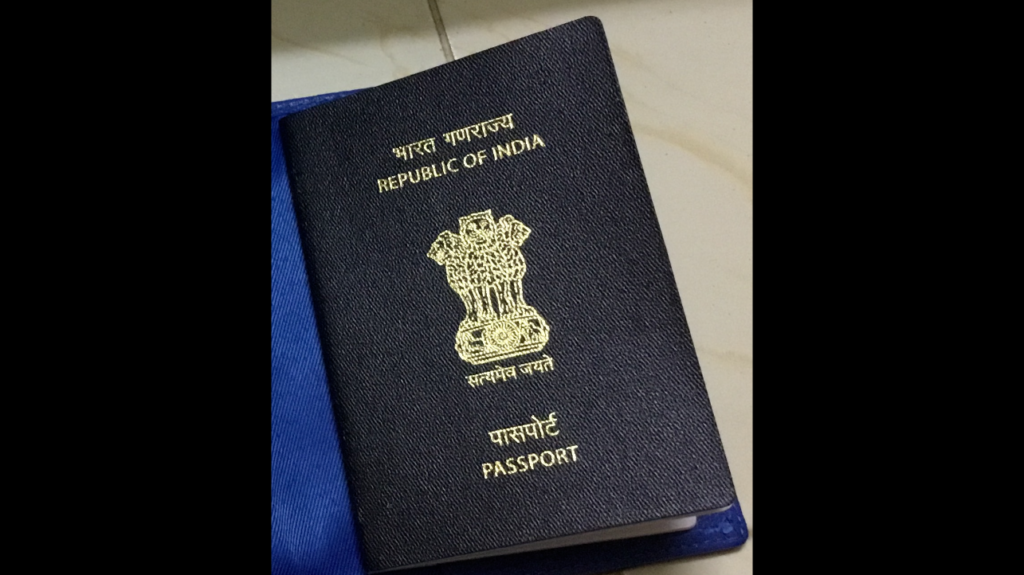
- The ordinary passport, commonly associated with the blue passport booklet, is issued to ordinary Indian citizens for international travel.
- Its standard validity for eligible adults is generally 10 years, subject to the applicable rules and category.
- Diplomatic and Official passports are issued in connection with eligible government officials undertaking official assignments or visits abroad.
- Official passports have a white cover. It is given to government officials and employees.
- Diplomatic passports have a maroon cover. It is reserved for Indian diplomats, members of parliament, and high-ranking officials representing the country internationally.
- Their validity is generally five years or less, depending upon the holder’s position and the nature of the assignment.
- The ordinary passport, commonly associated with the blue passport booklet, is issued to ordinary Indian citizens for international travel.
- Minor or Children Passport: For passport issuance purposes, any individual below 18 years of age is legally classified as a minor.
- Children cannot have their names endorsed in their parents’ passports.
- The fundamental prerequisite for eligibility is that the child must be a citizen of India, adhering strictly to the Passports Act, 1967 and the Citizenship Act, 1955.
- Minor applicants within this age bracket are granted a dual choice: they can either opt for a passport valid until they attain 18 years of age or apply for a full-validity passport (10 years).
- If the 10-year validity option is selected, the application is subjected to standard adult-level police verification protocols and fee schedules.
- Children below the age of five are fully exempted from submitting biometric data.
- Once a minor crosses five years of age, their biometric information must be recorded at the PSK.
- Passport Seva System: The Passport Seva Programme uses an integrated administrative system involving passport authorities, police verification, India Post and other government stakeholders.
- A fresh passport is generally sought when the applicant has never previously held a passport in that category.
- Reissue applies where an existing passport needs replacement, including circumstances such as expiry, change in particulars or other specified grounds.
- Tatkaal is the expedited passport-service mechanism under which applicants pay the applicable Tatkaal-inclusive fee for eligible services.
- An Emergency Certificate (EC) is a travel document used in specified circumstances, particularly to facilitate return to India when an ordinary passport cannot be issued or used.
- A Certificate of Identity is a travel document associated particularly with persons who are not citizens and cannot obtain a national passport, subject to the applicable Indian rules and international travel requirements.
Significance of the Passports (Amendment) Rules, 2026
- Greater Mobility for Children: The revised Rule 12(1A) replaces the earlier age ceiling of 15 years. This reduces repeated passport applications during adolescence.
- Longer potential validity can reduce the frequency of passport renewals, documentation and appointments for eligible children.
- This is relevant because India’s Passport Seva system handled 1.59 crore passports and other services in 2025, including 1.40 crore in India and 18.93 lakh abroad.
- Strengthening Citizen-Centric Digital Governance: The revised Schedule IV introduces updated fees. The revised framework covers not only passports but also Global Entry Programme verification.
- This reflects an integrated approach to contemporary international mobility and identity-related services.
- The scale—over 1.59 crore services in 2025—demonstrates why streamlined rules, standardised fees and predictable validity periods matter for large-scale public-service delivery.
- The increased revenue directly funds the rollout of the upgraded Passport Seva Programme (PSP) Version 2.0 and the full transition to advanced, chip-enabled biometric e-passports.
Frequently Asked Questions (FAQs):
1. What are the new Child Passport Rules 2026 in India?
Ordinary 36-page passports for children below 15 are valid for five years or until age 18, whichever is earlier.
2. How long is a passport valid for a child below 15 years?
It is valid for five years from issuance or until the child turns 18, whichever occurs first.
3. When did the new Minor Passport Rules come into effect?
The amendment came into force upon publication in the Official Gazette on September 17, 2026.
4. Does a child passport remain valid until the child turns 18?
Not always. It remains valid until 18 only if five years have not elapsed earlier; whichever condition occurs first applies.
5. What is the new passport fee for children in India?
The normal 36-page minor passport fee is ₹1,750; Tatkaal costs ₹4,250, before any applicable discount.
6. Do minor children need a separate passport in India?
Yes. Each minor requires an individual passport for international travel; children cannot simply travel using a parent’s passport.
Disclaimer: Information in this article is based on official announcements and public records. Details may evolve over time.
| Also Read: Indian Passport Ranking Improves in 2025 |