



India’s 51st Doppler Weather Radar in Sambalpur, Advancing India’s Climate Monitoring
| General Studies Paper III: Weather Forecasting, Indigenization of Technology |
Why in News?
Recently, India’s 51st Doppler Weather Radar (DWR) was inaugurated in Sambalpur, Odisha, boosting regional disaster preparedness and real-time weather forecasting.
What is Doppler Weather Radar (DWR)?
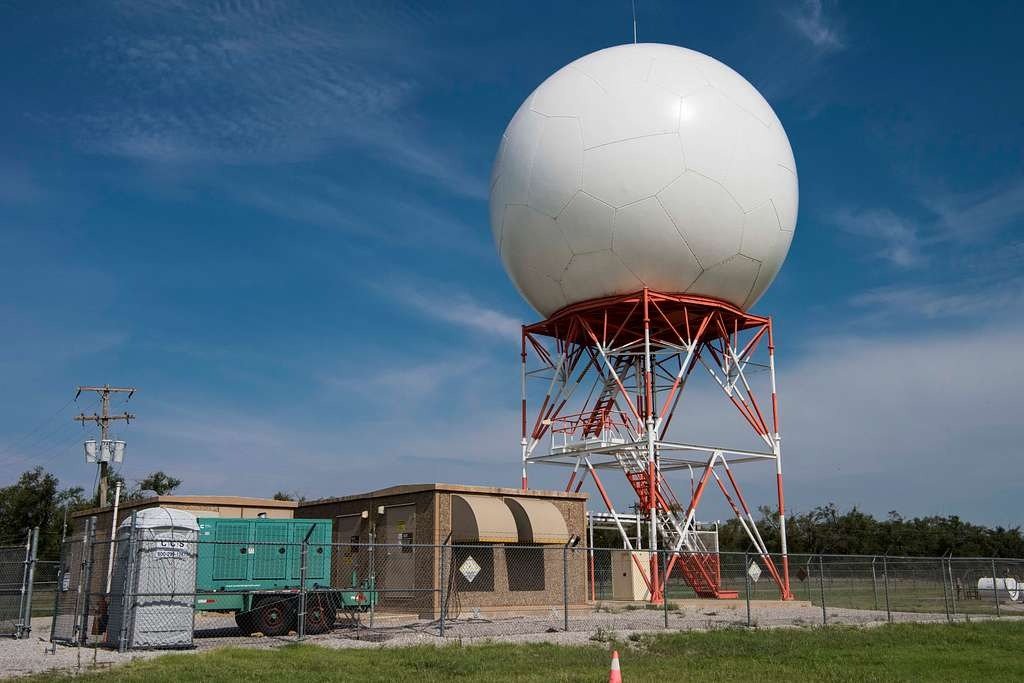
- About: A Doppler Weather Radar (DWR) is an advanced meteorological radar (radio detection and ranging) that uses the Doppler effect to detect precipitation and measure the radial velocity of hydrometeors such as raindrops, snowflakes and hail.
- It can determine the location and intensity of precipitation, the movement of particles toward or away from the radar.
- Note: The Doppler effect refers to the change in observed frequency caused by relative motion between the radar and atmospheric targets.
- In weather radar, this frequency shift enables measurement of radial wind velocity.
- Note: The Doppler effect refers to the change in observed frequency caused by relative motion between the radar and atmospheric targets.
- It can determine the location and intensity of precipitation, the movement of particles toward or away from the radar.
- Objective: It is developed to provide high-resolution, real-time atmospheric observations for improving weather forecasts and early-warning systems.
- Radar observations are also assimilated into Numerical Weather Prediction (NWP) models, improving localized forecasting and disaster preparedness.
- Developed By: DWR has been designed and developed by ISRO and manufactured by Bharat Electronics Limited (BEL), Bengaluru.
- Nodal Agency: The India Meteorological Department (IMD) under the Ministry of Earth Sciences (MoES) is the principal operational agency responsible for India’s meteorological radar network.
- Technology: Modern advanced radars can use dual polarization, transmitting and receiving electromagnetic waves in two polarization orientations.
- Working Mechanism:
- A DWR transmits microwave pulses into the atmosphere through a rotating antenna.
- When these electromagnetic waves encounter precipitation particles, part of the energy is reflected back as an echo.
- The radar analyses the returned signal to determine the particles’ distance, intensity and movement.
- The Doppler frequency shift indicates the particles’ radial velocity, while successive scans reveal the evolution of weather systems.
- Sophisticated processing converts these signals into products such as reflectivity, velocity, rainfall intensity and precipitation accumulation.
- Types: Doppler weather radars are categorized into L, S, C, X, and K bands based on their operating wavelengths and frequencies:
- L-Band operates at a wavelength of 15–30 cm and a frequency of 1–2 GHz. It is primarily used for clear-air turbulence studies and long-range surveillance.
- S-Band operates at a wavelength of 8–15 cm and a frequency of 2–4 GHz. It is ideal for both near- and far-range weather observation.
- C-Band operates at a wavelength of 4–8 cm and a frequency of 4–8 GHz. It is widely used for short-range weather monitoring and tracking developing cyclones.
- X-Band operates at a wavelength of 2.5–4 cm and a frequency of 8–12 GHz. Its tiny wavelength makes it highly sensitive to small particles like cloud droplets and light snow.
- K-Band operates at a wavelength of roughly 0.75–1.2 cm and a high frequency of 12–40 GHz. It features extreme sensitivity for detecting minute cloud particles.
- Features:
- Operational Range: This radar provides highly accurate data (at a resolution of 150 metres) within a range of 250 kilometres .
- It can provide general monitoring of developing weather systems up to 450 km.
- Real-time Updates: This system updates data every 10 minutes without interruption, allowing meteorologists to detect rapid changes immediately.
- Nowcasting Capability: It is capable of issuing ‘nowcasting’ i.e. short-term accurate forecasts for events occurring within the next 2 to 6 hours (such as sudden heavy rain or storm).
- Indigenous Development: This is a ‘Make in India’ establishment based entirely on indigenous technology.
- India has progressively developed indigenous radar capability.
- S-band Doppler Weather Radar was designed, developed and installed at Sriharikota in 2004 under an MoU with ISRO and the Department of Space.
- India’s first indigenous radar for detecting winds and thunderstorms had been developed at Safdarjung, Delhi, in 1958.
- Operational Range: This radar provides highly accurate data (at a resolution of 150 metres) within a range of 250 kilometres .
- Applications: DWRs support cyclone tracking, thunderstorm detection, rainfall estimation, hail warnings, flood forecasting, agriculture, hydrology and disaster management.
- Their observations can help estimate storm intensity and movement and contribute to safer navigation of aircraft and ships.
- In hydrology, radar-derived rainfall information can support catchment and reservoir management, particularly when integrated with other observations.
- Limitations: Radar observations do not independently provide a complete picture of the atmosphere.
- Terrain blockage, beam geometry, attenuation, anomalous propagation and limited low-level visibility can affect observations.
India’s 51st Doppler Weather Radar at Sambalpur
- Inauguration: India’s 51st Doppler Weather Radar was virtually inaugurated at Sambalpur, Odisha, on 17 September 2026 by Union Minister of State (Independent Charge) for Earth Sciences Dr. Jitendra Singh, in the presence of Odisha Chief Minister Mohan Charan Majhi.
- The facility is part of India’s expanding weather-observation infrastructure under Mission Mausam.
- Mission Mausam is a transformational ₹2,000 crore initiative launched by the Ministry of Earth Sciences, Government of India, to make the country weather-ready and climate-smart.
- India’s DWR network has expanded from 14 radars in 2014 to 51 in 2026, with further expansion planned.
- The facility is part of India’s expanding weather-observation infrastructure under Mission Mausam.
- Radar Type: The Sambalpur facility is a C-band Doppler Weather Radar and has been described by the Odisha Government as a state-of-the-art “Make in India” DWR.
- This is the third Doppler radar in Odisha, before this radars were operational in Paradip and Gopalpur.
- Significance: Its establishment expands radar-based observation from Odisha’s coastal belt into western and interior Odisha.
- It is particularly significant for Western Odisha and adjoining regions, improving monitoring of rainfall, thunderstorms, lightning, hailstorms and other severe weather systems.
- This will provide direct coverage to 13 districts in Odisha. It can benefit districts including Sambalpur, Bargarh, Jharsuguda and Sundargarh.
- This radar will accurately assess rainfall in the Hirakud Reservoir catchment area. This will bring greater accuracy to flood control planning and dam release decisions.
- It will also extend coverage to neighboring states such as Northern Chhattisgarh, Southern Jharkhand and parts of West Bengal.
- Accurate advance information about pre-monsoon storms and cyclonic rains will help farmers in Mahanadi Basin to protect their crops.
- Under ‘Mission Mausam’, it strengthens the country’s Layered Observation System, which is essential for aviation, power grid management and urban planning.
Frequently Asked Questions (FAQs):
1. Where was India’s 51st Doppler Weather Radar inaugurated?
India’s 51st DWR was inaugurated at Sambalpur, Odisha, strengthening weather monitoring across western Odisha.
2. When was the Sambalpur Doppler Weather Radar inaugurated?
The Sambalpur DWR was inaugurated on 17 September 2026, virtually by Union Minister Dr. Jitendra Singh.
3. What is the purpose of India’s 51st Doppler Weather Radar?
It aims to improve localized forecasting, severe-weather monitoring and timely early warnings for thunderstorms, lightning and heavy rainfall.
4. How will the Sambalpur Weather Radar help Odisha?
It will improve rainfall estimation, weather alerts, disaster preparedness, agriculture and Hirakud Reservoir water-inflow management.
5. How many Doppler Weather Radars does India have in 2026?
India has 51 Doppler Weather Radars in 2026, up from 14 in 2014; about 40 more are planned.
Disclaimer: Information in this article is based on official announcements and public records. Details may evolve over time.
| Also Read: X-band Radar in Wayanad |