



PM Modi Tamil Nadu Projects: Chennai Metro Rail, Road Transport, Railways, Maritime Infrastructure Inauguration
| General Studies Paper II: Infrastructure Development, Growth |
Why in News?
Recently, Prime Minister Narendra Modi inaugurated and launched Tamil Nadu development projects worth over ₹13,000 crore, spanning Chennai Metro Phase II, highways, railway modernization, port infrastructure and logistics.
Highlights of PM Modi’s Tamil Nadu Development Projects
- Inauguration: Prime Minister Narendra Modi inaugurated and laid the foundation stones for massive infrastructure development projects across Tamil Nadu.
- The mega development projects were officially unveiled on October 11, 2026, during a ceremony held at the IIT-Madras campus in Chennai.
- The launch was led by Prime Minister Narendra Modi, who shared the stage with the newly minted Tamil Nadu Chief Minister C. Joseph Vijay and Governor RN Arlekar.
- The leaders jointly flagged off new transit services and reviewed the technological frameworks.
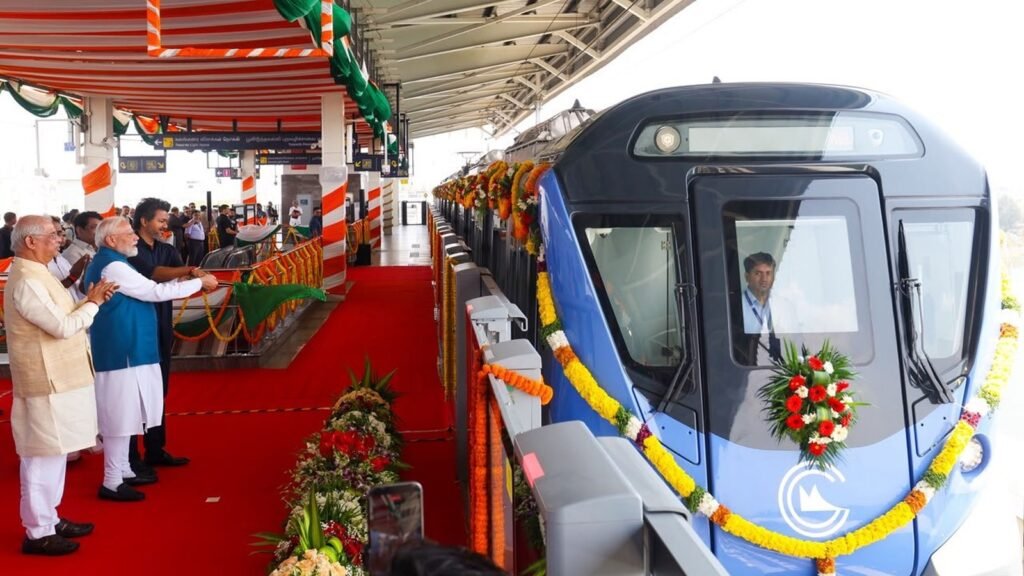
- Chennai Metro Rail: PM Modi inaugurated 14.64 km Poonamallee–Vadapalani elevated stretch, a crucial component of Chennai Metro Rail Project Phase II Corridor 4. It was built at an estimated cost of ₹4,900 crore.
- PM Modi and CM Joseph Vijay took a symbolic ride from the Porur Bypass station to experience the network.
- This advanced section comprises 11 elevated stations, incorporates a unique 3.7 km double-decker structure.
- It features state-of-the-art signalling designed for fully driverless operations to seamlessly link the city’s western suburbs to its core.
- Road and Railway Infrastructure: The transport sector received a significant boost with National Highway projects worth ₹3,700 crore, including the 36-km road upgrade in Virudhunagar and a 30-km ring road in Madurai to slash regional transit times.
- The Prime Minister also laid the foundation stone for the four-lane Thiruvarur Bypass on NH-83, connecting the Nagapattinam–Thanjavur corridor.
- PM Modi dedicated railway projects exceeding ₹750 crore, featuring the newly laid Karaikal–Peralam line and three rail flyovers in Coimbatore to eliminate hazardous level crossings.
- Five Amrit Bharat railway stations—located at Palani, Vellore Cantonment, Ambasamudram, Paramakkudi, and Namakkal—were officially opened after a comprehensive redevelopment.
- Maritime Infrastructure: At the Chennai Port, the PM inaugurated a Paved Storage Yard, four EXIM Godowns, an upgraded Cruise Terminal, and a Seafarers Club to expand container capacity.
- Investments also targeted Kamarajar Port and the V.O. Chidambaranar (VOC) Port in Thoothukudi, where a ₹517.19 crore container terminal was introduced as part of a larger plan to establish a world-class green energy and cargo handling hub.
- At Kamarajar Port, Coal Berth-3 was inaugurated and capital dredging for Container Terminal Phase I, Stage II, received a foundation stone.
- Petroleum and Industrial Infrastructure: PM laid the foundation stone for a Group II/III Lube Oil Base Stocks project at Chennai Petroleum Corporation Limited’s Manali Refinery.
- Costing approximately ₹1,620 crore, it is designed for a capacity of 270,000 metric tonnes per annum.
- The facility aims to manufacture premium-quality lubricant base stocks domestically, supporting industrial supply chains, reducing import dependence and creating employment opportunities.
Significance of PM Modi Tamil Nadu Projects
- Macroeconomic Growth Vision: The infusion of capital heavily bolsters Tamil Nadu’s targeted vision of becoming a $1.5 trillion economy by 2036. By fast-tracking industrial infrastructure, the Central government directly supports the state’s positioning as the second-largest economic contributor to India’s overall gross domestic product (GDP).
- Job Creation and Youth Empowerment: A vital highlight of this package is its massive employment generation potential for local youth. The rollout of multi-sectoral projects expands direct technical roles in construction and tech, while simultaneously driving extensive indirect labor opportunities across auxiliary service and engineering sectors.
- Boosting Global Manufacturing Infrastructure: The package aligns with national campaigns like Make in India and Vocal for Local. The enhanced logistics capability cements the state’s status as a top global manufacturing node for electronics and automotive engineering, accelerating its output capacity.
- Maximizing Blue Economy Efficiency: Maritime upgrades at the Chennai, Kamarajar, and VOC ports actively scale India’s international trade footprints. Drastically cutting down vessel turnaround times ensures that domestic products can reach highly competitive global markets much faster, saving millions in operational transit costs.
- Enhancing Urban Transport and Productivity: The expansion of the Chennai Metro Phase II provides reliable, rapid transit, directly reducing urban congestion. Lowering daily commute times directly translates to increased worker productivity and seamless daily travel.
- Strengthening Rural-Urban Economic Links: Upgrading critical corridors like the Madurai Ring Road and Virudhunagar highways optimizes the state’s freight movement networks. This eliminates logjams, smoothly linking agrarian markets and small-scale industries to major urban consuming zones and dispatch ports.
- Revolutionizing Regional Rail Connectivity: Dedicating redeveloped stations under the Amrit Bharat Station Scheme elevates passenger safety and modern comfort. Eliminating level crossings via new rail flyovers ensures faster turnaround times for freight trains, minimizing hazardous disruptions along major transit lines.
- Advancing Scientific Innovation: The launch of the advanced human brain mapping mission at IIT Madras positions India at the cutting edge of global medical tech. This research infrastructure fosters deeper public health breakthroughs.
How Tamil Nadu Fuels India’s Growth Engine?
- Macroeconomic Contribution: Tamil Nadu constitutes India’s second-largest state economy.
- The state contributes 9.4% to the national Gross Domestic Product (GDP).
- The nominal Gross State Domestic Product (GSDP) reached ₹35.29 lakh crore.
- The real economic growth recorded 10.83%, which exceeds the national average.
- The per capita income stands at ₹4.08 lakh, which is nearly double the national average.
- Industrial Powerhouse: The state generates 13.35% of India’s manufacturing GDP.
- Tamil Nadu hosts over 40,000 active factories, the highest volume in India.
- The state commands 45% of India’s automobile component exports. It produces 30% of the national automotive output.
- The secondary sector grew by 15.02%, driving local employment.
- Export Dominance: Tamil Nadu contributes 13.3% of India’s total merchandise exports. Total merchandise exports reached $59.30 billion.
- The state accounts for 41% of national electronics exports. It produces 38% of the country’s footwear exports.
- The textile industry handles 33.64% of India’s overall textile exports.
- The government utilizes an Export Promotion Council to diversify trade across advanced global networks.
- Strategic Ambitions: The administration targets a $1.5 trillion economy by 2036.
- This blueprint aligns with India’s Vision 2047 विकसित भारत goals.
- The state plans to expand electronics exports to $100 billion.
- The strategy prioritizes export diversification and export promotion.
- Infrastructure Projects: The government plans a dedicated Artificial Intelligence City named Arivagam.
- Authorities are establishing the Thoothukudi-Tirunelveli Space Industrial Investment Zone with INSPACe.
- Industrial parks receive ₹3,200 crore for SIPCOT expansions in backward districts. New Global Capability Center (GCC) hubs will elevate service technology.
- Tamil Nadu pitches the inter-state metro rail project to seamlessly connect the industrial hubs of Hosur and Bommasandra.
- The administration proposes the Chennai–Hyderabad and Chennai–Bengaluru high-speed rail corridors.
- Human Capital Mission: The state established the Youth Skill and Employment Mission.
- The program provides stipend-supported internships to 5 lakh youth annually. It trains youth in semiconductors, deep tech, and Artificial Intelligence. The initiative builds a future-ready workforce for global corporations.
- Green Energy Leadership: The state possesses 47.92 GW of total power capacity. Renewable energy sources contribute 27.25 GW to this total.
- Tamil Nadu develops green industrial clusters and green hydrogen pathways. The state targets long-term carbon neutrality.
- Innovation Initiative: The state drives global research by launching the Sudha Gopalakrishnan Brain Centre at IIT Madras.
- The project releases C-STROKE, which is world’s first unique atlas of the human brain affected by ischaemic stroke.
- It features over 1,000 annotated brain sections from a stroke-affected human brain.
- The complex three-dimensional digital reconstruction was mapped using India’s Param Shakti supercomputer.
Frequently Asked Questions (FAQs):
1. Which projects worth ₹13,000 crore did PM Modi inaugurate in Tamil Nadu?
Projects included Chennai Metro, national highways, railway modernisation, port infrastructure, and a domestic lubricant base-stock manufacturing facility.
2. What are the major highlights of PM Modi’s Tamil Nadu visit?
Major highlights included metro expansion, highway upgrades, railway connectivity, port modernisation, and foundation stones for new industrial infrastructure projects.
3. Which sectors will benefit from these development projects?
Transport, logistics, manufacturing, maritime trade, tourism, construction, petroleum, and allied services are expected to benefit from improved infrastructure.
4. What is the significance of these projects for Tamil Nadu’s infrastructure and economy?
They support economic growth, multimodal connectivity, industrial competitiveness, export efficiency, domestic manufacturing, and more sustainable urban and regional development.
Disclaimer: Information in this article is based on official announcements and public records. Details may evolve over time.