



IIT Bombay EV Battery Project: Institution Develops Power Supply Technology To Cut Electricity Bills
| General Studies Paper III: Environmental Pollution & Degradation, Sustainable Development |
Why in News?
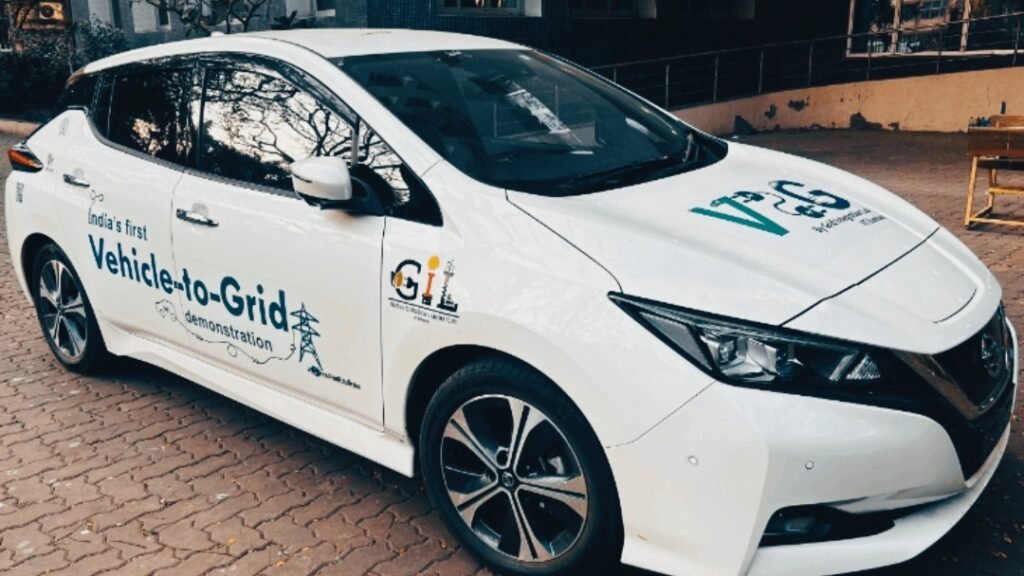
IIT Bombay advanced electric mobility through indigenous electric vehicles (EV) power-supply projects and battery technology, transforming electric vehicles into decentralized energy storage units.
IIT Bombay EV Battery Project
- Technology: The IIT Bombay EV Battery Project focuses on innovative Vehicle-to-Grid (V2G) and Vehicle-to-Home (V2H) technologies.
- V2H uses an EV battery to power a single house, while V2G feeds that energy back into the public utility network.
- It treats electric vehicles (EVs) as decentralized energy storage systems, allowing power to flow bidirectionally between the vehicle and the grid or home.
- IIT Bombay developed this project for the first time in the country.
- Developed By: This project is spearheaded by Prof. Zakir Hussain Rather along with his core research team at the Grid Integration Laboratory (GIL) within the Department of Energy Science and Engineering at IIT Bombay.
- Launched: The field trials and feasibility research progressed over a three-year experimental period at the IIT campus.
- The initial framework and pilot blueprints were formally submitted in November 2024.
- During the field trial, the setup successfully powered major household appliances like air conditioners.
- The integration demonstrated a significant 30% reduction in household electricity bills.
- The initial framework and pilot blueprints were formally submitted in November 2024.
- Working Principles: The system operates on bidirectional power flow.
- During off-peak daytime hours, the EV draws power to charge via Grid-to-Vehicle (G2V).
- During peak evening hours, the flow is reversed, converting the EV from a load into an active power source.
- The power supply integrates a smart framework linking rooftop solar PV installations, bidirectional converters, and household loads.
- The system manages EV charging loads efficiently while injecting up to 4 kW of power back into the grid.
- Feature: It includes intelligent demand response systems, congestion management, peak-load shaving, and Time-of-Use (ToU) tariffs that incentivize users to export energy during high-demand hours.
- The key innovation involves developing smart bidirectional chargers and communication layers that allow Indian EVs to inject electricity back into local networks safely.
- It incorporates algorithms that balance renewable energy integration.
- The key innovation involves developing smart bidirectional chargers and communication layers that allow Indian EVs to inject electricity back into local networks safely.
- MoU: The Kerala State Electricity Board (KSEB) signed a landmark Memorandum of Understanding (MoU) with IIT Bombay in July 2025.
- This initiates a two-phase pilot project connecting over 100 V2G-enabled EVs to stabilize Kerala’s grid and handle peak demand.
- Benefit: Field data proved that continuous V2H discharging causes no significant impact on battery health.
- State of Health (SoH) metrics dropped by a mere 1.5% after two years of usage.
- Limitation: EVs in India are not yet being designed for V2G due to a lack of a clear regulatory framework.
- Unlocking these cars requires installing custom hardware modifications currently being engineered by IIT Bombay.
Significance of V2G Technology for India
- Peak Demand Management
- India’s electricity demand spikes sharply during evening hours when solar generation drops and residential consumption peaks.
- V2G allows parked EVs to discharge energy back into the grid, helping distribution companies (DISCOMs) avoid costly peak-hour power purchases and reducing the risk of blackouts.
- Integration of Volatile Renewables
- India has an ambitious target of reaching 500 GW of non-fossil/renewable energy capacity.
- Because solar and wind are intermittent, V2G acts as a mobile storage medium to absorb surplus daytime solar energy and inject it back into the grid when generation is low (e.g., at night).
- Decentralized Energy Storage (Virtual Power Plants)
- Instead of relying solely on massive, capital-intensive centralized battery energy storage systems (BESS), millions of EV batteries function as a distributed virtual power plant.
- This reduces strain on high-voltage transmission lines and minimizes aggregate transmission and distribution (T&D) losses.
- Grid Stabilization & Ancillary Services
- V2G systems can provide real-time ancillary grid support, such as frequency regulation, voltage support, and phase balancing.
- This rapid response stabilizes the grid against sudden frequency deviations caused by load-generation mismatches.
- Energy Security & Disaster Resilience
- During natural disasters, extreme weather events, or localized grid failures, V2G-enabled EVs can serve as mobile emergency power units.
- They can supply critical backup power to essential infrastructure like hospitals, telecom towers, or remote households.
- Economic Incentives for EV Adoption
- V2G transforms EVs from depreciating assets into revenue-generating mobile assets.
- EV owners can charge their vehicles during cheap off-peak hours and sell stored electricity back to the grid during high-demand/high-tariff windows, accelerating India’s EV adoption curve.
- Alignment with Decarbonization & Net-Zero Goals
- By smoothing out renewable generation and providing peak support, V2G reduces the need to ramp up peaking thermal (coal-fired) power plants.
- This directly supports India’s broader pledge to achieve net-zero carbon emissions by 2070.
Challenges V2G Technology in India
- Regulatory and Policy Frameworks: Implementing V2G and V2H technologies in India faces severe headwinds due to the complete lack of a unified national policy.
- While the Central Electricity Authority (CEA) is consulting on reverse power flow guidelines, formal time-of-use (ToU) tariff frameworks and net-metering standards remain entirely unestablished.
- Grid Infrastructure and Discom Readiness: The Indian power distribution network is structurally unready for bidirectional flows. Less than 6% of state DISCOMs feature smart grid infrastructure capable of real-time demand response.
- High transmission losses and severe voltage fluctuations threaten overall grid stability when injecting power back into the utility lines.
- High Equipment and Hardware Costs: The hardware required for V2X systems imposes prohibitive financial barriers. Specialized bidirectional smart chargers cost up to three times more than standard units.
- Because India relies heavily on imported components for complex inverters and lithium-ion cells, local equipment scaling remains economically unviable.
- Battery Degradation and Warranty Risks: Accelerated lithium-ion battery degradation caused by continuous charging and discharging cycles deters prospective users.
- India’s harsh tropical climate further exacerbates thermal stress on cells during high-power extraction.
- Original equipment manufacturers (OEMs) refuse to extend battery warranties to cover vehicle-to-grid operations.
- Lack of Interoperability Standards: India lacks mandatory adherence to universal communication standards like ISO 15118-20 for vehicle-to-charger protocols and OCPP 2.0.1 for utility synchronization, resulting in severe cross-brand hardware compatibility problems.
- Urban Residential Constraints: Executing V2H is physically constrained by local housing infrastructure. Over 65% of urban EV consumers live in high-rise apartments lacking private parking slots or dedicated three-phase power connections.
Way Forward
- Formulate a National V2G Policy: The Ministry of Power and CEA must issue comprehensive guidelines for bi-directional metering, safety protocols, and grid-interconnection standards.
- Time-of-Use (ToU) Tariffs: Implement dynamic pricing across all DISCOMs so EV owners are automatically incentivized to charge during off-peak/solar-surplus hours and discharge during peak hours.
- Standardized Incentive & Credit Mechanisms: Introduce feed-in tariffs or electricity bill credits for EV owners who supply power back to the grid, mirroring successful frameworks in the UK and California.
- Smart Grid & Smart Meter Rollout: Accelerate the Revamped Distribution Sector Scheme (RDSS) to upgrade DISCOM automation, high-tension/low-tension (HT/LT) transformer monitoring, and real-time data analytics.
- Promote Domestic Manufacturing of Bi-Directional Chargers: Utilize Production Linked Incentive (PLI) schemes to scale local production of V2G hardware, driving down import costs.
- Scale Up Collaborative Pilots: Build on early initiatives like the Kerala State Electricity Board (KSEB) and IIT Bombay V2G pilot project to test real-world urban and semi-urban load profiles.
- Vehicle-to-Building (V2B) and Fleet First: Prioritize V2G deployment in captive commercial fleets (e.g., e-buses, logistics fleets, corporate campuses) before scaling to private passenger cars, as fleets have predictable idle hours and centralized management.
- Smart Battery Management Systems (BMS): Mandate AI-driven BMS software that limits deep discharge to preserve overall battery state-of-health (SoH).
- OEM-Assisted Warranties: Encourage Original Equipment Manufacturers (OEMs) like Tata Motors and others to design V2G-ready architectures that do not void battery warranties during grid-support operations.
Frequently Asked Questions (FAQs):
1. What is the IIT Bombay EV Battery Power Supply Project?
IIT Bombay’s project demonstrates bidirectional EV charging, enabling compatible electric vehicles to supply electricity to homes and potentially the grid.
2. How does IIT Bombay’s EV battery technology work?
A bidirectional charger controls electricity flow between an EV battery, household appliances and the grid, subject to compatibility and safety requirements.
3. What are the main objectives of the IIT Bombay EV project?
Its objectives include peak-load management, renewable-energy integration, demand response, grid resilience and evaluating battery health during bidirectional charging.
Disclaimer: Information in this article is based on official announcements and public records. Details may evolve over time.