


Chhonzin Angmo: First Blind Woman to Summit Mount Everest
| General Studies Paper I: Important Personalities, Achievements |
Why in News?
Chhonzin Angmo, from Himachal Pradesh, became the first visually impaired woman to summit Mount Everest in May 2025. Having lost eyesight aged eight, she champions inclusion, resilience and determination.
- Recently, she appeared as chief guest at the annual Thanksgiving Day celebration hosted by the Tong-Len Charitable Trust in Dharamshala, Himachal Pradesh.
About Chhonzin Angmo
- Early Life: Chhonzin Angmo born in the remote village of Chango in the Kinnaur district of Himachal Pradesh along the India-Tibet border.
- At the age of eight, she suffered complete vision loss due to an adverse reaction to medication.
- Rather than allowing total blindness to define her existence, she drew profound inspiration from Helen Keller.
- She embraces the philosophy that true vision resides in determination rather than physical sight.
- Education and Career: She moved to Ladakh to complete her schooling up to Class 10 at the Mahabodhi Residential School for Visually Impaired Children.
- She later migrated to New Delhi, earning both her undergraduate and master’s degrees from the prestigious Miranda House, University of Delhi.
- Alongside her athletic pursuits, she built a stable professional career as a Customer Service Associate and officer at the Union Bank of India in Delhi.
- Mountaineering: She completed her Basic Mountaineering Course in 2016 at the Atal Bihari Vajpayee Institute of Mountaineering and Allied Sports in Manali, where she was named Best Trainee.
- In 2021, she made history as the only woman in a team of people with disabilities to scale the Siachen Glacier under Operation Blue Freedom.
- Her rigorous preparation included scaling Mt. Kang Yatsae 2 (6,250 meters), Mt. Kanamo, Friendship Peak (5,289 meters), an unnamed 6,000-meter peak in Ladakh, and completing the Everest Base Camp trek (5,364 meters) in October 2024.
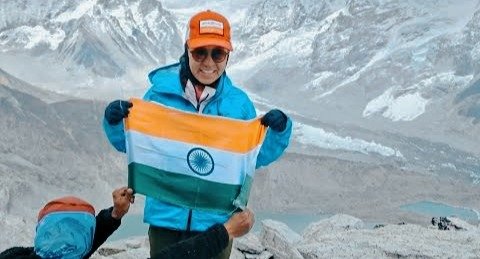
- On May 19, 2025, at 8:34 a.m., 29-year-old Angmo etched her name in global history by becoming the first visually impaired woman in the world—and fifth visually impaired person overall—to conquer Mount Everest (8,848.86 meters).
- Guided by Sherpas Dandu Sherpa and Om Gurung using tactile climbing techniques and fixed ropes, she hoisted the Indian Tricolour at the summit.
- Following Everest, she expanded her ambitions toward the Seven Summits, successfully scaling the highest peaks of Africa (Mount Kilimanjaro), Europe, and South America (Mount Aconcagua).
- She actively dismantles societal stereotypes surrounding disability.
- She champions inclusive opportunities, proving that physical impairments are not limitations when met with resilience, equal access, and unwavering willpower.
- Honors: Beyond mountaineering, Angmo is a multi-sport athlete.
- She won a state-level gold medal in swimming, earned two bronze medals in national marathons, competed in national judo and zonal football, and completed grueling tandem cycling expeditions from Manali to Khardung La.
- She won Sarvshresth Divyangjan National Award from President Droupadi Murmu in 2024, and the CavinKare Ability Mastery Award.
- She was specially mentioned by Prime Minister Narendra Modi on Mann Ki Baat.
Mount Everest and Its Expedition Challenges
- Mount Everest: It is locally known as Sagarmatha in Nepal and Chomolungma in Tibet. It is the world’s highest mountain above sea level.
- It lies in the Mahalangur Himal range of the Himalayas, along the Nepal–China (Tibet Autonomous Region) border.
- Its officially recognised height is 8,848.86 metres. It is a significant geographical landmark and an important subject for Himalayan ecology, and adventure tourism.
- Its two principal climbing routes are the Southeast Ridge route through Nepal and the Northeast Ridge route through Tibet.
- The Nepal route involves the Khumbu Icefall, Western Cwm, Lhotse Face and South Col.
- The Tibetan route approaches the mountain through the North Col and Northeast Ridge.
- The first successful ascent took place on 29 May 1953, when Edmund Hillary of New Zealand and Tenzing Norgay Sherpa of Nepal reached the summit.
- Expedition Challenges:
- Climbers face extreme altitude sickness (HAPE and HACE), arctic temperatures below -36°C, avalanches, and jet-stream winds.
- The Khumbu Icefall shifts daily with collapsing seracs and deep crevasses.
- Above 8,000 meters, the Death Zone has roughly one-third sea-level air pressure, causing rapid deterioration, frostbite, summit fever, and traffic jams.
- Preparation requires months of cardio and strength training, technical rope and crampon skills, prior high-altitude climbing, and comprehensive evacuation insurance.
- Expeditions typically run 40 to 60 days during spring (April–May).
- Climbers face extreme altitude sickness (HAPE and HACE), arctic temperatures below -36°C, avalanches, and jet-stream winds.
Major Indians Who Successfully Summited Mount Everest
- Avtar Singh Cheema (First Indian Man): On May 20, 1965, Captain Avtar Singh Cheema became the first Indian man to summit Mount Everest as part of the historic Indian Army Expedition led by M.S. Kohli.
- Climbing alongside Nawang Gombu Sherpa—the first person to scale the peak twice—Cheema helped put nine Indian climbers on the summit, a world record that stood for 13 years. He was honored with Padma Shri and Arjuna Award.
- Bachendri Pal (First Indian Woman): On May 23, 1984, Bachendri Pal shattered gender barriers by becoming the first Indian woman and fifth woman globally to reach the peak.
- Surviving a devastating avalanche at Camp III, she spent 43 minutes at the summit during the Everest ’84 mission.
- She later led pioneering all-women expeditions and received the Padma Bhushan in 2019 for transforming Indian adventure sports.
- Santosh Yadav (First Woman Twice): Santosh Yadav became the first woman in the world to summit Mount Everest twice, achieving the feat in consecutive years in May 1992 and May 1993.
- During her 1992 ascent via the South Col route, she saved a fellow climber’s life by sharing her supplemental oxygen, demonstrating extraordinary high-altitude endurance and earning the Padma Shri for her dual triumph.
- Arunima Sinha (First Female Amputee); On May 21, 2013, former national volleyball player Arunima Sinha became the world’s first female amputee to scale Mount Everest.
- Climbing with a prosthetic leg two years after losing her limb in a train robbery, she overcame severe frostbite and extreme fatigue.
- She conquered the Seven Summits across every continent, honoured with the Padma Shri for unmatched human resilience.
- Malavath Poorna & Anshu Jamsenpa (Youth & Speed Records); On May 25, 2014, Malavath Poorna became the youngest female globally to summit Everest at just 13 years and 11 months old via the treacherous North Ridge route.
- Anshu Jamsenpa made history in May 2017 as the first woman to summit twice within five days during a single season, completing a record five total ascents for an Indian woman.
- Tashi and Nungshi Malik (Mountaineering Twins): Indian twin sisters Tashi and Nungshi Malik summited Everest in 2013. They are internationally recognised for their mountaineering and adventure achievements.
Disability Empowerment in India
- The Constitution provides the foundation for disability inclusion through Article 14 (Equality before Law), Article 15 (Prohibition of Discrimination), Article 16 (Equality of Opportunity in Public Employment) and Article 21 (Right to Life and Personal Liberty).
- India ratified the United Nations Convention on the Rights of Persons with Disabilities (UNCRPD) in 2007.
- The Convention promotes dignity, accessibility, non-discrimination, independent living and equal participation.
- The Rights of Persons with Disabilities Act ,(RPwD Act) 2016, which came into force on 19 April 2017, expanded recognised disabilities from seven to 21 categories.
- Section 34 provides 4% reservation in government employment for persons with benchmark disabilities.
- Section 32 provides at least 5% reservation in government and government-aided higher educational institutions for persons with benchmark disabilities.
- Launched on 3 December 2015, the Accessible India Campaign (Sugamya Bharat Abhiyan) aims to create a barrier-free environment.
- The Unique Disability ID initiative seeks to create a national database of persons with disabilities and issue standardised disability identity cards.
- The Deendayal Disabled Rehabilitation Scheme (DDRS) provides financial assistance to eligible non-governmental organisations for delivering rehabilitation services.
- The Assistance to Disabled Persons for Purchase/Fitting of Aids and Appliances (ADIP) Scheme supports access to assistive devices such as wheelchairs, hearing aids, mobility equipment and other appliances.
- Under the National Trust, Niramaya offers health insurance up to ₹1 lakh without pre-insurance medical tests.
- Care initiatives include Disha (early intervention), Vikaas (day care), Samarth (respite care), and Gharaunda (group homes).
- NDFDC provides concessional self-employment loans, while PM-DAKSH-DEPwD and ISLRTC advance skill training and Indian Sign Language.
- The Khelo India programme, including the Khelo India Para Games, promotes sporting participation and competitive opportunities for para-athletes.
- The Target Olympic Podium Scheme (TOPS) supports selected elite athletes through assistance for international competition.
Frequently Asked Questions (FAQs):
1. Who is Chhonzin Angmo?
Chhonzin Angmo is an Indian visually impaired mountaineer from Himachal Pradesh who became the first blind woman to summit Mount Everest.
2. When did Chhonzin Angmo summit Mount Everest?
She successfully reached Mount Everest’s summit on 19 May 2025, marking a historic achievement in inclusive mountaineering.
3. What is the height of Mount Everest?
Mount Everest stands at 8,848.86 metres, making it the world’s highest mountain above sea level.
4. Who was the first Indian woman to climb Mount Everest?
Bachendri Pal became the first Indian woman to summit Mount Everest on 23 May 1984.
5. Which Indian law protects the rights of persons with disabilities?
The Rights of Persons with Disabilities Act, 2016 provides legal protection, equality, accessibility and reservation for persons with benchmark disabilities.
Disclaimer: Information in this article is based on official announcements and public records. Details may evolve over time.