




India-UAE Joint Military Exercise Mountain Guardian 2026 Conducted Between Two Countries
| General Studies Paper II: Bilateral Agreements, Security Challenges and Management |
Why in News?
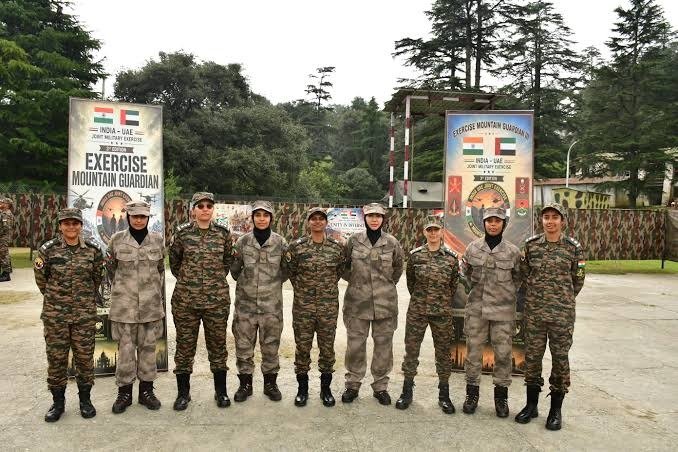
Recently, India and the UAE joint military Exercise Mountain Guardian 2026 is being conducted in Uttarakhand to strengthen mountain-warfare capabilities and bilateral defence cooperation.
What is Exercise Mountain Guardian 2026?
- About: Exercise Mountain Guardian 2026 is a bilateral military exercise between the Indian Army and the UAE Army. It is designed as a foundational mechanism for exchanging advanced military expertise, battlefield tactics, and operational procedures.
- 2026 marks the inaugural edition of this specific high-altitude defense collaboration.
- Objective: The primary objective is to enhance operational interoperability, mutual trust, and strategic cooperation.
- Location: The exercise is being hosted at the Foreign Training Node located in Chaubatia, Uttarakhand, India.
- The two-week program is scheduled to run from October 5 to October 18, 2026.
- Participation: A total of 92 personnel are actively participating with equal numbers from both armies.
- The Indian Army is represented by the Bhairav Battalion, while the UAE Land Forces are represented by a Mountain Infantry Battalion.
- Women officers and combatants from both armies are also participating in specialist roles, reflecting their involvement across different military functions.
- Focus Areas: The exercise is categorized into four main domains:
- High-Altitude Mountain Warfare & Survival: Shifting the UAE’s traditional desert-warfare expertise toward rugged terrain operations. Core drills focused on advanced mountain craft, rock climbing, rappelling, cliff assaults, slithering, and obstacle crossing.
- Technology-Enabled Reconnaissance: Integration of modern warfare tech. Drills involved operating surveillance grids and tactical drone operations to monitor and locate targets in difficult-to-observe mountainous areas.
- Combat & Specialised Marksmanship: Focus on improving tactical proficiency through day and night firing drills, reflex shooting, counter-terrorism maneuvers, and sniper combat practices.
- Interoperability & Joint Planning: Enhancing sub-conventional threat response through joint mission planning, mixed-team multi-day Integrated Field Training Exercises (FTX), and the sharing of Tactics, Techniques, and Procedures (TTPs).
- Physical Conditioning: Rigorous physical endurance sessions alongside close-quarters combat skills like Jiu-Jitsu to tackle demanding high-altitude conditions.
India–UAE Defence Relations
- Foundation: The foundation of India–UAE ties rests on centuries-old maritime trade, cultural affinity, and people-to-people relations.
- Formal diplomatic relations began in 1972.
- The foundation of India–UAE military ties was established via a bilateral Defence Cooperation MoU signed in 2003.
- The relationship was elevated to a Comprehensive Strategic Partnership in 2017, transforming basic commercial ties into a deeper institutional mechanism.
- A milestone Framework for Strategic Defence Partnership was signed in May 2026.
- This built upon a formal Letter of Intent inked in January 2026 during the UAE President’s visit to India.
- The 13th Joint Defence Cooperation Committee (JDCC) meeting in July 2025 institutionalized the technology transfer agenda.
- Cooperation: Bilateral defense operations span defense industrial collaboration, advanced technologies, cyber defense, secure communications, special operations, and joint training.
- A specialized MoU between the Indian Coast Guard and the UAE National Guard mandates collaborative search and rescue, anti-piracy, and pollution response workflows.
- Defence Exercises: Regular cross-service interactions include the bilateral Army exercise Desert Cyclone and tactical drills like Mountain Guardian 2026.
- Maritime engagements feature Ex Gulf Waves (formerly Zayed Talwar). In the air domain, the Indian Air Force regularly joins Ex Desert Flag in the UAE, while the UAE Air Force participates in India’s Ex Tarang Shakti.
- Defence Trade: Trade focuses on joint production, mirroring the ICOMM (India) and CARACAL (UAE) model for small arms manufacturing.
- The UAE’s advanced defense conglomerate, EDGE Group, explores co-development of next-generation hardware and artificial intelligence systems with Indian firms.
- India and the UAE signed a key MoU to construct a ship repair and fabrication cluster at Vadinar, Gujarat.
- Shipbuilding and platform retrofitting are routed through the Cochin Shipyard Limited and Drydocks World cluster.
- UAE is in early-stage talks with India to acquire the BrahMos supersonic cruise missile and the Akash automated air-defence systems to diversify its military suppliers.
- Bilateral Trade: Broader synergy is driven by the Comprehensive Economic Partnership Agreement (CEPA).
- Bilateral trade reached $101.25 billion for FY 2025-26, targeting $200 billion by 2032.
- Critical energy integration includes ADNOC’s participation in India’s Strategic Petroleum Reserves, a $3 billion LNG supply pact, and a $5 billion UAE infrastructure investment.
- Significance: The defense axis allows the UAE to diversify partnerships beyond the West. For India, it secures vital energy lanes, protects the 3.5 million Indian diaspora, and anchors minilateral groups like I2U2 and the India-Middle East-Europe Economic Corridor (IMEC) amid regional vulnerabilities.
- The nations prioritize real-time information sharing, search-and-rescue operations, anti-piracy, and securing critical sea lines in the Indian Ocean Region.
- Bilateral agencies utilize robust intelligence-sharing networks to track terror financing.
- Coordinated efforts are backed by the Financial Action Task Force (FATF) frameworks alongside a mutual cyber defense pact protecting secure communications.
Frequently Asked Questions (FAQs):
1. What is the objective of the India-UAE joint military exercise in Uttarakhand?
The objective is to enhance interoperability, tactical coordination, mutual understanding, and operational cooperation between Indian and UAE armies.
2. Why are Indian and UAE troops conducting mountain-warfare training?
The training develops mountain-combat proficiency, prepares troops for rugged terrain, and enables the exchange of specialised military tactics.
3. What military skills are being developed during the joint exercise?
Troops practise rock climbing, rappelling, obstacle navigation, firing, drone operations, surveillance, and coordinated tactical drills.
4. How does this exercise strengthen defence cooperation between India and the UAE?
It strengthens bilateral military ties through joint training, professional exchanges, shared operational practices, and enhanced mutual trust.
Disclaimer: Information in this article is based on official announcements and public records. Details may evolve over time.
| Also Read: India-Australia Joint Military Exercise |