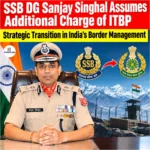




SSB DG Sanjay Singhal Assumes Additional Charge of ITBP, Strategic Transition in India’s Border Management
| General Studies Paper I: Appointments, Important Personalities |
Why in News?
Recently, Sashastra Seema Bal (SSB) Director-General Sanjay Singhal assumed additional charge as chief of the Indo-Tibetan Border Police (ITBP), succeeding Shatrujeet Singh Kapoor.
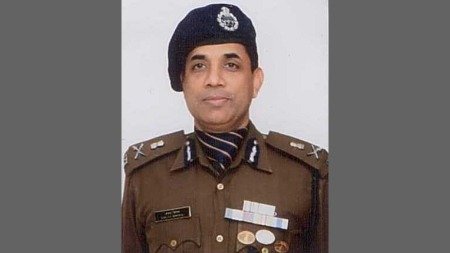
Who is Sanjay Singhal?
- Intro: Sanjay Singhal is a 1993-batch Indian Police Service (IPS) officer belonging to the Uttar Pradesh cadre.
- Early Life: He was born on 27 December 1968 and hails from Ghaziabad, Uttar Pradesh. His father’s name is Surendra Singhal.
- Education: Singhal holds a Bachelor of Engineering (B.E.) in Mechanical Engineering.
- He also completed a specialized Post Graduate Diploma in Police Management (PGDPM).
- Service and Career: After clearing the UPSC Civil Services Examination as a Direct Recruit, he officially joined the service on September 5, 1993.
- He was confirmed on October 26, 1995, and achieved Senior Scale on July 4, 1997. He attained Selection Grade on January 1, 2006.
- During his initial career, he served in different operational and supervisory capacities, including Assistant Superintendent of Police (ASP), Superintendent of Police (SP) and Senior Superintendent of Police (SSP).
- Elevating further, he was promoted to Deputy Inspector General (DIG) on February 5, 2009, and Inspector General (IG) on December 31, 2012.
- He ascended to Additional Director General (ADG) on January 1, 2018, followed by his promotion to Director General (DG) on June 11, 2025.
- He executed critical administrative mandates as ADG Crime and ADG Establishment. Moving to central deployments,
- Singhal served as DIG, Sector Headquarters, Dehradun, and IG, Eastern Frontier, ITBP.
- He later served as Special Director General (Special DG), Border Security Force (BSF).
- The Appointments Committee of the Cabinet approved his appointment as Director General, Sashastra Seema Bal (SSB) on 31 July 2025.
- He assumed charge on 1 September 2025, succeeding Amrit Mohan Prasad. His approved tenure extends until 31 December 2028 or until further orders, whichever is earlier.
- Following the retirement of Shatrujeet Singh Kapoor on 31 October 2026, Singhal assumed additional charge as Director General of ITBP on 1 November 2026.
- The arrangement continues until a regular incumbent is appointed or further orders are issued, whichever is earlier.
- Honors: For his flawless, courageous service, he was awarded the Police Medal for Meritorious Service in 2009.
- He received the President’s Police Medal for Distinguished Service in 2015. His honors also include the UN Peacekeeping Medal (Kosovo), multiple DG Commendation Discs (Silver, Gold, and Platinum), and the Maha Kumbh Sewa Medal in 2025.
| Note: The Sashastra Seema Bal (SSB), a Central Armed Police Force (CAPF) under the Ministry of Home Affairs, serves as a critical instrument of India’s asymmetric border management along the porous, visa-free frontiers with Nepal and Bhutan. |
What is the Indo-Tibetan Border Police (ITBP)?
- About: The Indo-Tibetan Border Police (ITBP) is a specialised Central Armed Police Force (CAPF) primarily guards India’s border with China and performs important security responsibilities.
- Establishment: The ITBP was raised on October 24, 1962, under the CRPF Act, following the geopolitical fallout of the Sino-Indian War.
- It was later structured as a dedicated border guarding force under the ITBPF Act of 1992 to specialize in high-altitude operations.
- ITBP headquarters is located in New Delhi.
- Governance: The force operates directly under the administrative control of the Ministry of Home Affairs (MHA).
- It is headed by a Director General (DG), typically a senior officer from the Indian Police Service (IPS).
- It is supported by senior officers, including Additional Directors General, Inspectors General and other operational commanders.
- The force operates through frontier headquarters, sector headquarters, service battalions, specialised battalions, training institutions and logistics establishments.
- Mandate and Jurisdiction: ITBP strictly adheres to the “One Border, One Force” principle.
- It is responsible for guarding 3,488 kilometers of the volatile Indo-China border, spanning from the Karakoram Pass in Ladakh to Jachep La in Arunachal Pradesh.
- Its area of responsibility covers Ladakh, Himachal Pradesh, Uttarakhand, Sikkim and Arunachal Pradesh.
- The force took over additional responsibilities in Sikkim and Arunachal Pradesh in 2004.
- Motto: The operational philosophy of the force is encapsulated in its official motto: “Shaurya-Dridhata-Karma Nishtha” (Valor – Determination – Devotion to Duty).
- Specialization: ITBP is a highly specialized mountain force, with most of its Border Outposts (BOPs) situated at altitudes ranging from 9,000 to 18,750 feet.
- Personnel are intensively trained in mountaineering, skiing, and survival tactics to withstand sub-zero temperatures dropping below -40°C.
- ITBP personnel are popularly known as Himveers, reflecting their specialised role in the Himalayan region.
- Personnel are intensively trained in mountaineering, skiing, and survival tactics to withstand sub-zero temperatures dropping below -40°C.
- Diverse Roles:
- Beyond border vigilance, the ITBP performs critical secondary duties including Anti-Naxal Operations in Chhattisgarh.
- It provides security to vital installations, protecting VVIPs, managing civilian crowds, and deploying for UN Peacekeeping Missions globally.
- The force maintains vigil across the Line of Actual Control (LAC), preventing border violations, smuggling, and illegal trans-border infiltration in highly inhospitable terrain.
- The ITBP acts as the first responder for natural disasters in the Himalayan region.
- Highly trained in Chemical, Biological, Radiological, and Nuclear (CBRN) emergencies, the force leads critical search and rescue operations during flash floods, avalanches, and landslides.
- Beyond border vigilance, the ITBP performs critical secondary duties including Anti-Naxal Operations in Chhattisgarh.
- Significance: During the intense Galwan Valley face-offs in Eastern Ladakh, ITBP troops fought shoulder-to-shoulder with the Indian Army.
- ITBP actively drives the construction of strategic border roads and advanced operational tracks to ensure rapid troop mobilization.
- According to reporting based on the MHA Annual Report 2024–25, ITBP added 29 border outposts between 2022 and 2024, taking their reported total to 209.
- ITBP’s interaction with local communities supports information-sharing, public confidence and effective border management.
- The government’s Vibrant Villages Programme complements this broader approach.
- Its 2013 Kedarnath disaster response, involving the rescue of 33,009 people, demonstrated its humanitarian capabilities. It also undertook rescue operations during the 2021 Tapovan disaster.
Frequently Asked Questions (FAQs):
1. Who is Sanjay Singhal?
Sanjay Singhal is a 1993-batch Uttar Pradesh-cadre IPS officer and Director General of SSB.
2. Which additional responsibility has Sanjay Singhal taken over?
He assumed additional charge as Director General of the Indo-Tibetan Border Police (ITBP) on 1 November 2026.
3. What is the full form of ITBP?
ITBP stands for Indo-Tibetan Border Police, a Central Armed Police Force under the Ministry of Home Affairs.
4. What are the primary responsibilities of the ITBP?
ITBP guards the India-China border, conducts surveillance and patrolling, prevents trans-border activities and undertakes high-altitude rescue operations.
5. What is the role of the Sashastra Seema Bal in India’s border security?
SSB guards India’s borders with Nepal and Bhutan, preventing smuggling, illegal crossings and trans-border crimes.
Disclaimer: Information in this article is based on official announcements and public records. Details may evolve over time.
| Also Read: Mukesh Singh Appointed as DGP of Ladakh |