




CISF Introduces Sector-Specific Functional Command, Securing National Infrastructure Security
| General Studies Paper III: Security Challenges & their Management in Border Areas |
Why in News?
Recently, the Central Industrial Security Force (CISF) replaced territorial commands with sector-specific functional commands, effective from November 1, 2026.
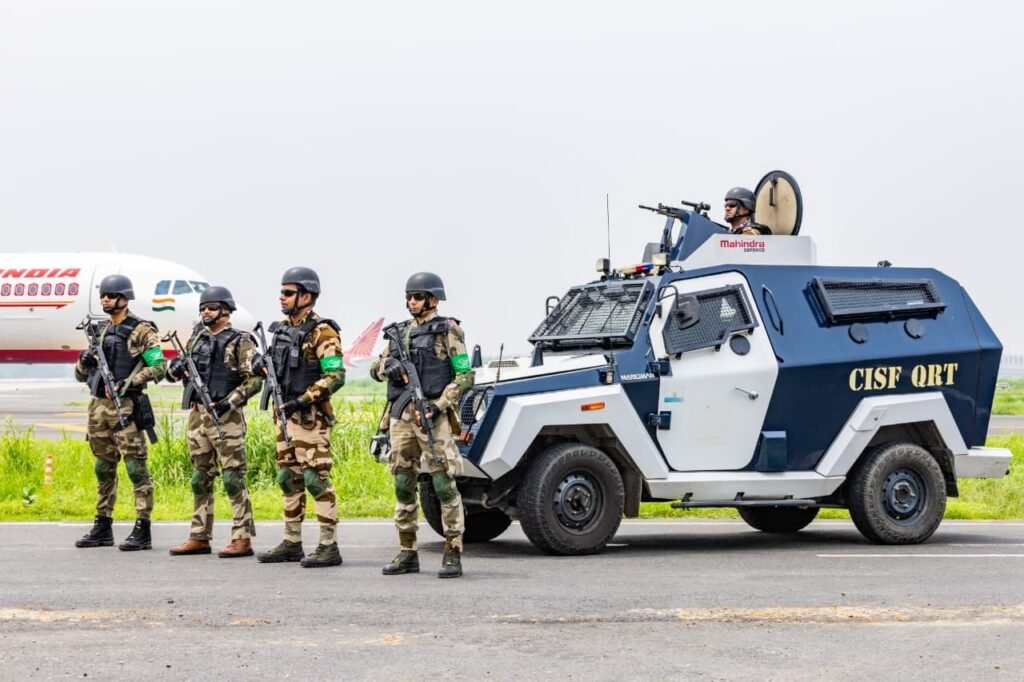
What is CISF and Its Command Structure?
- About: The Central Industrial Security Force (CISF) is a Central Armed Police Force (CAPF) functioning under the Ministry of Home Affairs (MHA).
- It was established on 10 March 1969, following the enactment of the CISF Act, 1968 (Act No. 50 of 1968).
- CISF headquarters is located at Lodhi Road, New Delhi.
- Its foundational mandate is to provide integrated security cover to Public Sector Undertakings (PSUs), critical infrastructure, and major aerospace and maritime installations across the nation.
- It provides round-the-clock protection to airports, seaport docks, nuclear power plants, space research centers, and Delhi Metro.
- It also provides VIP security through its Special Security Group (SSG), subject to government authorisation.
- The force possesses a specialized Fire Wing dedicated to managing industrial fire hazards and safety protocols.
- The Force has approximately 2.70 lakh personnel, protects 361 critical installations, including 70 airports, maintains 12 Reserve Battalions and operates eight training institutions.
- Command Structure: The field formations and administrative bases of the force functioned under geographical jurisdiction model.
- Under this arrangement, single administrative commands supervised highly mixed installations within their designated geographic boundaries.
- A single territorial sector could supervise more than 50 units belonging to different industries, including coal, power and ports.
- The older setup utilized an administrative network consisting of eight geographic sectors to supervise nationwide field deployment.
- These territorial divisions consisted of the Northern Sector (New Delhi), Eastern Sector (Ranchi), Central Sector (Bhilai), Western Sector (Mumbai), Southern Sector (Chennai), and North Eastern Sector (Guwahati).
- The division was completed by the North Eastern Sector-II (Kolkata) and the National Capital Region (NCR) Sector.
- The organizational hierarchy is headed by a Director General (DG), traditionally a senior officer from the Indian Police Service (IPS).
- The specialized geographic sectors were commanded by an officer of the rank of Inspector General (IG).
- Below the sectors, the field forces are split into battalions and units led by a Commandant, who handles localized security administration.
CISF Sector-Specific Functional Commands
- Approval: The Ministry of Home Affairs (MHA) officially approved this landmark restructuring plan presented by CISF DG Praveer Ranjan.
- Implementation: The historic restructuring officially came into direct effect on November 1, 2026.
- This shift establishes an intelligence-led and risk-based framework
- New Structure: The new supervisory framework divides operations into 11 specialized sectors.
- Eight traditional territorial commands have been completely dissolved and converted into functional, domain-specific units.
- The newly operationalized commands are explicitly categorized into core industrial divisions:
- Power Sector Commands: Two dedicated commands have been established: Power-I Sector, headquartered in New Delhi, and Power-II Sector, headquartered in Kolkata.
- Their purpose is to strengthen specialised supervision of power infrastructure and improve coordination with relevant organisations.
- Coal, Steel and Petroleum Commands: Three specialised commands address major industrial sectors: Coal Sector (Ranchi), Steel Sector (Bhilai) and Petroleum and Natural Gas Sector (Guwahati).
- This arrangement enables focused security planning for coalfields, steel plants, oil installations and natural-gas infrastructure.
- Port Security Commands: The maritime infrastructure has been divided into West Coast Port Sector (Mumbai) and East Coast Port Sector (Chennai).
- This geographical division within a functional framework supports specialised maritime-installation security and coordination with port authorities.
- Government Buildings and Urban Transport: The Government Buildings, Museums and Monuments and Mass Rapid Transit System (GBMM & MRTS) Sector, headquartered in New Delhi, combines supervision of sensitive government properties, heritage installations and mass-transit infrastructure under a dedicated functional command.
- Existing Specialised Commands: Three highly successful, pre-existing functional arrangements continue unaltered under the new plan.
- These include the Airport-I (New Delhi) and Airport-II (Bengaluru) Sectors, alongside the Department of Atomic Energy and Department of Space (DAE & DoS) Sector.
- Power Sector Commands: Two dedicated commands have been established: Power-I Sector, headquartered in New Delhi, and Power-II Sector, headquartered in Kolkata.
Significance of Sector-Specific Functional Commands
- The reform replaces mixed-industry territorial supervision with installation-based command responsibility.
- Dedicated headquarters are expected to improve communication with client organisations, standardise Standard Operating Procedures (SOPs), strengthen access control, and improve Quick Reaction Team deployment.
- The restructured framework encourages greater integration of advanced surveillance, counter-drone systems, cyber-risk management and sector-specific emergency response plans.
- It also promotes risk-based security assessment according to the vulnerabilities of individual industries.
- Functional commands reduce cross-sector responsibilities, enable quicker decisions and improve operational accountability during security emergencies.
- The reform establishes dedicated single points of contact between CISF sector headquarters, client organisations and concerned ministries.
- Dedicated port, petroleum, coal and power commands strengthen supervision of strategically important infrastructure.
- This is significant because disruptions in ports can affect international trade, while attacks on energy installations can threaten industrial production and essential services.
Frequently Asked Questions (FAQs):
1. What is the sector-specific functional command implemented by CISF?
CISF reorganised supervisory commands around specific industries, including power, coal, steel, petroleum, ports and government infrastructure.
2. Why has CISF introduced a new functional command structure?
To improve specialised expertise, operational efficiency, administrative accountability and coordination across different critical infrastructure sectors.
3. What types of critical infrastructure does CISF protect in India?
CISF protects airports, nuclear facilities, space establishments, ports, power plants, refineries, mines, metros and government buildings.
4. How will the new command system improve infrastructure security?
It enables specialised supervision, faster decision-making, sector-specific security protocols, improved coordination and better responses to emerging threats.
Disclaimer: Information in this article is based on official announcements and public records. Details may evolve over time.
| Also Read: PRAHAAR Counter Terrorism Policy Unveiled |