


Indian Constitution in 22 Schedule Languages: Highlights and Significance
| General Studies Paper II: Governance & Constitutional Provisions |
Why in News?
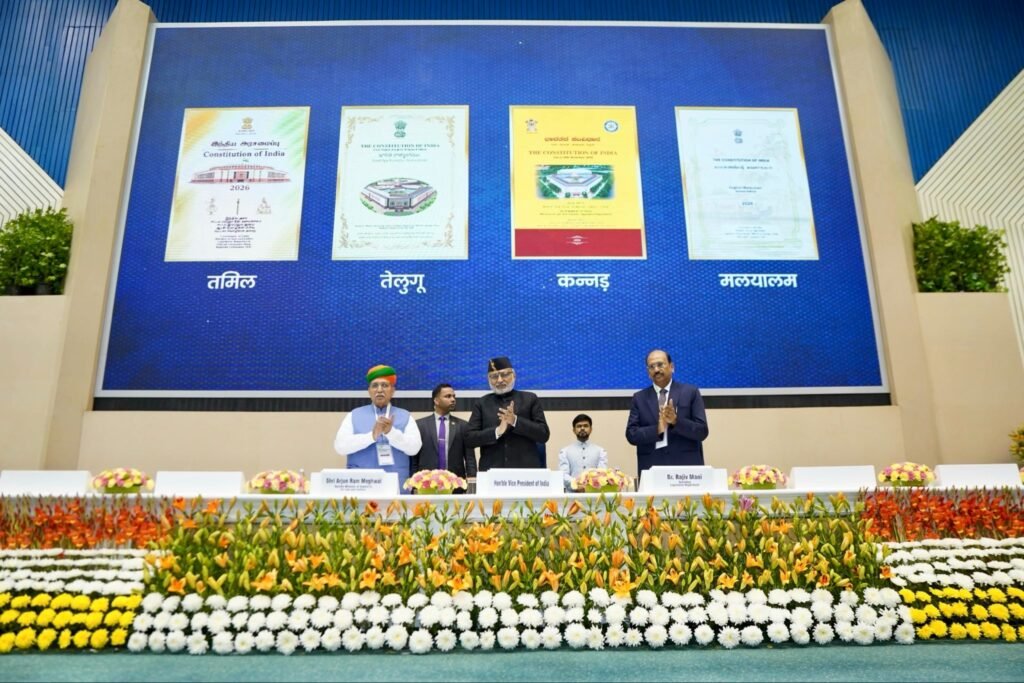
Recently, on Constitution Day 2026 (26th November, 2026), Vice-President C. P. Radhakrishnan released updated Indian Constitution editions in all 22 Scheduled Languages, marking a historic milestone in linguistic inclusivity.
Constitution of India and Language Translations
- About: The Constitution of India is the supreme legal framework that establishes the country’s political structure, defines governmental powers, regulates relations between institutions and citizens, and guarantees fundamental rights.
- It embodies the principles of justice, liberty, equality and fraternity, forming the foundation of India’s parliamentary democracy.
- The demand for constitutional self-government developed during the freedom struggle.
- The Government of India Act, 1935 provided an important administrative framework, while the Cabinet Mission Plan (1946) facilitated the formation of the Constituent Assembly to prepare an independent Constitution.
- Assembly: The Assembly first met on 9 December 1946, with Dr. Sachchidananda Sinha as temporary Chairman. Dr. Rajendra Prasad became its permanent President on 11 December 1946.
- The Drafting Committee was established on 29 August 1947, under the chairmanship of Dr. B. R. Ambedkar.
- Adoption: After 2 years, 11 months and 18 days, the Constituent Assembly adopted the Constitution on 26 November 1949.
- It came into force on 26 January 1950, celebrated annually as Republic Day. Constitution Day is observed on 26 November.
- Originally, the Constitution contained 395 Articles, 22 Parts and eight Schedules. It is among the world’s lengthiest written national constitutions.
- Language Translations:
- The original constitutional manuscripts were prepared in English and Hindi.
- The text was hand-lettered by Prem Behari Narain Raizada and illustrated by Shantiniketan artists led by Nandalal Bose.
- In 1981, the first Odia translated edition of Constitution, published in Bhubaneswar under the title Bharatara Sambidhana.
- Sanskrit Edition, first translated and published on 1 April 1985 in New Delhi as Bharatasya Samvidhanam.
- Later, the Constitution (Fifty-eighth Amendment) Act, 1987 inserted Article 394A.
- It authorises the President to publish an authoritative Hindi text aligned with Central Acts and incorporating prior and subsequent English amendments.
- Subsequently, constitutional translation initiatives expanded to other Indian languages.
- The Legislative Department progressively worked towards updated regional-language editions.
- On 26 November 2025, President Droupadi Murmu released digital editions in nine languages—Assamese, Bodo (first official edition), Kashmiri (first official edition), Malayalam, Marathi, Nepali, Odia, Punjabi, and Telugu.
- On 21 February 2026 (International Mother Language Day), updated editions in Tamil and Gujarati were released alongside the 8th Edition of the English–Hindi Legal Glossary.
- On 26 November 2026, Vice-President C. P. Radhakrishnan released updated editions of the Constitution in all 22 Scheduled Languages at Vigyan Bhawan, New Delhi.
- It was the first time since the Constitution came into force.
- The milestone advances Ek Bharat, Shreshtha Bharat.
- The original constitutional manuscripts were prepared in English and Hindi.
Availability of the Constitution in All 22 Languages
- Constitutional literacy means understanding the Constitution’s principles, institutions, rights, duties and democratic processes.
- Availability in familiar languages can help citizens understand Fundamental Rights, Directive Principles of State Policy, Fundamental Duties and constitutional remedies without depending entirely on English-language resources.
- Citizens who face language barriers can engage more effectively with constitutional provisions.
- Students, teachers, researchers, local institutions and civil society organisations can use regional-language editions for education, awareness campaigns and public discussions.
- Greater linguistic accessibility can strengthen informed citizenship, encourage participation in democratic institutions and improve awareness of government accountability.
- Regional-language editions can help bridge information gaps between urban and rural populations.
- They are particularly relevant for communities whose access to legal information and educational resources may be limited by language barriers.
What are Scheduled Languages?
- About: Scheduled Languages are the 22 languages expressly recognised in the Eighth Schedule of the Indian Constitution.
- They represent India’s major linguistic traditions granted formal constitutional status under Part XVII.
- The primary objective is to preserve linguistic diversity, promote cultural integration, and ensure democratic representation across a multilingual nation.
- According to the 2011 Census, roughly 96.71% of India’s population speaks one of these languages as their mother tongue.
- Constitutional Recognition: The Eighth Schedule operates directly alongside Article 344(1) and Article 351.
- Article 344(1) mandates the President to constitute an Official Language Commission with members representing all scheduled languages to advise on the progressive use of Hindi.
- Article 351 directs the Union to enrich Hindi by drawing vocabulary and stylistic elements from Sanskrit and these scheduled languages.
- India has no national language, and English is excluded from the Eighth Schedule despite being an associate official language.
- Article 343 identifies Hindi in Devanagari script as the Union’s official language, while English continues to be used for Union official purposes under the Official Languages Act, 1963.
- Evolution: Originally, the Constitution recognized 14 languages in 1950: Assamese, Bengali, Gujarati, Hindi, Kannada, Kashmiri, Malayalam, Marathi, Odia, Punjabi, Sanskrit, Tamil, Telugu, and Urdu.
- Subsequent amendments expanded this list to 22 languages:
- 21st Amendment Act (1967): Added Sindhi.
- 71st Amendment Act (1992): Added Konkani, Manipuri, and Nepali.
- 92nd Amendment Act (2003): Added Bodo, Dogri, Maithili, and Santali (effective 2004).
- 96th Amendment Act (2011): Renamed Oriya to Odia.
- Benefits: Inclusion in the Eighth Schedule grants significant institutional privileges.
- Recognized languages receive Sahitya Akademi literary awards, dedicated central government funding for development, and parliamentary translation facilities.
- Furthermore, candidates can write UPSC Civil Services examinations in any of these 22 languages.
- Criteria: Currently, no fixed constitutional criteria exist for adding new languages, despite recommendations from the Pahwa (1996) and Sitakant Mohapatra (2003) committees.
- Pending Demands: Demands to include 38 additional languages—such as Bhojpuri, Rajasthani, and Tulu—remain pending before the Ministry of Home Affairs.
India’s Linguistic Diversity and Policies
- India is one of the world’s most linguistically diverse countries, with languages belonging to several major language families, including Indo-Aryan, Dravidian, Austroasiatic, Tibeto-Burman and Tai-Kadai.
- Languages represent regional identities, traditional knowledge, literature and cultural heritage.
- According to the Office of the Registrar General and Census Commissioner of India, the 2011 Census recorded 19,569 raw mother-tongue returns.
- Following linguistic scrutiny and rationalisation, these were classified into 1,369 rationalised mother tongues.
- The Census identified 121 languages with at least 10,000 speakers, comprising 22 Scheduled and 99 non-Scheduled languages.
- According to Census 2011, approximately 96.71% of India’s population reported a Scheduled Language as their mother tongue, while the remaining 3.29% reported other languages.
- The People’s Linguistic Survey of India identifies 780 distinct languages across the nation.
- Articles 29, 30, 350A, and 350B safeguard linguistic minorities, guaranteeing mother-tongue primary instruction and appointing a Special Officer for Linguistic Minorities.
- The States Reorganization Act, 1956 redrew state boundaries largely along linguistic lines, allowing states to adopt their own regional official languages under Article 345.
- To preserve ancient literary heritage, the government grants Classical Language status.
- Following the October 2024 inclusion of Marathi, Pali, Prakrit, Assamese, and Bengali, India now recognizes 11 Classical Languages, joining Tamil, Sanskrit, Kannada, Telugu, Malayalam, and Odia.
- The Central Institute of Indian Languages (CIIL), Mysuru, supports language research, documentation and development.
- The Commission for Scientific and Technical Terminology develops technical terminology in Indian languages.
- To counter language endangerment and bridge communication gaps, the government enforces the Three-Language Formula and promotes mother-tongue education under the National Education Policy (NEP) 2020.
- Key institutional efforts include the Scheme for Protection and Preservation of Endangered Languages (SPPEL), the Bharatavani knowledge portal, and Bhasha Sangam.
- The National Language Translation Mission, implemented through Digital India BHASHINI Division under MeitY, uses artificial intelligence, natural language processing and speech technologies to reduce language barriers in digital services.
Frequently Asked Questions (FAQs):
1. How many Scheduled Languages are recognised by the Indian Constitution?
The Eighth Schedule recognises 22 Scheduled Languages, reflecting India’s linguistic diversity and cultural heritage.
2. Which Constitutional Articles deal with Scheduled Languages?
Articles 344(1) and 351 specifically refer to the Eighth Schedule and its languages.
3. Which Constitutional Amendment first added a language to the Eighth Schedule?
The 21st Constitutional Amendment Act, 1967, added Sindhi, increasing the total from 14 to 15.
4. Does India have any constitutionally declared national language?
No. India has no constitutionally declared national language; Hindi is the Union’s official language under Article 343.
5. When were updated Constitution editions released in all 22 Scheduled Languages?
On 26 November 2026, Constitution Day, Vice-President C. P. Radhakrishnan released the editions.
Disclaimer: Information in this article is based on official announcements and public records. Details may evolve over time.
| Also Read: APPROVAL OF 5 NEW CLASSICAL LANGUAGES |