


Census 2027 Housing Block Mapping: Special Software Digitally Mapped 24.25 Lakh HLBs Across India
| General Studies Paper II: Government Policies & Interventions, Population and Associated Issues |
Why in News?
Recently, the Registrar General of India (RGI) digitally mapped 24.25 lakh Houselisting Blocks (HLBs) using specialised auxiliary software, anchoring data accuracy for the upcoming Census 2027.
What is Housing Block Mapping?
- About: Housing Block Mapping refers to the digital demarcation of Houselisting Blocks (HLBs).
- These HLBs are foundational, micro-level administrative units that typically encompass a population of up to 800 individuals or roughly 120 to 150 households.
- They serve as the baseline geographic structure required for conducting a structured national headcount.
- This framework is the structural prerequisite for Census 2027.
- This precise mapping successfully prevents the omission or duplication of any habitation areas.
- Managed By: This massive nationwide mapping exercise is directly managed by the Registrar General of India (RGI) and Census Commissioner.
- The organization operates under the Ministry of Home Affairs to coordinate with States and Union Territories.
- Framework: The structural framework involves a two-phased process.
- The first stage focuses on the House-listing and Housing Census.
- The second phase uses these established HLBs as the primary foundation to build Enumeration Blocks (EBs) for the population headcount.
- Software: The transition leverages the Houselisting Block Creator (HLBC) Web Mapping Application.
- This is an ancillary system of the Census Management and Monitoring System (CMMS).
- The bespoke CMMS backbone allows authorities to track and monitor mapping progress in near real-time.
- Nationwide Coverage: A massive milestone of updating 24.25 Lakh HLBs has been successfully achieved. This coverage spans across all States and Union Territories, excluding Manipur.
- It establishes the country’s first fully digitalized, nationwide population enumeration footprint.
- The 2026 digital mapping revolutionizes this by using high-resolution satellite imagery.
- Historically, mapping relied on manual, hand-drawn paper sketch maps prone to inconsistencies.
- Next Step: Authorities will complete pre-enumeration adjustments. These include correcting administrative unit boundaries and resolving overlapping HLBs.
- They will cover remaining unmapped areas and split oversized blocks into Sub-Enumeration Blocks (Sub-EBs).
- It will assist regional planning by identifying civic amenities, landmarks, and roads within each boundary.
India’s Census 2027
- About: Census 2027 is India’s 16th national census overall and the 8th since Independence.
- It is serving as the country’s first fully digital population census.
- It follows a prolonged delay of the 2021 decennial cycle caused by the COVID-19 pandemic.
- Managed By: It is managed by the Office of the Registrar General and Census Commissioner of India (ORGI) under the Ministry of Home Affairs.
- Constitutional Provision: Under Article 246 of the Constitution, the Census is a Union Subject listed as Entry 69 in List I (Union List) of the Seventh Schedule.
- Statutory Basis: It is legally mandated and governed under the Census Act, 1948 (specifically Sections 3 and 17A) and the Census Rules, 1990.
- Data Confidentiality: Section 15 of the Census Act, 1948 ensures that individual census data remains strictly confidential.
- It is not open to public inspection and cannot be used as evidence in a court of law.
- Financial Outlay: The Union Cabinet approved a dedicated budget of ₹11,718.24 crore for this mega-exercise.
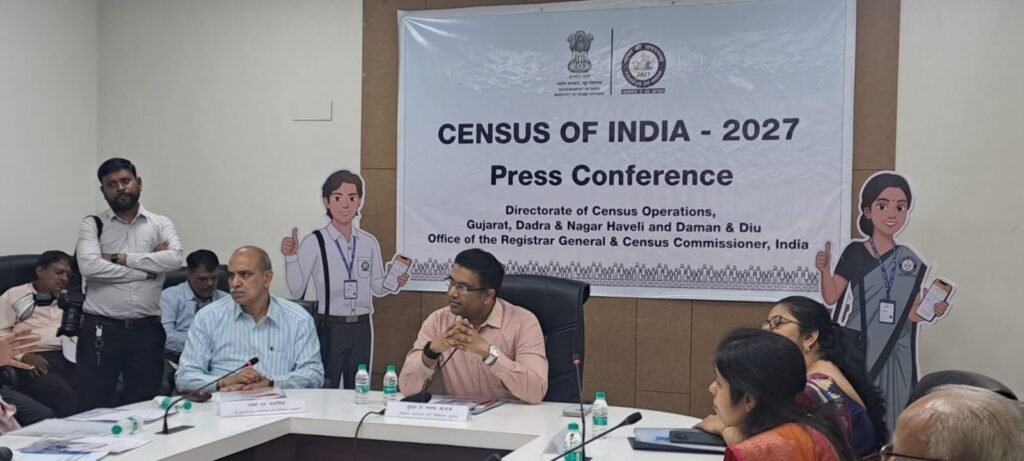
- Mascots & Slogan: The official slogan for Census 2027 is “Census for Public Welfare”.
- To enhance gender equity and public awareness, two mascots have been launched: Pragati (representing a female enumerator) and Vikas (representing a male enumerator).
- Operational Timeline: The census is being conducted in a structured, two-phase rollout backed by crucial “Census Moments”
- Phase I: House-listing & Housing Census (April–September 2026): Conducted across all States and Union Territories (UTs), with each administration completing the exercise within a continuous 30-day state window.
- It collects information on building structures, living conditions, available amenities, and assets.
- Phase II: Population Enumeration (February 2027): Captures individual details like socio-economic status, education, religion, and migration.
- It is scheduled early for Uttar Pradesh, Punjab, Goa, and non-snow-bound areas of Uttarakhand with self-enumeration from November 16 to 30, 2026, door-to-door enumeration from December 1, 2026, to January 4, 2027, and a revisional round from January 5 to 9, 2027.
- Nationwide Population Enumeration will take place from January 25 to February 28, 2027, with a revisional round from March 1 to 5, 2027, and a reference date of 00:00 hours on March 1, 2027.
- Technological Innovations: Census 2027 transitions India from centuries of paper-based documentation to an agile Digital-First Approach:
- Self-Enumeration Portal: For the first time, citizens can opt to log in via a dedicated web portal, verify themselves through an OTP, complete the questionnaire in 16 scheduled languages, and generate a Self-Enumeration ID (SE ID) to present to local field workers.
- Mobile Apps & GIS Tracking: Roughly 32 lakh field workers are using Android/iOS mobile applications for offline and online data capture. Buildings are mapped using digital layout applications and geo-referenced coordinates.
- Granular Indicators: The questionnaires are expanded to include contemporary parameters, such as smartphone ownership, internet access, types of piped gas connections (PNG/LPG), and cereal consumption.
- Security Standard: Employs end-to-end encryption, hosted at ISO/IEC 27001:2022 compliant Critical Information Infrastructure (CII) data centers to prevent leakages.
- Caste Enumeration: For the first time since Independence, the Census will feature a comprehensive nationwide caste enumeration beyond SC and ST categories.
- Historical Precedent: The last comprehensive caste data publication occurred in 1931. (While data was gathered in 1941, the compilation was dropped due to World War II budget freezes; post-1951, iterations only counted SCs and STs).
- Methodology: The second phase features an open-ended text column allowing respondents to declare their exact caste lineage.
- A precise sub-caste data ledger helps optimize reservations, satisfy the judicial tests of “quantifiable backward data” required for welfare quotas.
- Delimitation: The data collected in Census 2027 will serve as the constitutional bedrock for the next Delimitation Commission.
- Constitutional Freeze: Under Article 82 (read with the 84th Constitutional Amendment Act), the redistribution of parliamentary seats across Indian states remained frozen based on the 1971 Census figures until the relevant population statistics of the first census taken after 2026 are published. Census 2027 meets this milestone.
- It will redefine Lok Sabha boundaries and influence the roll-out of the Women’s Reservation Act (Nari Shakti Vandan Adhiniyam), which is statutory bound to the post-2026 delimitation cycle.
Digital Census: Benefits and Challenges
- Benefits:
- Digital census reduce manual entry mistakes through automated validation checks and logical constraints built into data-collection applications, eliminating the traditional risks of illegible handwriting.
- Digital platforms streamline the coverage tracking of populations by utilizing geospatial mapping software and GPS tracking to monitor progress. Enumerators can easily identify unvisited households
- Governments experience unprecedented speed in data aggregation, processing timeline from years to just a few months.
- This rapid availability of census statistics allows authorities to design highly targeted public welfare programs and distribute financial budgets more effectively.
- Challenges:
- Digital divide across rural areas limits self-enumeration because one-third of the population lacks internet access or basic smartphone literacy.
- Over 1.4 billion people will participate in this decadal exercise. Rughly 35% of the population still lacks reliable internet access.
- Aggregated citizen records remain highly vulnerable to malicious cyberattacks and data breaches on fragmented communication networks.
- Deep gender disparities in smartphone ownership threaten the accurate counting of women.
- Studies show that only 43% of women own smartphones compared to 62% of men.
- Rural women face a staggering 36-point technology ownership gap.
- Many ground-level enumerators struggle with technical proficiency issues regarding complex digital interfaces and data definitions.
- Over 31 lakh government school teachers face severe operational pressure as field enumerators.
- Digital divide across rural areas limits self-enumeration because one-third of the population lacks internet access or basic smartphone literacy.
Frequently Asked Questions (FAQs):
1. How many housing blocks have been mapped across India for Census 2027?
Approximately 24.25 lakh Houselisting Blocks (HLBs) have been digitally mapped nationwide.
2. Which special software was used to map the 24.25 lakh housing blocks?
The Houselisting Block Creator (HLBC) Web Mapping Application, under CMMS, was used.
3. What is a House Listing Block (HLB) in the Indian Census?
An HLB is a geographical enumeration unit, normally covering up to 800 individuals, forming the basis for population enumeration.
4. How will digital mapping help prevent omissions and duplication during the Census?
Satellite-based demarcation identifies boundaries, overlapping blocks and uncovered habitations, ensuring comprehensive geographical coverage without omissions or duplication.
5. When will the Population Enumeration phase of Census 2027 take place?
In most areas, 25 January–28 February 2027; selected states have separate schedules, while snow-bound areas had September 2026 enumeration.
Disclaimer: Information in this article is based on official announcements and public records. Details may evolve over time.