


TRAI Satellite Network Provider Authorisation Proposal, Backs Direct-to-Device Connectivity
| General Studies Paper II: Government Policies |
Why in News?
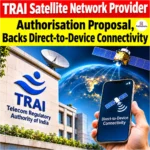
Recently, Telecom Regulatory Authority of India (TRAI) recommended a new satellite network provider authorisation framework, enabling Direct-to-Device connectivity through satellite and mobile spectrum.

TRAI’s Proposed Satellite Network Authorisation Framework
- Recommendation: TRAI released recommendations on 5 November 2026 to establish a dedicated authorisation framework for Satellite Communication Network (SCN) providers.
- The initiative follows the Department of Telecommunications’ (DoT) reference dated 3 July 2025, under the Telecommunications Act, 2023.
- Its objective is to create a technology-neutral regulatory ecosystem to improve satellite infrastructure utilisation.
- Operational Model: TRAI recommended a new Satellite Communication Network Provider Authorisation under Section 3(1)(b) of the Telecommunications Act 2023.
- Authorized entities can offer Satellite Communication Network as a Service (SCNaaS) to eligible telecom operators but cannot serve end-users directly.
- Scope and Authorization Validity: The proposed framework allows Fixed Satellite Services (FSS), Mobile Satellite Services (MSS), and Direct-to-Device (D2D) capabilities.
- The proposed authorisation would cover the entire national territory, with a maximum validity of 20 years, renewable for another period of up to 20 years.
- Subject to the National Frequency Allocation Plan (NFAP), 2025, TRAI identified C-band, Ku-band, Ka-band and Q/V-band for FSS user links, depending on satellite orbit. For MSS user links, it identified L-band and S-band.
- TRAI identified 600, 700, 800, 900, 1,800 and 2,100 MHz FDD bands for satellite-based D2D.
- The proposed authorisation would cover the entire national territory, with a maximum validity of 20 years, renewable for another period of up to 20 years.
- Eligible Service Providers: Existing entities holding eligible authorisations, including Unified Service, Access Service, Internet Service and Long-Distance Service, could also provide SCNaaS, subject to eligibility, technical, operational, rollout and security requirements.
- Spectrum Allocation Mechanism: The regularized model favors the administrative assignment of spectrum over auctions.
- It covers FSS spectrum for feeder links connecting satellites to terrestrial gateways, alongside FSS and MSS frequencies for user links.
- Spectrum Lease Durations: The initial administrative frequency assignment is slated for a tenure of up to 5 years.
- The Central Government retains the flexibility to grant an extension of 2 years depending on prevailing market conditions.
- Connectivity Integration: The framework permits both MSS-based and IMT-based D2D services. Telecom operators holding IMT bands can deploy satellite-to-phone connectivity on a non-interference and non-protection basis using existing spectrum footprints without extra spectrum fees.
- Licensing and Fee Structures: Financial parameters mandate an entry fee of ₹37.5 lakh and an application processing fee of ₹10,000.
- The ongoing license fee is pegged at 8% of the Adjusted Gross Revenue (AGR) with no minimum threshold.
- Fiscal Assurances and Capitalization: Applicants must sustain an initial bank guarantee of ₹45 lakh. Entities are required to satisfy a minimum equity of ₹60 lakh coupled with an identical minimum net worth of ₹60 lakh.
- Spectrum Charge Framework: When spectrum is assigned directly by the government, a minimum spectrum charge of ₹3,500 per MHz applies annually.
- For Non-Geostationary Orbit (NGSO) FSS, a differential charging model features higher urban subscriber fees.
- Mandatory Security Safeguards: All domestic traffic must map exclusively through gateways located within India.
- SCN providers are legally bound to deliver real-time monitoring and lawful interception configurations while enabling targeted signal blocking.
Note: The proposals have been forwarded to the Department of Telecommunications (DoT) for final implementation and are not yet binding rules.
What is Direct-to-Device (D2D) Satellite Connectivity?
- About: Direct-to-Device (D2D) Satellite Connectivity is an advanced wireless technology enabling standard, unmodified smartphones and IoT devices to link directly with orbital satellites.
- Mechanism:
- Low Earth Orbit (LEO) satellite constellations act as cell towers in space.
- Equipped with highly sensitive multi-antenna arrays, they use beamforming to isolate weak radio signals emitted by standard handsets.
- The satellite catches the data, forwards it to a ground gateway station, and routes it straight into core telecom networks.
- Satellite Network Operators (SNOs) manage the orbital infrastructure and space segment.
- Mobile Network Operators (MNOs) provide the essential spectrum assets and subscriber integration.
- Low Earth Orbit (LEO) satellite constellations act as cell towers in space.
- Features:
- The system relies on a seamless network handover mechanism governed by global 3GPP standards (such as Release 17 and 18) + Non-Terrestrial Network (NTN) frameworks.
- Connectivity operates via two primary spectrum deployment strategies.
- The first utilizes Mobile Satellite Service (MSS) bands like the L and S bands.
- The second uses standard International Mobile Telecommunications (IMT) bands (e.g., 700MHz to 2.1GHz).
- It works on existing mobile phones rather than requiring specialized satellite hardware or large handheld dishes.
- It bypasses the need for terrestrial cell towers in isolated, mountainous, or disaster-stricken regions.
- It handles low-bandwidth tasks like text messages and emergency alerts, with ongoing expansion toward voice and broader data.
Benefits of Proposed Satellite Network Authorisation Framework
- Infrastructure Expansion for Digital Inclusion: SCNaaS deployment allows authorized operators to provide Satellite Communication Network as a Service.
- This can bridge the urban-rural divide by connecting remote schools, healthcare centers, and local administrative offices.
- Sharing resources ensures equitable internet access for underserved populations without high upfront costs.
- It allows existing mobile operators to easily lease network capacity from LEO operators like Starlink, Amazon Project Kuiper, or Eutelsat OneWeb to connect remote schools, health centers, and panchayats without expensive ground infrastructure investments.
- It can improve access to digital education, telemedicine, e-governance and online financial services.
- Regulatory Ease and Long-Term Stability: The 20-year nationwide authorization can create market predictability and attracts significant foreign and domestic investments.
- Removing barriers like a minimum authorization fee ensures a level playing field. It can allow smaller regional players to scale alongside global space internet giants.
- Strategic and Border Security: Reliable satellite communication can strengthen connectivity in remote border regions, improve coordination among authorised agencies and support communication infrastructure in strategically sensitive areas.
- D2D Mobile Continuity: Satellite-to-phone connectivity can link consumer smartphones directly to space networks using both mobile satellite and terrestrial IMT spectrum.
- This model can bypasse traditional towers entirely. It provides an unbroken communication link for voice and data services across the entire country.
- Disaster Resilience and Emergency Response:Space-based infrastructure can operate independently of ground-level systems, remaining completely unaffected when terrestrial fiber lines or towers snap.
- It can deliver vital backup telecom links within critical hours of natural disasters.
- The framework can streamline the rapid rollout of backup links to aid first responders during natural disasters.
- Emergency services can organize urban evacuations and dispatch rescue teams safely.
- Spectrum Optimization for Remote Areas: Administrative spectrum allocation can ensure efficient distribution of necessary user and feeder link frequencies.
- It implements non-interference guidelines so that satellite backhauls can maximize data speeds in difficult terrains without disrupting existing urban mobile networks.
- Wholesale B2B Ecosystem Synergy: The framework can separate satellite infrastructure management from customer-facing service delivery. This clear distinction prevents retail monopoly.
- It allows traditional telecom operators to buy wholesale capacity to expand their network footprints into deep valleys, maritime zones, and isolated islands seamlessly.
- Digital Bharat and Inclusive Growth: Improved satellite connectivity can complement Digital India, Digital Bharat Nidhi and universal telecom access initiatives, supporting financial inclusion, rural development and delivery of public services.
Frequently Asked Questions (FAQs):
1. What is TRAI’s proposed Satellite Network Provider Authorisation?
It is a proposed licence framework allowing authorised entities to establish, operate and share satellite communication networks with telecom providers.
2. Why has TRAI proposed a separate authorisation framework for satellite network providers?
To ensure regulatory clarity, encourage investment, promote infrastructure sharing, improve competition and expand satellite connectivity across India.
3. How will the proposed authorisation affect satellite internet services in India?
It could improve satellite infrastructure access, encourage service competition, expand remote-area coverage and strengthen affordable connectivity.
4. What is the role of TRAI in regulating satellite communication services?
TRAI recommends authorisation conditions, spectrum allocation policies, pricing frameworks and regulatory safeguards for India’s telecommunications sector.
5. How is satellite communication different from traditional mobile network services?
Satellite communication uses space-based satellites, whereas traditional mobile networks primarily rely on terrestrial towers and ground-based infrastructure.
Disclaimer: Information in this article is based on official announcements and public records. Details may evolve over time.