


Delhi NCR Air Pollution, GRAP Stage III Restrictions Imposed
| General Studies Paper III: Environmental Pollution and Degradation, Climate Change |
Why in News?
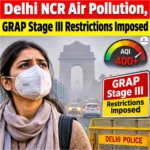
Recently, alarming Delhi NCR Air Pollution triggered emergency GRAP Stage III restrictions as the average AQI neared the “severe” threshold.
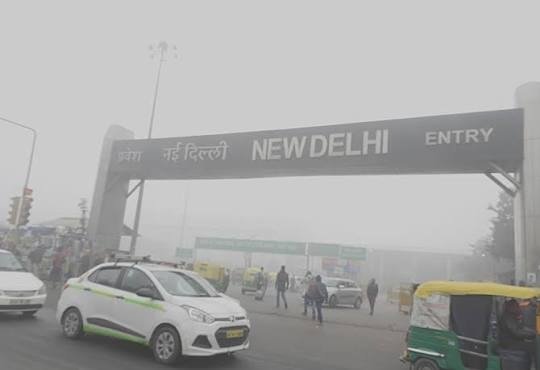
Delhi NCR Air Pollution: AQI Trends, Sources and Impacts
- Trends:
- On 6 November 2026, Delhi’s average Air Quality Index (AQI) reached 382, placing it in the Very Poor category.
- AQI is a standardized numerical scale used by government agencies to measure air pollution.
- The AQI classification ranges from Good (0–50), Satisfactory (51–100), Moderate (101–200), Poor (201–300), Very Poor (301–400) and Severe (401–500).
- According to government data, Delhi’s annual average PM2.5 concentration declined from 105 µg/m³ in 2024 to 97 µg/m³ in 2025, while PM10 decreased from 212 to 198 µg/m³.
- PM2.5 remains substantially above India’s annual permissible limit of 40 µg/m³.
- The Commission for Air Quality Management (CAQM) preemptively invoked GRAP Stage III restrictions across the entire National Capital Region (NCR) based on meteorology forecasts.
- On 6 November 2026, Delhi’s average Air Quality Index (AQI) reached 382, placing it in the Very Poor category.
- Sources:
- A 2026 CAQM expert assessment identified the following wintertime PM2.5 contributions: secondary particulates (27%), transport (23%), biomass burning (20%), dust (15%) and industries, including thermal power plants (9%).
- Secondary particulates form through atmospheric chemical reactions involving gaseous pollutants.
- During summer, dust becomes the largest contributor (27%), followed by transport (19%), secondary particulates (17%), industries (14%) and biomass burning (12%).
- Other important sources include construction and demolition activities, road dust, diesel generators, waste burning, landfill fires, household fuel combustion and industrial emissions.
- Seasonal crop-residue burning in Punjab and Haryana further aggravates the situation.
- Regional wind patterns transport pollutants across state boundaries, making Delhi’s air pollution an airshed-level governance challenge.
- A 2026 CAQM expert assessment identified the following wintertime PM2.5 contributions: secondary particulates (27%), transport (23%), biomass burning (20%), dust (15%) and industries, including thermal power plants (9%).
- Impacts:
- Fine particulate matter penetrates deep into the lungs and can enter the bloodstream, increasing the risk of asthma, COPD, cardiovascular diseases, lung cancer and premature mortality.
- A 2024 Lancet Planetary Health study estimated approximately 11,964 annual PM2.5-attributable deaths in Delhi, based on its 2008–2019 study period.
- Studies show that 99% of children in Delhi suffer from varying degrees of lung function deficits.
- Air pollution contributes to reduced visibility, atmospheric haze, vegetation damage, soil contamination and ecosystem degradation.
- Nitrogen oxides and sulphur dioxide contribute to acid deposition, while black carbon influences atmospheric warming.
- Pollution increases healthcare expenditure, workforce absenteeism, productivity losses and premature mortality.
- Construction restrictions, transport disruptions and reduced outdoor commercial activity also affect economic output.
- AQLI’s 2024 assessment estimated that an average Indian could lose 3.4 years of life expectancy if 2022 particulate pollution levels persisted.
- The Clean Air Fund links polluted air to a staggering $95 billion annual impact on the Indian economy.
- The Global Burden of Disease Study highlights that Delhi suffers the highest per-capita economic loss at $62 per citizen annually due to lost productivity.
- Fine particulate matter penetrates deep into the lungs and can enter the bloodstream, increasing the risk of asthma, COPD, cardiovascular diseases, lung cancer and premature mortality.
Institutional Framework to Control Delhi NCR Air Pollution
- Framework:
- Graded Response Action Plan (GRAP) is an emergency, graded pollution-control mechanism implemented across Delhi-NCR.
- It was formulated following Supreme Court directions in M.C. Mehta v. Union of India (2016), drafted in 2016, and notified in January 2017.
- The Supreme Court has repeatedly asserted that the right to a clean and pollution-free environment is a fundamental component of the right to life under Article 21.
- It is implemented by the Commission for Air Quality Management (CAQM) in coordination with the Ministry of Environment, Forest and Climate Change (MoEFCC) and state authorities.
- It scales actions across four distinct stages:
- Stage I – Poor (AQI 201–300): Focuses on basic pollution control, including mechanized road sweeping, water sprinkling, dust mitigation at construction sites, enforcing vehicle PUC norms, and banning open waste burning.
- Stage II – Very Poor (AQI 301–400): Introduces stricter curbs such as limiting diesel generator usage, banning coal or firewood in eateries, and increasing parking fees to deter private vehicle use.
- Stage III – Severe (AQI 401–450): Imposes stringent bans on non-essential construction and demolition activities, halts older/specified motor vehicles (such as BS-III petrol and BS-IV diesel light motor vehicles), and restricts inter-state bus operations.
- Stage IV – Severe+ / Emergency (AQI > 450): Enforces a complete entry ban on truck traffic (except for essential goods), shifts schools to online/hybrid classes, stops construction on public infrastructure, and allows for emergency measures like the odd-even vehicle scheme.
- It was formulated following Supreme Court directions in M.C. Mehta v. Union of India (2016), drafted in 2016, and notified in January 2017.
- Graded Response Action Plan (GRAP) is an emergency, graded pollution-control mechanism implemented across Delhi-NCR.
- Institutions:
- Commission for Air Quality Management (CAQM): Established under the CAQM Act, 2021, it is the principal statutory coordinating authority for Delhi-NCR and adjoining areas.
- Under Section 12, it can issue binding directions, regulate polluting activities, order industrial closures and coordinate state-level action.
- It supervises GRAP and monitors implementation across Delhi, Punjab, Haryana, Rajasthan and Uttar Pradesh.
- Central Pollution Control Board (CPCB): Established under the Water Act, 1974, and functioning under the Air Act, 1981, CPCB coordinates pollution-control activities, monitors air quality, publishes AQI bulletins and provides technical standards.
- State Pollution Control Boards (SPCBs) and Delhi Pollution Control Committee (DPCC) monitor emissions, inspect industries and enforce pollution-control regulations.
- Commission for Air Quality Management (CAQM): Established under the CAQM Act, 2021, it is the principal statutory coordinating authority for Delhi-NCR and adjoining areas.
Government Measures To Combat Air Pollution:
- Clean Air Healthy Delhi Project: An ₹8,300 crore comprehensive project running from September 2026 to August 2033 (co-funded 65% by the World Bank) targeting transport, road dust, construction waste, solid waste management, and industrial emissions.
- Winter Action Plan: Delhi’s Winter Action Plan 2026–27 came into effect on November 1, 2026, and runs through February 28, 2027.
- Up to 50% work-from-home (WFH) arrangements and staggered office timings are implemented for government and private offices during critical pollution phases.
- Municipal parking fees are doubled in targeted zones to discourage private car usage.
- Over 334 specialized enforcement teams and 60 air quality monitoring stations operate across the city alongside the revised GRAP framework.
- The “No PUC, No Fuel” Policy: Vehicle owners cannot buy petrol, diesel, CNG, or LPG at designated fuel stations unless they possess a valid Pollution Under Control (PUC) certificate, monitored via Automatic Number Plate Recognition (ANPR) cameras across 500 fuel stations.
- Vehicular & Fleet Restrictions:
- Only BS-VI compliant vehicles from outside Delhi are permitted entry into the national capital.
- Phasing out petrol vehicles older than 15 years and diesel vehicles older than 10 years.
- Expanding public transport with electric buses, growing metro networks, and scaling up Electric Vehicle (EV) infrastructure (targeting 32,000 EV charging points).
- Construction and Dust Control:
- Strict bans on dust-generating demolition and outdoor civil construction (such as the seasonal civil construction ban from November 1, 2026, to January 31, 2027, and a complete construction ban from December 10, 2026, to January 20, 2027.
- Real-time monitoring of construction sites via AI-enabled CCTV cameras connected to the central Command and Control Centre.
- Mechanical road sweeping and large-scale water sprinkling.
- Industrial & Energy Transitions:
- Shifting conventional fuel industrial units to Piped Natural Gas (PNG).
- Deploying 334 dedicated enforcement teams to inspect and penalize non-compliant or polluting industrial units.
- Real-Time Tracking & Complaints:
- The Delhi Pollution Control Committee (DPCC) manages public complaints regarding open garbage burning and dust violations.
- Central command centers track stubble burning and industrial emissions via satellite and ground-level monitoring stations.
Frequently Asked Questions (FAQs):
1. What is GRAP Stage III?
GRAP Stage III is an emergency pollution-control framework activated during severe air quality conditions to reduce emissions through stricter restrictions.
2. Why have GRAP Stage III restrictions been imposed across Delhi-NCR?
The Commission for Air Quality Management (CAQM) invoked Stage III on 6 November 2026 following deteriorating air quality, with Delhi’s AQI reaching approximately 380.
3. Which activities are restricted under GRAP Stage III?
Restrictions include construction, demolition, certain industrial operations, older vehicle movement and specified dust-generating activities, with exemptions for essential projects.
4. What is the difference between GRAP Stage II and Stage III restrictions?
Stage II emphasises intensified dust control and public transport; Stage III introduces stricter construction bans and restrictions on older vehicles.
Disclaimer: Information in this article is based on official announcements and public records. Details may evolve over time.