Glaw Lake Becomes India’s 101st Ramsar Site
| General Studies Paper III: Wildlife Protection, Biodiversity |
Why in News?
On August 3, 2026, Glaw Lake was designated as India’s 101st Ramsar Site under the Ramsar Convention on Wetlands. It is the first Ramsar Site in Arunachal Pradesh.
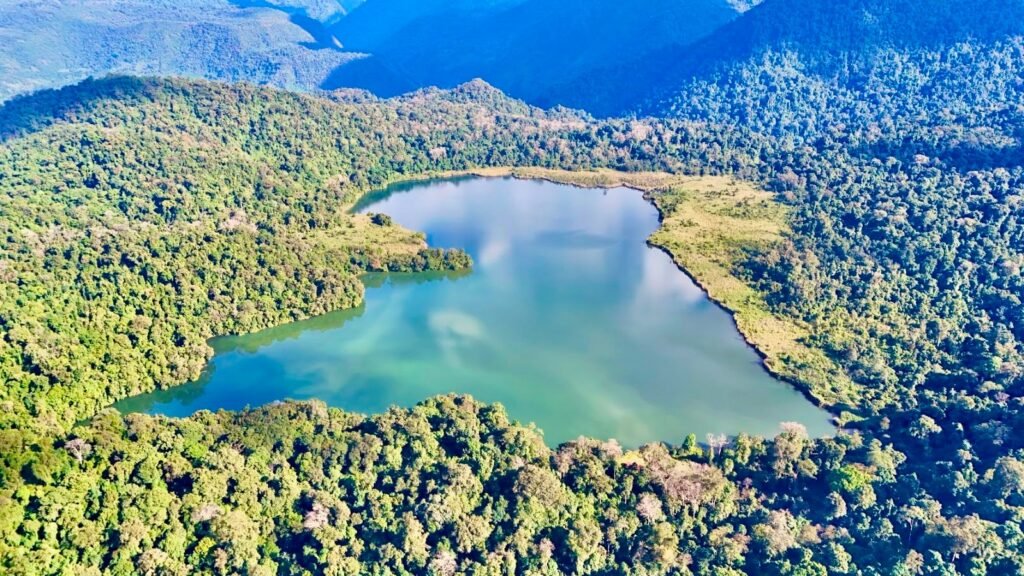
Highlights of Glaw Lake as India’s 101st Ramsar Site
- Location: The Glaw Lake (also known as Glow Lake) is located within the Lohit district of Arunachal Pradesh in Northeast India.
- It is nestled deep inside the fragile eco-zone of the Kamlang Tiger Reserve and Wildlife Sanctuary.
- Physical Parameters: The wetland sits at a high-altitude mountain terrain elevation of approximately 1,168 metres above sea level.
- It features a surface water expanse covering an estimated area of 8 square kilometres along with a baseline circumference of 5 kilometres.
- Geomorphological Origin: The lake basin is classified as a high-altitude natural depression formed through historic tectonic activity and structural land-block warping.
- This formation is typical of the young, active Eastern Himalayan structural fold belt.
- Hydrological Characteristics: It is a pristine, high-altitude freshwater lake that is continuously fed by multiple perennial mountain streams.
- It forms an important part of the Lohit River basin, a major tributary of the Brahmaputra River.
- The glaciated run-off from the surrounding ridges makes it the primary headwater source for the Kamlang River.
- Floral Richness: The ecosystem hosts a dense micro-climate supporting over 150 tree species, including valuable varieties like Hollong, Canarium, and Rhododendron.
- Researchers have recorded at least 49 unique wild orchid species within the wetland’s immediate catchment zone.
- Big Cat Apex Habitats: The lake basin acts as a unique continuous wildlife corridor supporting four major big cat species concurrently.
- These are the Bengal Tiger, Indian Leopard, Clouded Leopard, and the elusive high-altitude Snow Leopard.
- Faunal Diversity: The contiguous forest ecosystem serves as a secure refuge for several endangered primates and rare alpine mammals.
- Notable endemic fauna include the Hoolock Gibbon, Slow Loris, Capped Langur, Red Panda, and the rare Mishmi Takin.
- The lake is a vital habitat and a seasonal wintering ground for the critically endangered White-bellied Heron (Ardea insignis).
- Additionally, the wetland supports over 20 diverse species of reptiles and amphibians.
- Ecosystem Services: The wetland functions as a critical natural reservoir that regulates regional water flows and drives groundwater recharge.
- It aids in climate resilience by serving as a major carbon sink and protecting downstream areas from flash floods.
- Socio-Cultural Significance: The lake holds immense cultural, traditional, and religious value for the indigenous Mishmi (Miju, Digaro, and Idu) community.
- Local communities protect the lake ecosystem out of deep reverence, regarding it as a sacred natural site.
About Kamlang Tiger Reserve and Wildlife Sanctuary
- The Kamlang Tiger Reserve and Wildlife Sanctuary situated in the southeastern alpine zone of the Lohit District in Arunachal Pradesh.
- It stands as one of India’s most ecologically significant alpine and tropical wildlife habitats.
- It is situated near the international border crossing with Myanmar.
- It was initially established as a Wildlife Sanctuary in 1989. In 2016, it was formally designated as India’s 50th Tiger Reserve under the framework of Project Tiger.
- The reserve covers 783 square kilometres. It is bounded by the Lang River to the north and the famous Namdapha National Park to the south.
- The terrain features an extreme altitudinal gradient ranging from 200 metres in the foothills to 4,572 metres above sea level.
- The park derives its name from the perennial Kamlang River flowing through its landscape.
- This river is a vital headwater tributary that feeds directly into the massive Lohit River system.
- In 2024, the government declared the surrounding perimeter a protected Eco-Sensitive Zone (ESZ).
What is a Ramsar Site?
- About: A Ramsar Site is an ecologically sensitive wetland officially registered under the Convention on Wetlands.
- Wetlands include lakes, rivers, marshes, swamps, peatlands, floodplains, mangroves, estuaries, coral reefs, and even human-made wetlands such as reservoirs, fish ponds, rice fields and salt pans.
- It focuses on protecting vital habitats for global waterfowl, which include approximately 180 distinct bird species.
- Historical Genesis: It originates from the Iranian city of Ramsar, where the treaty was signed on February 2, 1971.
- Administered by UNESCO, it came into official global enforcement in 1975.
- It is the world’s first global treaty focused solely on wetlands.
- World Wetlands Day: To raise global public awareness about wetland conservation, February 2 is observed annually as World Wetlands Day.
- Philosophy: The convention revolves around the foundational principle of “Wise Use”.
- It dictates that contracting nations must maintain the ecological character of wetlands through sustainable utilization.
- Framework: The convention’s secretariat is located in Gland, Switzerland. It works alongside International Organization Partners (IOPs) like the IUCN, WWF, and Wetlands International for technical expertise.
- Montreux Record, is a register of Ramsar sites where ecological changes have occurred, are occurring, or are likely to occur.
- When a site faces severe anthropogenic threats, a member state can request a Ramsar Advisory Mission. This team provides high-level monitoring and actionable remediation strategies.
- Designation Criteria: A wetland must satisfy at least one of nine strict criteria to be listed:
- Criterion 1: Contains a representative, rare, or unique example of a natural or near-natural wetland type.
- Criterion 2: Supports vulnerable, endangered, or critically endangered species.
- Criterion 3: Supports populations of plant/animal species important for maintaining regional biodiversity.
- Criterion 4: Supports species at a critical stage in their life cycles (e.g., migration) or provides refuge during adverse conditions.
- Criterion 5: Regularly supports 20,000 or more waterbirds.
- Criterion 6: Regularly supports 1% of the individuals in a population of one species or subspecies of waterbird.
- Criterion 7: Supports a significant proportion of indigenous fish subspecies, life-history stages, or species interactions.
- Criterion 8: Important source of food, spawning ground, nursery, or migration path for fish.
- Criterion 9: Regularly supports 1% of the individuals in a population of one species or subspecies of wetland-dependent non-avian animal species.
- Significance: Ramsar Sites conserve biodiversity, regulate floods, recharge groundwater, purify water, store carbon, protect coastlines and sustain ecological balance.
- Ramsar Sites strengthen global cooperation on water security, climate adaptation, disaster risk reduction and sustainable livelihoods.
- The designation improves international scientific research, restoration funding, and eco-tourism opportunities.
- Global Footprint: As of 2026, there are 172 contracting nations participating in the convention.
- Globally, over 2,500 Ramsar sites protect an area exceeding 250 million hectares.
- Top Country (by count) is the United Kingdom with 176 sites and Top Country (by area) is Bolivia.
- Cobourg Peninsula (Australia) was recognized in 1974 as the world’s first designated Ramsar site.
- Rio Negro (Brazil), spanning roughly 12,000,000 hectares, it is one of the largest individual Ramsar wetland sites on earth.
- India’s Engagement: India ratified the treaty on February 1, 1982.
- As of August 2026, India’s network has expanded significantly to encompass 101 official Ramsar sites nationwide.
- India’ encompass a total area of 1,387,741 hectares (14,005.12 km²), the largest network of protected wetlands in South Asia.
- The number of protected wetlands increased from a mere 26 sites in 2014 to over 100 sites in 2026.
- Chilika Lake (Odisha) and Keoladeo National Park (Rajasthan), both designated in 1981 are India’s oldest Ramsar sites.
- The Sundarban Wetland in West Bengal stands as India’s largest Ramsar site.
- Conversely, Renuka Lake in Himachal Pradesh is officially recognized as the smallest wetland site.
- Tamil Nadu leads nationwide with 20 sites.
- Currently, India’s Keoladeo National Park and Loktak Lake remain on this watch list.
- New Ramsar Sites of 2026:
- 97th Patna Bird Sanctuary – Uttar Pradesh (Added in January 2026)
- 98th Chhari-Dhand Wetland Reserve – Gujarat (Added in January 2026)
- 99th Shekha Jheel Bird Sanctuary – Uttar Pradesh (Added in April 2026)
- 100th Jai Prakash Narayan Bird Sanctuary (Surha Tal) – Uttar Pradesh (Added in June 2026)
- 101st Glaw Lake – Arunachal Pradesh (Added on 3 August 2026)
Frequently Asked Questions (FAQs):
1. What is Glaw Lake and where is it located?
Glaw Lake is a freshwater Himalayan wetland in Wakro, Lohit district, Arunachal Pradesh, within the Lohit River basin.
2. Why has Glaw Lake been designated as a Ramsar Site?
Due to its rich biodiversity, ecological importance, freshwater ecosystem and contribution to wetland conservation.
3. Why is this designation significant for Arunachal Pradesh?
It becomes Arunachal Pradesh’s first Ramsar Site, boosting conservation, research, eco-tourism and global recognition.
4. What is a Ramsar Site?
A Wetland of International Importance designated under the Ramsar Convention for conservation and wise use.
5. How many Ramsar Sites does India now have?
India now has 101 Ramsar Sites, following the inclusion of Glaw Lake.
Disclaimer: Information in this article is based on official announcements and public records. Regulations and implementation details may evolve over time.