



India Fifth Generation Fighter Jet Project
|
General Studies Paper III: Defence Technology, Indigenization of Technology |
Why in News?
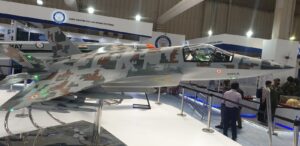
Recently, the Defence Ministry has issued the Request for Proposal (RFP) to three private consortia to design and manufacture prototypes for India’s fifth-generation stealth fighter jet Advanced Medium Combat Aircraft (AMCA).
- The three shortlisted bidders are: Tata Advanced Systems Limited (TASL), Larsen & Toubro (L&T) in partnership with Bharat Electronics Limited (BEL) and Bharat Forge in collaboration with Bharat Earth Movers Limited (BEML).
What is India’s Fifth Generation Fighter Jet Project?
- About: India’s Fifth Generation Fighter Aircraft program, commonly known as Advanced Medium Combat Aircraft (AMCA), is a stealth multirole combat aircraft project, aimed at strengthening indigenous air combat capability.
- It is a medium-weight, twin-engine configuration built for advanced multi-role missions.
- Nodal Agency: The Aeronautical Development Agency (ADA), functioning under the Defence Research and Development Organisation (DRDO), serves as the nodal agency for designing this platform.
- Private Sector Involvement: The Defence Ministry is advancing development through three shortlisted private consortiums: Tata Advanced Systems Limited (TASL), Larsen & Toubro (L&T) partnering with Bharat Electronics Limited (BEL) and Bharat Forge partnering with BEML.
- The private sector involvement framework spans 84 months and incorporates 14 rigorous milestones.
- It includes the first prototype’s maiden flight within 30 months and 1,800 flight-test sorties prior to series production.
- Project Cost: The Cabinet Committee on Security (CCS) cleared a dedicated budget of ₹15,000 crore ($1.8 billion) strictly for the design and development of five physical prototypes.
- Mass industrial layout infrastructure requires an additional ₹65,000 crore.
- Weight Category: The aircraft belongs to the 25-tonne class twin-engine category.
- It features a large concealed internal structure optimized for low radar visibility while accommodating a massive 6.5-tonne internal fuel load.
- Stealth Technology: The structural design incorporates serpentine air intakes and diverterless supersonic inlets to hide engine blades from enemy sensors.
- Advanced radar-absorbent materials (RAM) and a diamond-shaped geometry guarantee minimal radar cross-section.
- Engine: The AMCA Mk1 will utilize the imported 98 kN thrust General Electric F414 engine, while the Mk2 will feature a co-developed 110 kN engine partnered with Safran of France.
- Weapon Carriage: To preserve low radar profiles, it holds a 1,500 kg payload inside an internal weapons bay.
- For non-stealth missions, the exterior structure supports an additional 5,500 kg external payload across multiple hardpoints.
- Operational Performance: The single-seat fighter hits a top speed of Mach 2.15 with a 1,620 km combat range.
- It boasts supercruise capability, enabling supersonic transit without using fuel-guzzling afterburners.
- Core Avionics: The cockpit utilizes an AI-assisted electronic pilot for automated decision support.
- Systems integrate Active Electronically Scanned Array (AESA) radar, sensor fusion, and a net-centric warfare suite to coordinate with unmanned loyal wingman drones.
- Squadron Target: The Indian Air Force (IAF) plans to induct seven initial squadrons totaling roughly 126 stealth jets.
- This fleet will phase out aging assets and counter regional J-20 and J-35 stealth deployments.
- Delivery Timeline: Full engineering tooling began after the final design freeze. The first prototype rollout is targeted for 2026-27, with the inaugural flight scheduled for 2028.
- Serial production is planned for the mid-2030s. The IAF intends to eventually induct squadrons (roughly 120+ stealth fighters) beginning in 2035.
Why India Needs Fifth-Generation Combat Aircraft?
- Rising Chinese Air Power: India requires fifth-generation fighters primarily due to China’s rapidly expanding stealth fleet.
- Defence assessments in 2026 indicate the PLA Air Force operates over 300 J-20 stealth fighters, alongside induction of the newer J-35 platform, significantly altering Asian air-power balance.
- Two-Front Security Threat: The Indian Air Force faces simultaneous pressure from China and Pakistan, especially as reports indicate Pakistan may also pursue stealth aircraft technology.
- Fifth-generation fighters are considered essential for maintaining regional deterrence and air dominance in a two-front conflict scenario.
- Squadron Strength Crisis: The IAF’s authorised strength is 42.5 squadrons, but operational levels are projected near 29–31 squadrons after retirement of ageing MiG-21 fleets.
- This declining combat strength creates urgent demand for technologically superior aircraft with higher survivability and mission flexibility.
- Need for Stealth Capability: India currently lacks an operational stealth fighter aircraft, while major powers increasingly deploy radar-evading jets.
- 5G jets are already possessed & devoleped by Russia (Sukhoi Su-57), China (Chengdu J-20), and the US (F-35).
- Fifth-generation platforms provide low radar visibility and network-centric warfare integration, crucial for future air combat environments.
- Indigenous Defence Self-Reliance: The AMCA programme is central to India’s Atmanirbhar Bharat defence strategy.
- Beyond combat aviation, the project strengthens domestic capability in advanced materials, electronics, weapons integration, aerospace manufacturing, and engine technology ecosystems.
- Technological Competition: Several countries such as the US, China, Russia, the UK, Japan, Italy, France, Germany, and Spain have announced the development of sixth-generation fighters.
- Indian parliamentary discussions in 2026 stressed that air warfare is becoming increasingly technology-driven, requiring India to rapidly build expertise in stealth combat systems.
- Long-Term Strategic Autonomy: Fifth-generation fighters reduce dependence on foreign suppliers for critical combat platforms.
- Indigenous stealth aircraft development ensures operational sovereignty, independent upgrades, domestic weapons integration, and secure wartime logistics, strengthening India’s long-term strategic autonomy.
|
India’s Current Combat Aircraft Fleet Structure:
|
|
Also Read: India to Launch First Indigenous C-295 Military Aircraft by September 2026 |