Xtreme Weather Grade Diesel Launched for Sub-Zero Operations
| General Studies Paper III: Indigenous Technology, Defence Technology |
Why in News?
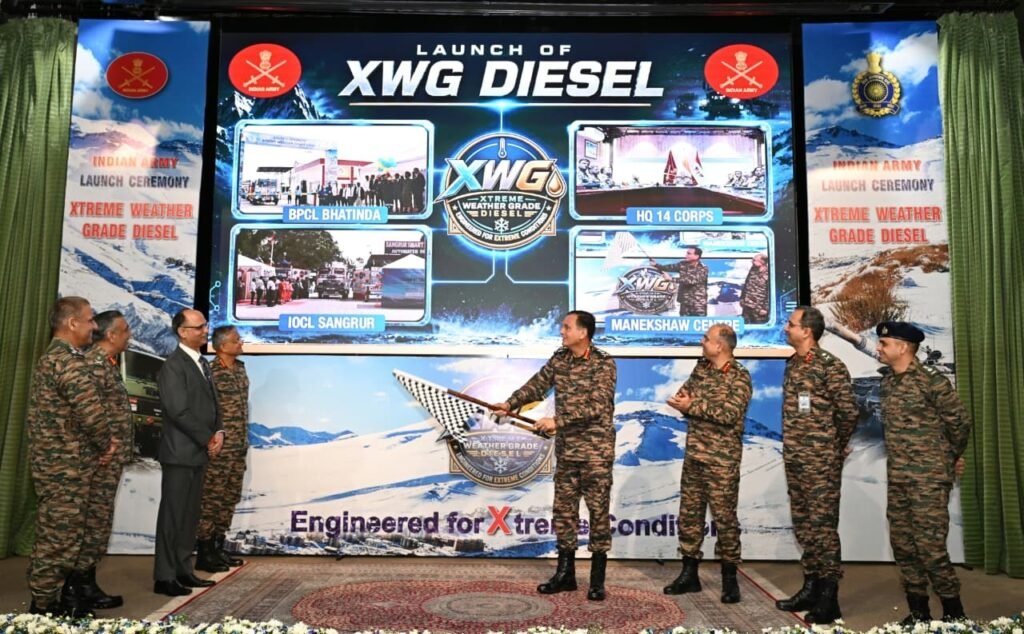
Recently, the Indian Army launched indigenous Xtreme Weather Grade Diesel for Sub-Zero Operations, ensuring reliable vehicle operations and dual-use civilian resilience.
What is Xtreme Weather Grade Diesel?
- About: Xtreme Weather Grade (XWG) Diesel is an indigenously developed specialised diesel fuel for the Indian Army.
- Chief of Army Staff General Dhiraj Seth launched the indigenous Xtreme Weather Grade Diesel on 31 July 2026.
- It is designed to keep combat and logistics vehicles operational in extreme cold where ordinary diesel thickens or stops flowing.
- Joint Development: This diesel technology has been jointly developed by the Indian Army and public sector oil marketing companies (OMCs) like Bharat Petroleum Corporation Limited (BPCL).
- This entire technology has been developed within a record one year.
- Need: The paraffin wax in regular diesel begins to crystallize at extremely low temperatures (below 0°C). This causes the diesel to become thick (gel-like).
- The thick diesel would completely block the fuel system and fuel filter, causing the vehicle to stop starting.
- To tackle this issue, this fuel was developed to ensure uninterrupted mobility in areas such as Eastern Ladakh, the Line of Actual Control (LAC) and the Line of Control (LoC).
- Features:
- Pour Point: This fuel has a pour point of minus 42 degrees Celsius (-42°C).
- It remains fully effective and does not freeze even in freezing temperatures as low as -42°C.
- Emission Norms: It is fully compliant with the environment friendly BS-VI norms.
- Specification: It meets IS 1460:2025 specifications of Bureau of Indian Standards (BIS).
- Drop-in Fuel: Its biggest feature is that for its use, no engine modification is required in the engines of existing army vehicles.
- Ideal Flash Point: XWG Diesel has a flash point of around 50°C.
- Its viscosity is balanced in such a way that it easily atomizes in the combustion chamber of the engine even in extreme cold.
- Vehicle Mobility: The fuel maintains uninterrupted operation of tanks, trucks, engineering vehicles, and logistics platforms.
- Dual Utility: Extends high-altitude reliability to civilian transportation and logistics in severe winter sectors.
- Pour Point: This fuel has a pour point of minus 42 degrees Celsius (-42°C).
- Supply Chain: BPCL has established a dedicated logistics network from its Bina Refinery to strategic military storage facilities in Bathinda.
- The first shipment was dispatched from Indian Oil’s Sangrur terminal.
Importance of XWG Diesel for India
- Strengthens Year-Round Border Deployment: XWG Diesel enables the Indian Army to sustain continuous deployment throughout harsh winters without seasonal fuel limitations.
- Enhances Strategic Deterrence: Reliable fuel availability strengthens India’s credible military deterrence along sensitive frontiers. Faster mobilisation improves the Army’s ability to respond rapidly.
- Improves Logistics Sustainability: Continuous vehicle movement ensures uninterrupted transportation of food, ammunition, fuel, engineering stores, medicines and winter equipment. Robust logistics directly support long-duration military deployments.
- Boosts Defence Industrial Capability: The specialised fuel demonstrates India’s growing expertise in developing mission-specific defence technologies. It strengthens the domestic defence ecosystem.
- Reduces Strategic Vulnerability: Indigenous specialised fuel decreases dependence on foreign formulations during emergencies. This improves energy security and ensures uninterrupted military preparedness.
- Encourages Future Fuel Innovation: The project creates a technological foundation for developing advanced Arctic-grade fuels, specialised lubricants, and other climate-specific military energy solutions for future operational requirements.
Other Indigenous Military Logistics Innovations
- 46-Metre Indigenous Modular Bridge: India developed a 46-metre Modular Bridge through DRDO for the Indian Army.
- The mechanically launched bridge enables rapid crossing of canals, ravines and ditches.
- Forty-one bridge sets, worth about ₹2,585 crore, are being inducted.
- Short Span Bridging System (SSBS–10 m): The SSBS–10 m is another indigenous DRDO innovation.
- It creates a 4-metre-wide roadway across gaps up to 9.5 metres, allowing faster troop movement and disaster-response operations in difficult terrain.
- Advance Truss Bridge: The Army has also developed an indigenous Advance Truss Bridge for emergency connectivity.
- It requires fewer personnel, assembles quickly and restores roads damaged by floods, landslides or military operations.
- 20-Tonne Heavy Drop System: India validated the indigenous Advance 28-ft Heavy Drop System–20T, enabling aircraft to air-drop 20-tonne military loads, including vehicles and engineering equipment, into inaccessible areas without runways.
- ADC-150 Air Droppable Container: DRDO and the Indian Navy successfully tested the ADC-150.
- It is an indigenous air-droppable logistics container carrying 150 kg of essential stores.
- It enables aircraft to deliver medicines, spare parts and emergency supplies to naval ships without landing.
Frequently Asked Questions (FAQs):
-
What is Xtreme Weather Grade Diesel?
Xtreme Weather Grade Diesel is an indigenous military diesel engineered to operate reliably in temperatures as low as −42°C.
-
Why was this fuel developed?
It was developed to ensure uninterrupted Indian Army vehicle operations in extreme cold by preventing diesel gelling and difficult engine starts.
-
Who launched the indigenous Xtreme Weather Grade Diesel?
Chief of Army Staff General Dhiraj Seth launched the indigenous Xtreme Weather Grade Diesel on 31 July 2026.
-
How is it different from conventional diesel?
Unlike conventional diesel, XWG Diesel remains fluid at −42°C, ensuring reliable fuel flow, engine starting, and vehicle performance.
-
Where will this diesel primarily be used?
It will primarily be used in high-altitude Himalayan border areas, including Eastern Ladakh and other extreme cold operational regions.
-
What are the benefits of using this fuel in extreme weather conditions?
It improves combat readiness, vehicle reliability, logistics continuity, border mobility, reduced maintenance, and uninterrupted military operations during severe winter conditions.
Disclaimer: Information in this article is based on official announcements and public records. Regulations and implementation details may evolve over time.
| Also Read: Indian Army T-72 Tanks Upgradation Plan |