Indian Army T-72 Tanks Upgradation Plan
|
General Studies Paper III: Government Policies & Interventions, Defence Technology |
Why in News?
Recently, the Indian Army accelerated Project Rhino to modernise ageing T-72 Main Battle Tanks (MBTs) to contemporary combat standards, ensuring their operational viability well beyond 2030.
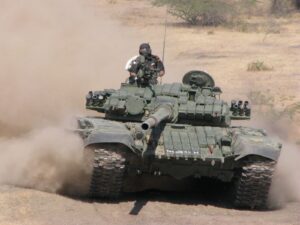
What are T-72 Main Battle Tanks (MBTs)?
- About: The T-72 Main Battle Tank (MBT) is a Soviet-origin heavy armoured combat platform designed for frontline warfare.
- It combines firepower, mobility and armour protection for offensive and defensive battlefield operations.
- The tank was designed to achieve high survivability and rapid battlefield dominance against enemy armour.
- It was developed to counter Western-made tanks like the American M60, British Chieftain, and German Leopard 1.
- Developed By: The T-72 was developed by Soviet designers Leonid Kartsev and Valeri Venediktov during 1967–1973.
- It officially entered production in 1973 under manufacturer Uralvagonzavod.
- Dimensions: The T-72 measures around 9.53 metres (31 feet) with gun forward, 3.59 metres width and nearly 2.23 metres height. Its smaller height made it difficult to detect on battlefields.
- Crew System: The tank operates with only three crew members — commander, gunner and driver — because of its automatic loading system, reducing manpower requirements during combat.
- Firepower Strength: Its primary weapon is a 125 mm smoothbore gun carrying nearly 45 rounds. The powerful cannon can destroy enemy tanks, bunkers and fortified positions effectively.
- This gun can fire Armor-Piercing Fin-Stabilized Discarding-Sabot (APFSDS) rounds to smash through enemy steel.
- It provides a steady firing rate of up to 8 rounds per minute and reduces the crew to just three members.
- Engine Mobility: The T-72 uses an 840-horsepower diesel engine with a maximum road speed of nearly 60 km/h and operational range around 500 km.
- Armour Protection: The tank contains steel, composite armour and explosive reactive armour (ERA) protection systems. These enhance survivability against anti-tank missiles and battlefield explosives.
- Combat Assistance: In modern war situations, it relies on twin-axis stabilization that ensures accurate firing while moving across rough terrain.
- It is also equipped with Nuclear, Biological, and Chemical (NBC) protection systems to keep the crew safe in hazardous zones.
- Presence: Over 25,000 T-72 tanks were produced globally and deployed across nearly 40 countries.
- It was heavily exported to Warsaw Pact countries and the Middle East, and license-produced in nations like India.
- India inducted the T-72 into the Indian Army in 1978. It rapidly became the backbone of India’s armoured corps.
- It has seen widespread deployment in major conflicts spanning from the Yom Kippur War and Iran-Iraq War to the recent Russo-Ukrainian War.
|
Indian T-72 Fleet And Upgraded Variants:
|
Why T-72 Tanks Upgradation Needed?
- Ageing Platform: India inducted T-72 tanks in 1978, making several platforms over 45 years old.
- Continuous battlefield deployment has reduced operational efficiency, while newer Chinese and Pakistani tanks now possess superior electronics, sensors and armour systems.
- Night Warfare: The original T-72 relied on outdated optical sights that performed poorly during darkness, fog and smoke-heavy combat.
- After the 1991 Gulf War, Soviet-era tanks showed major weaknesses against thermal-imaging equipped Western tanks, forcing India to modernise night-fighting capabilities.
- China Threat: China has deployed advanced armoured systems like the Type-99 and Type-15 tanks with digital targeting, thermal sights and network-centric warfare capabilities.
- India requires upgraded T-72 tanks with advanced fire-control systems to maintain battlefield balance along northern borders.
- Pakistan Challenge: Pakistan inducted upgraded T-80UD, Type-85 and VT-4 tanks possessing stronger engines, improved armour and modern targeting systems.
- Without upgrades, India’s large T-72 fleet could face survivability and accuracy disadvantages during high-intensity mechanised warfare.
- Mobility Decline: The T-72 originally used a 780 HP engine, but additional armour and electronic systems increased tank weight from nearly 41 tonnes to 44 tonnes, reducing speed and manoeuvrability.
- Government therefore developing an upgraded engine to restore mobility in deserts and battlefield operations.
T-72 Tanks Modernisation Roadmap
- Project Rhino: The Indian Army is executing Project Rhino to modernise nearly 1,500–2,000 T-72 tanks.
- The programme aims to retain operational relevance of the ageing fleet beyond 2030–2040 until Future Ready Combat Vehicles (FRCVs) are inducted.
- The broader objective is maintaining India’s armoured numerical strength against China and Pakistan while bridging capability gaps before next-generation FRCV induction.
- Upgraded T-72 fleets are expected to remain combat-operational until nearly 2045.
- Engine Laboratory: India’s Combat Vehicles Research and Development Establishment (CVRDE) under DRDO is supporting integration of upgraded 1000 HP engines replacing older 780 HP engines.
- Laboratory-level testing focuses on mobility restoration, fuel efficiency and high-altitude operational performance.
- Protection Systems: The roadmap includes advanced Explosive Reactive Armour (ERA), laser-warning receivers, smoke grenade launchers and automatic fire-suppression systems to counter drones, anti-tank guided missiles.
- Digital Firepower: Advanced digital ballistic computers, automatic target tracking and laser range-finders are planned for upgraded variants.
- These systems significantly improve first-shot kill probability during rapid mechanised warfare and network-centric combat operations.
- Aditi Initiative: Under the proposed Aditi 4.0 initiative, India may convert selected T-72 tanks into remotely operated or unmanned combat platforms.
- These systems could support reconnaissance, minefield penetration and high-risk assault missions without crew exposure.