US Treasury Prepares To Print Trump Portrait On $250 Note
|
General Studies Paper II: Effect of Policies & Politics of Countries on India’s Interests |
Why in News?
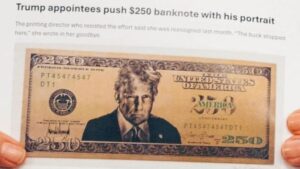
The US Treasury Department has been preparing preliminary mock-ups of a proposed USD 250 banknote featuring President Donald Trump’s portrait.
- If approved, Trump would become the first living person in over 160 years to appear on U.S. paper currency.
Key Facts About Proposed $250 Bank Note
- Proposal: The U.S. Treasury Department confirmed that the Bureau of Engraving and Printing (BEP) has initiated “appropriate planning and due diligence” for a proposed $250 commemorative banknote carrying former President Donald Trump’s portrait.
- Treasury Secretary Scott Bessent stated the department is preparing prototype concepts in advance if Congress approves the measure.
- Reports indicate internal mock-ups were already circulated among Treasury officials.
- Semiquincentennial Link: The proposal is closely connected to the 250th anniversary of the U.S. Declaration of Independence in 2026, officially termed the Semiquincentennial.
- The Trump administration reportedly considers the commemorative note part of broader patriotic celebrations planned for America’s founding anniversary.
- Treasury officials argued that a special note could symbolize national heritage and political continuity during the historic observance.
- Legislative Push: Republican Congressman Joe Wilson introduced the “Donald J. Trump $250 Bill Act” to authorize the commemorative currency.
- The bill directs the BEP to design and print a $250 bill of legal U.S. tender bearing Donald J. Trump’s portrait.
- This act explicitly seeks to create an exemption of existing acts for individuals who have served as President.
- Design Features: Prototype designs reportedly include Trump’s second-term portrait, patriotic American flag colors, the phrase “250 America,” commemorative anniversary insignia, and Trump’s signature.
- British artist Iain Alexander allegedly prepared concept illustrations after consultations with administration officials.
- Some reports suggest the portrait style resembles Trump’s 2023 Georgia mugshot image, later modified with national symbolism and semiquincentennial branding elements.
Constitutional and Legal Challenges
- Historic Restriction: The biggest constitutional obstacle comes from the 1866 federal currency law, commonly linked to the Thayer Amendment, which clearly prohibits any living person from appearing on U.S. banknotes, bonds, or securities.
- Congress enacted the rule after Treasury official Spencer Clark controversially placed his own portrait on currency, triggering national outrage and institutional reforms.
- Congressional Authority: Under the U.S. constitutional framework, only Congress can legally authorize new currency denominations or amend currency-design laws.
- Therefore, the proposed “Donald J. Trump $250 Bill Act” introduced by Congressman Joe Wilson must first secure House and Senate approval before the Treasury Department can proceed legally.
- Senate approval remains difficult because most legislation requires 60 votes, while Republicans currently hold 53 seats. Democrats criticized the proposal as politically self-promotional.
- Institutional Neutrality: Critics argue U.S. currency traditionally represents national continuity rather than active political leadership.
- Featuring a sitting president may weaken institutional impartiality and transform currency into a tool of political personalization, raising broader constitutional ethics concerns.
- Denomination Legality: The proposed $250 denomination itself lacks statutory recognition under existing U.S. currency structures, raising concerns regarding practicality, printing costs, circulation utility, and inflation-era political messaging.
- Current circulating denominations officially stop at $100, meaning Congress must separately authorize both the portrait and the entirely new denomination category.
- Judicial Possibility: If Congress changes the law, constitutional litigation could still emerge over whether commemorative political currency violates principles of democratic neutrality, equal representation, or misuse of federal symbolic authority.
Broad Currency Changes Under Trump
- Signature Change: The U.S. Treasury Department confirmed that future American paper currency will carry Donald Trump’s handwritten signature, beginning with newly issued $100 bills in June 2026.
- This marks the first time in U.S. history that a sitting president’s signature appears on circulating Federal Reserve notes, replacing the traditional signature position of the U.S. Treasurer maintained since 1861.
- Gold Coin: The U.S. Commission of Fine Arts approved a 24-karat commemorative gold coin featuring Trump’s image for the 2026 Semiquincentennial celebrations.
- The coin reportedly depicts Trump on the obverse side, while reverse designs include patriotic symbols such as a raised fist, bald eagle, and national anniversary insignia.
|
US Currency Related Framework:
|
|
Also Read: US Paper Currency to Feature Trump Signature |