



New Giant Waterlily Discovery, Facts About the Species
| General Studies Paper III: New Species, Biodiversity |
Why in News?
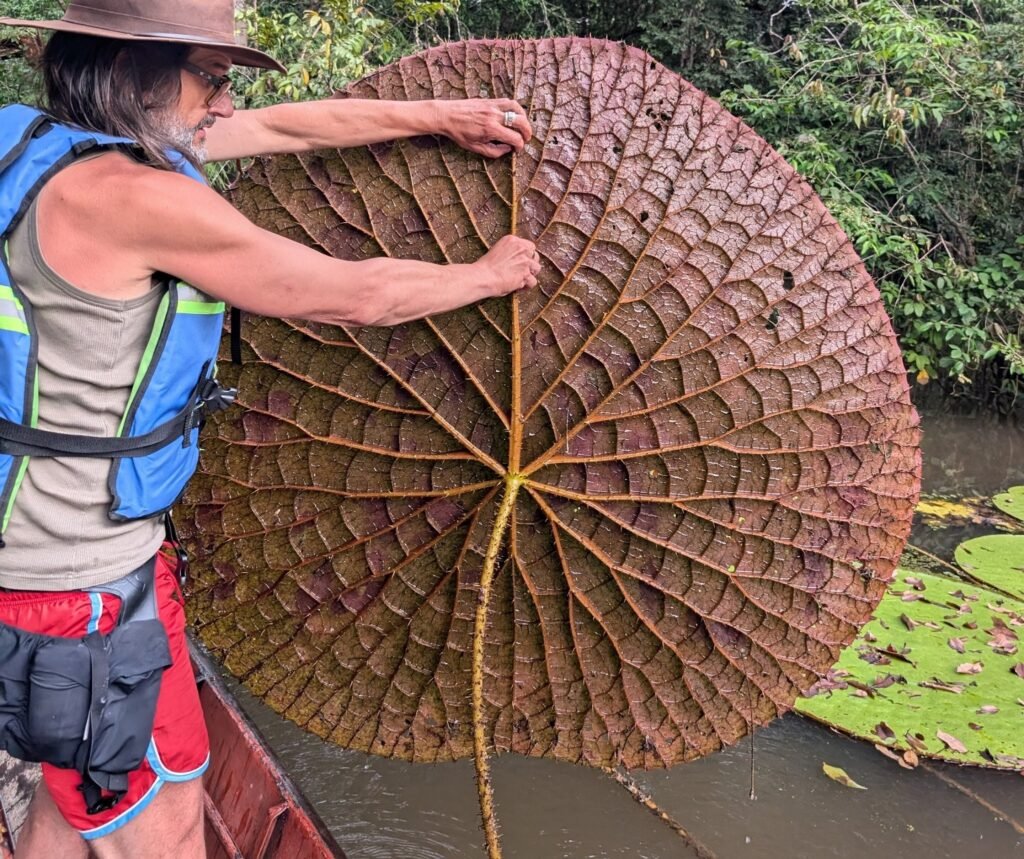
Recently, scientists identified a new giant waterlily in Colombia’s Orinoco basin, with leaves reaching two metres.
Highlights New Giant Waterlily
- Discovery: The new giant waterlily species, formally identified as Victoria colombiana, was discovered growing natively within the Inírida River basin located in the Guainía department of the Colombian rainforest.
- The rare plant grows in secluded, flooded lagoons and lakes tucked deep inside the South American rainforest ecosystem.
- Discovered By: The discovery began when Carlos Magdalena, a botanical horticulturist from the Royal Botanic Gardens, Kew, noticed unusual social media photos.
- The images were posted by an American plant enthusiast named Jeremiah Harris in 2021.
- A dedicated five-day scientific expedition was later launched alongside experts from the Bogotá Botanical Garden and local Indigenous Tucano guides.
- Identification Method: Scientists utilized a combination of modern satellite imagery and physical fieldwork to confirm the new species.
- Researchers tracked their exact coordinates through satellite data. Local boatmen named Gustavo Melo then guided scientists to a secluded lake to collect a vital flowering specimen for structural and genetic verification.
- The findings were published in the botanical journal Phytotaxa.
- Taxonomy: The plant belongs to the flowering aquatic plant family Nymphaeaceae.
- It is recognized as the fourth official species belonging to the distinct genus Victoria.
- It shares its lineage alongside its close giant relatives: Victoria amazonica, Victoria cruziana, and the world’s largest waterlily, Victoria boliviana.
- Features: This giant waterlily features floating leaves that can grow up to two meters across.
- The plant is anchored to the muddy lagoon floors by long, sturdy underwater stalks.
- To survive in moving waters, the underside of each leaf features a complex network of air pockets and ribs that maximize buoyancy while resisting river currents.
- Unlike its sister species, it possesses a unique cube-shaped ovary with distinct sunken sides.
- The structural prickles running along its body are characteristically shorter, denser, and softer than other giant lilies.
- The massive nocturnal flowers bloom for a very short duration, opening at night to draw in native pollinators.
- A thick waxy leaf cuticle coats the top surface to repel heavy rainfall and keep its gas-exchanging stomata completely clear.
- Distribution: The species is strictly endemic to the Orinoco River watershed in eastern Colombia.
- It has currently only been documented across three interconnected lakes within the isolated, flooded rainforest regions of Guainía.
- This highly restricted range separates it from other giant waterlilies that dominate the main Amazon basin.
- It has currently only been documented across three interconnected lakes within the isolated, flooded rainforest regions of Guainía.
- Population: Biologists estimate that only 30 to 50 individual plants currently remain in the wild.
- Conservation: Due to these alarming numbers, the waterlily is classified as critically endangered.
- Conservationists are urgently planning seed collection to cultivate the plant safely within Kew Gardens and Bogotá, while establishing protected zones inside Indigenous territories.
- Challenges: The main challenge facing the plant is its extreme rarity and highly localized distribution, leaving it vulnerable to minor environmental shifts.
- Navigating the isolated and flooded terrain makes continuous monitoring highly difficult for researchers.
- Safeguarding the wild population requires delicate, long-term cooperation and legal protection within remote tribal lands.
About Waterlilly
- Taxonomy: Waterlilies belong to the family Nymphaeaceae, which falls under the order Nymphaeales.
- They are classified as basal angiosperms (ANA grade), representing one of the earliest diverging branches of flowering plants.
- The family comprises roughly 58 to 70 perennial aquatic species spread across genera such as Nymphaea, Nuphar, Barclaya, and the giant Victoria.
- Adaptations: The plant is an evolutionary marvel of aquatic adaptation, featuring hydrophobic waxy cuticles on circular leaves (lily pads) to repel water and prevent sinking.
- Long, flexible petioles (stems) anchor the plant to underground rhizomes buried in benthic mud while allowing the leaves to adjust to fluctuating water levels.
- Internally, well-developed aerenchyma tissues (air spaces) facilitate buoyancy and gas exchange between the submerged roots and the surface atmosphere.
- Distribution: Waterlilies exhibit a true cosmopolitan distribution, inhabiting freshwater wetlands, shallow lakes, and slow-moving streams across both temperate and tropical zones.
- The genus Nymphaea is absent only from extreme polar zones, specific variants like the massive Victoria amazonica are restricted to tropical South America.
- Their wide latitudinal tolerance allows them to thrive from boreal regions in the Northern Hemisphere down to the wetlands of Australia.
- In India, waterlilies are widely distributed across wetlands, village ponds, and the floodplains of the Indo-Gangetic and Peninsular river basins.
- The most prominent native Indian species include Nymphaea nouchali (the blue star waterlily or Neelkamal) and Nymphaea pubescens (the pink/white night-blooming waterlily).
- The Andaman and Nicobar Islands serve as unique ecological zones, recording introduced or naturalized wild species like Nymphaea micrantha.
- Classification: Horticultural and ecological grouping divides waterlilies into hardy and tropical varieties.
- Hardy waterlilies grow strictly during the spring and summer, going entirely dormant in winter to survive freezing temperatures, and display daytime-only blooms.
- Tropical waterlilies require warm water temperatures year-round, exhibit more intense color spectrums, and feature both day-blooming and night-blooming mechanisms.
- Ecological Functions: Waterlilies act as critical foundation species within freshwater lentic ecosystems.
- Their expansive surface canopy blocks sunlight, which effectively limits harmful algal blooms and regulates ambient water temperature.
- The submerged root networks stabilize pond sediments to control turbidity, while the leaf surfaces provide pivotal microhabitats, spawning grounds, and shelter for macroinvertebrates, amphibians, and fish species.
- Waterlilies reproduce through seeds and, in many species, vegetative growth.
- Economic Uses: They are significant in agro-economics and regional cuisines across India, particularly in West Bengal and the Northeast.
- The peduncle (flower stalk) is peeled and eaten as a nutritious vegetable, while the nutrient-dense, starchy rhizomes and seeds are frequently harvested, boiled, or roasted.
- In traditional medicine systems like Ayurveda, extracts from Nymphaea species are deployed for their anti-inflammatory, antimicrobial, and cooling properties.
- Conservation: Most widespread species like Nymphaea nouchali and Nymphaea pubescens are categorized as Least Concern (LC) on the IUCN Red List.
- Localized populations face massive degradation due to wetland encroachment, agricultural runoff causing eutrophication, and hydrological changes.
- Specific hyper-endemic global species, such as the thermal-adapted Nymphaea thermarum, have faced severe extinction crises.
Frequently Asked Questions (FAQs):
1. What is the newly identified giant waterlily species in Colombia?
Victoria colombiana, a newly described giant waterlily species published in Phytotaxa in October 2026.
2. Where was the new giant waterlily species discovered?
It was found in Colombia’s Inírida region, Guainía Department, within the upper Orinoco River basin.
3. What are the main characteristics of this giant waterlily?
It has floating leaves reaching approximately 2 metres, short soft prickles, and distinctive flowers with a cube-shaped ovary.
4. How is the newly identified species different from other giant waterlilies?
It differs in morphological features, including its distinctive ovary and shorter, softer prickles, and occupies the upper Orinoco basin.
Disclaimer: Information in this article is based on official announcements and public records. Details may evolve over time.
| Also Read: Lady’s Slipper Orchid |