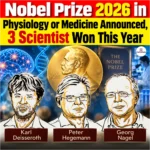




Nobel Prize 2026 in Physiology or Medicine Announced, 3 Scientist Won This Year
| General Studies Paper I: Awards, International Recognition |
Why in News?
Recently, the 2026 Nobel Prize in Physiology or Medicine was awarded to Karl Deisseroth, Peter Hegemann, and Georg Nagel for pioneering optogenetics.
Highlights of the 2026 Nobel Prize in Physiology or Medicine
- Announcement: The 2026 Nobel Prize in Physiology or Medicine was announced on 5 October 2026 by the Nobel Assembly at Karolinska Institutet, Stockholm.
- Secretary-General Thomas Perlmann delivered the breaking news, marking the formal opening of the 2026 Nobel Prize season.
- Winners: The award was jointly given to Karl Deisseroth of Stanford University and Howard Hughes Medical Institute, USA, Peter Hegemann of Humboldt University of Berlin, Germany, and Georg Nagel of the University of Würzburg, Germany.
- Award Citation: The laureates were recognised “for their discoveries concerning light-gated ion channels and optogenetics.”
- The assembly praised their groundbreaking work for introducing a molecular switch for nerve cells, fundamentally opening up a new era in global neuroscience.
- In scientific terms, their work established the basis for using light-sensitive proteins to manipulate electrical activity in living cells, particularly neurons, with exceptional spatial and temporal precision.
- The scientific story began with studies of the single-celled green alga Chlamydomonas reinhardtii.
- Hegemann and Nagel helped identify and characterise channelrhodopsins, proteins that function as light-gated ion channels.
- Their 2002 and 2003 studies established ChR1 and ChR2, respectively.
- Deisseroth and collaborators subsequently adapted channelrhodopsin-2 for neuroscience.
- In 2005, they demonstrated millisecond-scale optical control of mammalian neuronal activity, showing that genetically targeted neurons could be activated using light.
- This converted a microbial light-sensing mechanism into a practical tool for studying neural circuits.
- The Nobel Committee highlighted that optogenetics allows scientists to investigate how individual nerve cells contribute to memory, feelings and behaviour inside a living brain, laying the foundation for a new era of neuroscience.
- Prize Money: The three laureates share 12 million Swedish kronor equally.
What Are Light-Gated Ion Channels & Optogenetics?
- Ion channels are membrane proteins that regulate the movement of electrically charged particles across cell membranes.
- Light-gated ion channels are specialised proteins whose activity changes when exposed to particular wavelengths of light.
- Channelrhodopsins are important examples because illumination can rapidly alter the electrical state of a cell.
- Hegemann and Nagel’s research identified channelrhodopsins in Chlamydomonas.
- When activated by light, these proteins allow ions to cross the cell membrane, changing membrane voltage.
- This discovery was scientifically important because the protein itself could act as a compact biological light-to-electrical signal converter.
- Optogenetics combines optics and genetics. Scientists introduce genes encoding light-sensitive proteins, or opsins, into selected cells.
- Those cells then become responsive to light. Carefully delivered light can subsequently increase or decrease their electrical activity.
- Technique: First, a suitable opsin gene is genetically targeted to particular neurons.
- Second, the protein is expressed on the neuronal membrane. Third, researchers deliver light—often through specialised optical systems—to the targeted cells.
- Depending on the opsin, light can cause depolarisation and excitation or hyperpolarisation and inhibition.
- The major strength is cell-type specificity combined with millisecond-scale temporal control.
- Significance: Optogenetics has helped identify neuronal pathways associated with memory formation, motivation, fear, movement, reward and emotional states.
- The technology is widely used in experimental models of conditions including Parkinson’s disease, epilepsy, Alzheimer’s disease, depression, schizophrenia and addiction.
- Optogenetics has generated interest in future therapies involving neuromodulation, vision restoration and neurological disorders.
- Light-sensitive proteins can be used to manipulate cell signalling, membrane potential and physiological processes in different cell types.
- Research has also explored applications in plant biology, cardiac systems, drug discovery and cellular engineering.
- Optogenetic systems can create highly controlled cellular models for testing biological mechanisms and potential medicines.
- Their ability to manipulate cellular activity with high precision can improve functional screening, disease modelling and target validation.
- Challenges: Major challenges include gene delivery, immune responses, optical penetration, surgical implantation, long-term safety and precise control.
About the Scientists
- Karl Deisseroth, born in 1971, is an Americanneuroscientist, bioengineer and practising psychiatrist associated with Stanford University and the Howard Hughes Medical Institute.
- His interdisciplinary career combines medicine, psychiatry, engineering and neuroscience.
- Deisseroth earned an A.B. in Biochemical Sciences from Harvard University, followed by an M.D. and Ph.D. in Neuroscience from Stanford University.
- He subsequently completed medical internship, psychiatry residency and further training at Stanford.
- His laboratory developed and expanded optogenetic technologies, including methods for targeting specific neuronal populations and delivering light through optical systems.
- He also pioneered CLARITY and hydrogel-tissue chemistry, alongside extensive work on neural circuits underlying behaviour and psychiatric disease.
- He has received the Kyoto Prize, Breakthrough Prize, Lasker Basic Medical Research Award and Japan Prize, among numerous honours.
- Peter Hegemann, born in 1954 in Münster, Germany, is a German biophysicist and Hertie Professor of Neuroscience at Humboldt University of Berlin.
- His scientific interests developed around photoreceptors, microbial rhodopsins and light-controlled ion transport.
- Hegemann studied chemistry at the University of Münster and LMU Munich and obtained his Ph.D. from the Max Planck Institute for Biochemistry in 1984.
- His early research on halorhodopsin helped establish expertise in light-driven membrane proteins.
- He subsequently became a key discoverer and characteriser of channelrhodopsins, providing the molecular foundation of optogenetics.
- Hegemann has received major international recognition including the Shaw Prize, Louis-Jeantet Prize, Brain Prize, Wiley Prize, Warren Alpert Foundation Prize and Rumford Prize.
- He also received substantial European Research Council support for research into the mechanisms of light-sensitive proteins and their optogenetic applications.
- Georg Nagel, born 24 August 1953 in Weingarten, Germany, studied biology and biophysics at the University of Konstanz and completed his doctorate at Goethe University Frankfurt in 1988.
- He subsequently conducted postdoctoral research at Yale University and Rockefeller University before returning to Germany.
- Nagel’s research demonstrated how microbial rhodopsins could function in other cells. He later served at Julius-Maximilians-Universität Würzburg, where he conducted extensive research on photoreceptors and optogenetics.
- His honours include the Wiley Prize in Biomedical Sciences, Karl Heinz Beckurts Prize, Louis Jeantet Prize, Brain Prize, Rumford Prize and Shaw Prize.
- In 2024, Würzburg awarded him its Röntgen Medal.
Important Facts:
- Nobel: The Nobel Prize is a prestigious international award administered by the Nobel Foundation in Stockholm, Sweden, based on the 1895 will of Alfred Nobel, a Swedish chemist and inventor of dynamite.
- Categories: Originally five—Physics, Chemistry, Physiology or Medicine, Literature, and Peace (awarded since 1901). The Sveriges Riksbank Prize in Economic Sciences was established later in 1968.
- Awarding Bodies:
- Royal Swedish Academy of Sciences (Physics, Chemistry, Economics)
- Nobel Assembly at the Karolinska Institute (Medicine)
- Swedish Academy (Literature)
- Norwegian Nobel Committee (Peace—awarded in Oslo, Norway, while others are in Stockholm, Sweden).
- Key Rules: It cannot be awarded posthumously unless the recipient dies after the announcement.
- A prize can be shared by a maximum of three individuals.
- Indian / Indian-Origin Laureates:
- Rabindranath Tagore (1913): First Asian to win (Literature).
- CV Raman (1930): Physics (Raman Effect).
- Mother Teresa (1979): Peace.
- Amartya Sen (1998): Economic Sciences (Welfare Economics).
- Kailash Satyarthi (2014): Peace (Child rights).
- Notable Indian-origin/citizenship winners: Har Gobind Khorana, Subrahmanyan Chandrasekhar, Venki Ramakrishnan, Abhijit Banerjee.
Frequently Asked Questions (FAQs):
1. Who are the Nobel Prize 2026 winners?
Karl Deisseroth, Peter Hegemann and Georg Nagel won the 2026 Nobel Prize in Physiology or Medicine for discoveries concerning light-gated ion channels and optogenetics.
2. When were the Nobel Prize 2026 winners announced?
The 2026 Nobel announcements began on 5 October 2026 and are scheduled through 12 October 2026, covering six prize categories.
3. Who won the Nobel Peace Prize 2026?
Not yet announced. The 2026 Nobel Peace Prize is scheduled for announcement on 9 October 2026 by the Norwegian Nobel Committee.
4. What are the Nobel Prize 2026 categories?
The six categories are Physiology or Medicine, Physics, Chemistry, Literature, Peace, and Economic Sciences in Memory of Alfred Nobel.
Disclaimer: Information in this article is based on official announcements and public records. Details may evolve over time.
| Also Read: Nobel Prize 2025 in Literature |