




UN Praises India Efforts Against Child Marriage, India’s Progress in Safeguarding Girl Child Rights
| General Studies Paper III: Social Justice, Education, Human Resources |
Why in News?
Recently, at a United Nations (UN) event co-hosted by India and Sierra Leone titled ‘Investing in Girl Child: Transforming Our Future’, global leaders lauded India’s community-driven investments that significantly reduced child marriage.
What is Child Marriage?
- About: Child marriage is a formal marriage or informal union. It involves at least one individual under 18 years of age. International frameworks recognize this practice as a human rights violation.
- Global Scale: Child marriage affects approximately 12 million girls every year worldwide.
- Roughly 21 percent (or 1 in 5) of young women globally were married before reaching adulthood at age 18.
- Around 640 million women and girls alive today were married as children.
- Highest prevalence rates occur across parts of Africa, South, Southeast, and West Asia, and Latin America.
- Causes: Deep-rooted gender inequality heavily drives this harmful custom. Entrenched poverty and cultural traditions push families to marry children early.
- Parents often view girls as financial burdens or seek to secure dowries.
- Consequences: Married children almost always drop out of school immediately.
- The loss of education severely restricts their future career opportunities.
- Child brides face elevated risks of experiencing domestic violence and sexual abuse.
- Child brides face severe health risks due to early pregnancy and childbirth.
- Their bodies are not ready, leading to high maternal mortality and obstetric fistulas. Their infants also suffer higher risks of malnutrition and death.
Child Marriage in India
- Data:
- India hosts the largest number of child brides globally. Data from the UNFPA India Report shows that 23.3% of women aged 20–24 married before turning 18.
- Although the overall rate has dropped from 47.4% in 2005–06, millions of girls still face early marriage each year.
- India accounts for approximately one-third of the world’s child brides.
- According to the UNICEF Data Profile on India, five states—Uttar Pradesh, Bihar, West Bengal, Maharashtra, and Madhya Pradesh—account for more than half of all women in India who married before age 18.
- West Bengal, Bihar, and Tripura show the highest prevalence, where over 40% of young women marry before adulthood.
- Conversely, southern and western states generally report much lower rates due to better social infrastructure.
- Lakshadweep, Jammu & Kashmir, Ladakh, Himachal Pradesh, Goa, and Nagaland are lowest.
- Girls with no formal education face a 48% child marriage rate, compared to just 4% for girls with higher education.
- 40% of girls in the lowest wealth quintile marry early, compared to only 8% in the highest wealth bracket.
- India hosts the largest number of child brides globally. Data from the UNFPA India Report shows that 23.3% of women aged 20–24 married before turning 18.
- Legal Frameworks:
- The Prohibition of Child Marriage Act (PCMA), 2006 sets the current legal age limits.
- The law establishes the minimum age as 18 for females and 21 for males.
- The PCMA replaced the older Child Marriage Restraint Act of 1929.
- The current law explicitly makes child marriages voidable at the option of the contracting minor.
- The legal framework imposes strict criminal penalties. Offenders face up to two years of rigorous imprisonment and a fine of ₹1,00,000.
- The government recently proposed a bill to raise the female legal marriage age to 21 years.
- The Supreme Court ruled in Society for Enlightenment and Voluntary Action v. Union of India on October 18, 2024, that PCMA 2006 cannot be stunted or restricted by personal laws.
- In 2017, the court ruled that sexual intercourse with a wife under 18 years is rape.
- Protection of Children from Sexual Offences (POCSO) Act, 2012 criminalises sexual relations with a wife below 18 years of age.
- State governments appoint dedicated Child Marriage Prohibition Officers (CMPOs) to prevent child marriages and gather localized evidence.
- The law coordinates with Child Welfare Committees (CWCs) under the Juvenile Justice Act to provide institutional care and rehabilitation to rescued minors.
- The Prohibition of Child Marriage Act (PCMA), 2006 sets the current legal age limits.
- Government Initiatives:
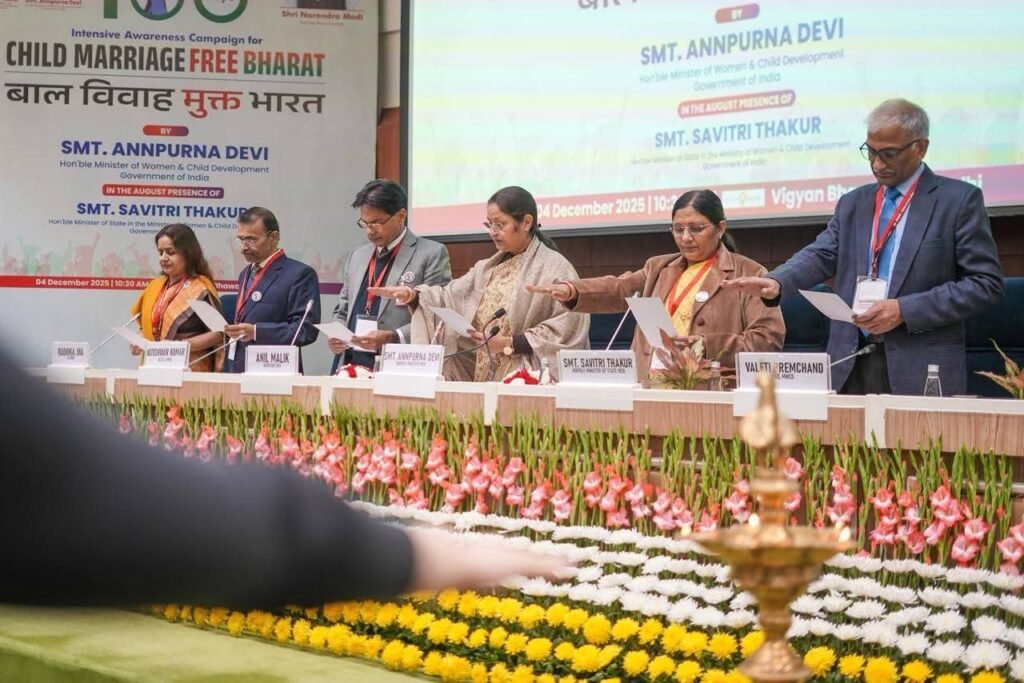
- The Ministry of Women and Child Development launched the Bal Vivah Mukt Bharat (Child Marriage-Free India) campaign in November 2024.
- This initiative aligns directly with Sustainable Development Goal 5.3 to completely eradicate child marriage by the year 2030.
- The government established the Bal Vivah Mukt Bharat Portal and a dedicated Mission Shakti App.
- These digital tools host centralized directories of Child Marriage Prohibition Officers, simplify complaint registration, and enable real-time tracking of child marriage cases.
- The administration executed a high-intensity 100-Day Special Campaign starting December 4, 2025, to accelerate community mobilization.
- The strategic drive focuses heavily on 257 high-prevalence districts to systematically reduce national child marriage numbers.
- The central government utilizes the Beti Bachao Beti Padhao (BBBP) scheme to fight deep-rooted patriarchal mindsets.
- This scheme works to ensure that families prioritize female literacy, delay marriage, and retain girls in secondary schools.
- State governments implement targeted Conditional Cash Transfer (CCT) schemes to discourage early marriages.
- The Ladli Lakshmi Yojana purchases savings certificates for the girl child, which matures into a lump sum payment when she reaches 21 years unmarried.
- Other Socio-Economic incentives like Sukanya Samriddhi Yojana, Kanyashree Prakalpa (West Bengal) and Kalyana Lakshmi / Shaadi Mubarak (Telangana).
- The CHILDLINE (1098) service provides a 24×7 emergency helpline for children in distress across India.
- This network works alongside the National Commission for Protection of Child Rights (NCPCR) to issue preventive advisories during mass wedding festivals like Akshay Tritiya.
- Reducing child marriage in India accelerates national development and protects fundamental human rights.
- This network works alongside the National Commission for Protection of Child Rights (NCPCR) to issue preventive advisories during mass wedding festivals like Akshay Tritiya.
- The Ministry of Women and Child Development launched the Bal Vivah Mukt Bharat (Child Marriage-Free India) campaign in November 2024.
Child Marriage in India: Key Challenges and Strategic Measures
- Challenges:
- Cultural Norms & Traditions: Communities accept early marriages due to traditional honor, caste values, and child betrothals.
- These rigid customs normalize the practice widely. Social acceptance severely weakens legal enforcement on the ground.
- Household Poverty: Severe economic insecurity pushes families toward early marriages.
- Parents view the practice as a financial survival strategy. Early weddings successfully reduce household expenses and dowry pressures.
- Access Gaps in Education: Marginalized girls lack proper access to quality secondary education. Rural areas witness high female student dropout rates.
- This structural educational deficit directly increases early marriage vulnerability.
- Ineffective Implementation of Laws: The judicial system enforces child marriage laws weakly. Overburdened grassroot officials fail to monitor remote villages properly.
- Low conviction rates completely dilute legal deterrence against offenders.
- Normative Gender Inequality: Deep-rooted patriarchy severely restricts female autonomy. Families regularly prioritize marriage over higher education.
- Fears of harassment or social backlash compel parents to marry girls early.
- Cultural Norms & Traditions: Communities accept early marriages due to traditional honor, caste values, and child betrothals.
- Measures:
- Boost Girls’ Education: The government implements programs like Samagra Shiksha.
- Secondary school retention provides the strongest deterrent against child marriages.
- Education effectively delays marriages and builds girls’ future capabilities.
- Reform and Strengthen Enforcement: A legislative proposal aims to raise the female marriage age to 21 years.
- The campaign deploys full-time Child Marriage Prohibition Officers. Teams utilize district monitoring and real-time reporting.
- Economic Support to Families: Welfare schemes like DAY-NRLM stabilize rural household incomes.
- Financial support directly reduces poverty-driven marriages. Cash assistance helps parents educate their daughters.
- Awareness and Community Ownership: Flagship campaigns like Poshan Abhiyaan utilize local Anganwadis. Peer educators actively change local mindsets and delay marriages.
- Community participation builds long-term institutional ownership against social evils.
- Keep Girls Safe and Empowered: Targeted initiatives like Mission Shakti strengthen safety nets.
- Adolescent schemes provide health support and life skills. Empowered girls effectively resist family pressure and claim their rights.
- Boost Girls’ Education: The government implements programs like Samagra Shiksha.
Frequently Asked Questions (FAQs):
1. Why has the United Nations praised India’s efforts against child marriage?
The UN recognised India’s progress through girls’ education, sustained government investment, community participation, and coordinated initiatives against child marriage.
2. What initiatives has India taken to prevent child marriage?
India implements Bal Vivah Mukt Bharat, Beti Bachao Beti Padhao, legal enforcement, community awareness, and child-protection services.
3. What is the United Nations’ position on child marriage in India?
The UN considers child marriage a harmful practice and supports stronger education, healthcare, protection, gender equality, and community-led prevention.
4. How prevalent is child marriage in India?
NFHS-5 (2019–21) found that 23.3% of women aged 20–24 married before age 18, down from 26.8% in 2015–16.
5. Which Indian laws prohibit child marriage?
The Prohibition of Child Marriage Act, 2006, is the principal law; POCSO and other applicable child-protection laws provide additional safeguards.
Disclaimer: Information in this article is based on official announcements and public records. Details may evolve over time.