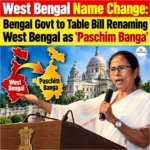




West Bengal Name Change: Bengal Govt to Table Bill Renaming West Bengal as ‘Paschim Banga’
| General Studies Paper II: Indian Constitution, Government Policies |
Why in News?
Recently, the West Bengal government announced plans to table a legislative bill aimed at renaming West Bengal as ‘Paschim Banga’.
Background and Historical Evolution of West Bengal’s Name
- Ancient: The earliest origins of the region’s name trace back to the ancient Vanga Kingdom, a powerful seafaring nation mentioned extensively in Vedic texts and the Mahabharata.
- The word originates from “Bang,” a Bronze Age proto-Dravidian tribe that inhabited the area around 1000 BC.
- It referred to a kingdom in the Ganges river delta.
- Medieval: During the 4th to 7th centuries, the territory was frequently referred to as Gaur under the legendary King Shashanka.
- The name later transitioned into Vangala or Bangala during the Bengal Sultanate era in the 14th century, which established a unified identity.
- The 805 CE Nesari plates and old South Indian inscriptions used Vangala or Vangaladesha to describe the region.
- Colonial: Following the Battle of Plassey in 1757, the British East India Company consolidated the region into the Bengal Presidency.
- In 1905, Lord Curzon carried out the first formal administrative partition, dividing it into East Bengal and West Bengal, which triggered the Swadeshi Movement before reunification in 1911.
- After Independence: The definitive geopolitical name West Bengal was officially adopted on August 15, 1947, under the Indian Independence Act.
- The wider province was partitioned along religious lines; the eastern portion became East Pakistan (now Bangladesh), while the western portion stayed with India.
- Modern Renaming: The word “West” became politically redundant after East Pakistan became Bangladesh in 1971. Renaming efforts began in 1999 under Chief Minister Jyoti Basu. Beginning with a ‘W’, West Bengal appears at the very bottom of official state lists.
- Later, Mamata Banerjee’s government passed resolutions in 2011, 2016 and 2018 proposing Paschim Banga and Bangla to resolve the state’s alphabetical disadvantage at national meetings.
- The Centre rejected this in 2017, stating that a state cannot have different official names across different languages.
- In 2018, the state assembly passed a new resolution proposing the single name Bangla across Hindi, English, and Bengali.
- The Central Government rejected this proposal due to concerns over its phonetic similarity to the neighboring nation of Bangladesh.
- In 2026, political updates entered another phase with the BJP state government proposing a bill to firmly retain West Bengal as the permanent name.
- Samik Bhattacharya, Rajya Sabha member, announced the government’s plan and advocated Paschim Banga.
- Later, Mamata Banerjee’s government passed resolutions in 2011, 2016 and 2018 proposing Paschim Banga and Bangla to resolve the state’s alphabetical disadvantage at national meetings.
Constitutional and Legal Procedure for Renaming a State
- Constitutional Provision: The official renaming of any state in India is strictly governed by Article 3 of the Constitution of India.
- This specific article grants plenary power exclusively to the Union Parliament to alter state areas, boundaries, and names.
- Process:
- The procedure typically begins when a State Legislative Assembly passes a unanimous or majority resolution requesting a name change.
- This proposal is then formally sent to the Union Ministry of Home Affairs (MHA) for evaluation. Alternatively, the Central Government can independently initiate this process.
- A formal Alteration of Name Bill cannot be directly introduced in the legislature. Under the proviso of Article 3, the draft bill requires the prior recommendation of the President of India before its introduction in either House of Parliament.
- Before recommending the bill, the President must refer the draft legislation to the affected State Legislature.
- This referral allows the regional assembly to express its formal views and feedback within a strictly specified timeframe.
- According to Article 4, any law enacted for renaming a state is not treated as a constitutional amendment under Article 368.
- Once the bill is introduced in Parliament. It must be passed in both houses of Parliament (Lok Sabha and Rajya Sabha) by a simple majority.
- It must be approved by more than 50 percent of members present and voting in each independent house of Parliament.
- After passing in Parliament, the bill is sent to the President for approval. Upon the President’s approval, the bill becomes law, and the state’s name is officially changed.
- Once the renaming process concludes legally, automatic administrative updates are recorded in the First Schedule (list of states) and Fourth Schedule (allocation of Rajya Sabha seats) of the Constitution.
- The procedure typically begins when a State Legislative Assembly passes a unanimous or majority resolution requesting a name change.
- Centre’s Role:
- The views expressed by the State Legislature are entirely advisory and non-binding on the Union. As clarified by the Supreme Court in the Babulal Parate case, Parliament can accept, reject, or completely ignore state modifications.
- The Union Cabinet must formally deliberate on and approve the proposal before the legislative process begins.
- The Ministry of Home Affairs coordinates inter-ministerial clearances from central agencies like the Railways, Posts, and Survey of India.
Examples of State Name Changes After Independence
- United Provinces to Uttar Pradesh (1950): The first major state renaming occurred on January 24, 1950, when the colonial-era United Provinces was officially transformed into Uttar Pradesh.
- This move shed British administrative terminology, integrating regional princely states like Rampur and Banaras under a native Indian identity.
- Madras State to Tamil Nadu (1969): Driven by fierce linguistic pride and the leadership of C.N. Annadurai, Madras State was renamed Tamil Nadu on January 14, 1969.
- The historic shift directly honored the distinct cultural and linguistic identity of the regional Tamil-speaking population.
- Mysore to Karnataka (1973): Formed initially under the States Reorganisation Act of 1956, the old Mysore State was officially renamed Karnataka on November 1, 1973.
- This comprehensive restructuring aimed to unify and encompass all Kannada-speaking regions under a single culturally relevant name.
- Pondicherry to Puducherry (2006): On October 1, 2006, the official name of the Union Territory was changed from Pondicherry to Puducherry, which means “New Village” in the local Tamil language.
- Uttaranchal to Uttarakhand (2007): Carved out of Uttar Pradesh in 2000, the northern hill state Uttaranchal was renamed Uttarakhand on January 1, 2007.
- The parliamentary bill received presidential assent following sustained public demands honoring the original “Uttarakhand Andolan” grassroots public movement.
- Orissa to Odisha (2011): To correct colonial misspellings and align with native phonetics, Orissa became Odisha on November 1, 2011.
- Enacted through the Orissa (Alteration of Name) Act, the parallel constitutional amendment simultaneously changed the official language spelling from Oriya to Odia.
- Kerala to Keralam (2026): In 2026, Kerala officially transitioned to Keralam on August 25, 2026. This followed a unanimous state assembly resolution to amend the First Schedule of the Constitution, adopting the state’s traditional Malayalam linguistic form.
Frequently Asked Questions (FAQs):
1. Why is West Bengal being renamed?
The proposed change aims to connect the state’s official name with its Bengali history, identity and Partition-era origins, according to the government’s stated position.
2. What is the proposed new name of West Bengal?
The proposed new name is Paschim Banga, replacing the English designation West Bengal in official usage.
3. Is West Bengal being renamed to Paschim Banga?
Yes, a renaming Bill is proposed, but the name has not yet legally changed; Assembly and subsequent parliamentary approval are required.
4. What is the West Bengal Name Change Bill?
It is a proposed State legislation seeking to formally rename West Bengal as Paschim Banga, beginning the constitutional process for changing the state’s official name.
5. When will the West Bengal Name Change Bill be introduced?
The Bill is expected to be introduced in the next Assembly session, with the state government indicating an early legislative move.
6. Who proposed the West Bengal name change?
Samik Bhattacharya, West Bengal BJP president and Rajya Sabha member, announced the government’s plan and advocated Paschim Banga.
Disclaimer: Information in this article is based on official announcements and public records. Details may evolve over time.
| Also Read: Proposal to Rename West Bengal |