Bangladesh First Nuclear Power Plan
|
General Studies Paper II: Nuclear Technology, Government Initiatives, India’s Neighborhood |
Why in News?
Recently, Bangladesh advanced its energy sovereignty by beginning uranium fuel loading at Unit-1 of the 2,400 MW Rooppur Nuclear Power Plant, marking its entry as the 33rd nation using nuclear power.
Highlights of Rooppur Nuclear Power Plant
-
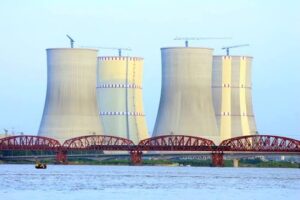
- About: The Rooppur Nuclear Power Plant (RNPP) is Bangladesh’s first nuclear energy project, marking a historic transition toward high-density, low-carbon energy.
- Location: The plant is situated on the eastern bank of the Padma River at Rooppur in Ishwardi Upazila, approximately 160 km northwest of Dhaka.
- The site was originally selected in the 1960s due to its stable geological conditions and proximity of the river for essential cooling water requirements.
- Ownership: It is owned by the Bangladesh Atomic Energy Commission (BAEC).
- Cooperation: The project is implemented through a trilateral model involving Bangladesh, Russia, and India.
- Rosatom (Russia) is the general contractor.
- Under a 2018 agreement, India provides technical consultancy, personnel training through the Global Centre for Nuclear Energy Partnership (GCNEP), and non-critical construction support.
- This is India’s first atomic energy venture abroad under an Indo-Russian deal to undertake projects in third countries.
- It operates under strict supervision of the International Atomic Energy Agency (IAEA) and national regulators like BAERA.
- Reactor Technology: RNPP features two VVER-1200 reactors, which are Russian-designed Generation III+ pressurized water reactors.
- Each unit has a gross capacity of 1,200 MW, providing a combined total output of 2,400 MW to the national grid.
- It can operate safety functions without a power supply or human intervention.
- Key components include Passive Heat Removal Systems (PHRS) shells to withstand earthquakes and aircraft impacts.
- Safety Standards: The plant utilizes a “defense-in-depth” safety philosophy, including both active and passive systems.
- Key features include a “Core Catcher” to contain molten core material in case of a meltdown, a double containment structure to resist external impacts, and passive heat removal systems that operate without electricity.
- Funding: The total project cost is estimated at $12.65 billion, with Russia providing a state export credit covering roughly 90% of the expenditure.
- The loan is to be repaid over a 20-year period, including a 10-year grace period.
- Fuel Management: Under a bilateral agreement, Russia will supply the Uranium-235 fuel for the plant’s entire 60-year lifespan.
- Crucially, an agreement exists for the repatriation of spent nuclear fuel to Russia for processing, mitigating local long-term waste storage concerns.
- Operational Timeline: Construction of Unit 1 officially began in November 2017, followed by Unit 2 in July 2018.
- Fuel loading for Unit 1 commenced on April 28, 2026, with initial trial generation of 300 MW expected by August 2026.
- Around 163 fuel assemblies enriched with 3–5% uranium-235 are inserted over 40–45 days, initiating controlled nuclear reactions and critical testing.
- Full commercial production is targeted for late 2027 or early 2028.
- Grid Contribution: Once fully operational, RNPP is expected to contribute approximately 9–10% of Bangladesh’s total electricity generation.
- It provides a reliable baseload of power, reducing the nation’s heavy reliance on expensive imported fossil fuels and natural gas.
- Development Goals: The plant supports the “Smart Bangladesh 2041” vision by providing clean energy with low carbon emissions.
- It is estimated to contribute roughly 2% to the national GDP by fostering industrial growth in the western region of the country.
- Bangladesh becomes the third power-generating country in South Asia after India and Pakistan, strengthening regional technological standing.
- Implications: The project enhances India-Russia-Bangladesh strategic energy dynamics and signals growing nuclear adoption in developing economies.
|
What is a Nuclear Power Plant?
|
India and Regional Energy Interdependence in South Asia
- Nuclear Diplomacy: India is leveraging its “Neighbourhood First” policy to act as a regional nuclear mentor.
- Through GCNEP, India provides advanced training to Bangladeshi scientists, effectively using “Science Diplomacy” to create a shared technical culture that stabilizes long-term bilateral relations.
- Grid Integration: The plant necessitates the expansion of Cross-Border Electricity Trade (CBET) infrastructure.
- The development of high-voltage 400kV transmission lines ensures that the Indian Power Grid acts as a technical buffer, providing the necessary spinning reserves to maintain frequency stability for Bangladesh’s massive new baseload input.
- Supply Chain: This project marks the debut of Indian domestic firms like Larsen & Toubro and Hindustan Construction Company in international nuclear logistics.
- By supplying “non-critical” components, India is establishing a regional manufacturing hub, reducing South Asia’s dependence on distant Western suppliers.
- Strategic Balancing: By facilitating Russia’s Rosatom in Bangladesh, India provides a viable alternative to China’s Belt and Road Initiative (BRI).
- This cooperation ensures that critical infrastructure in the Bay of Bengal remains within a Delhi-Moscow-Dhaka security architecture, preserving India’s maritime and terrestrial influence.
- Standardized Regulation: India is assisting in the creation of a regional nuclear regulatory framework aligned with IAEA standards.
- By harmonizing safety and emergency protocols, India ensures that any future nuclear expansion in South Asia follows a uniform safety code, mitigating trans-border environmental risks.
- Green Hydrogen Leadership: India’s National Green Hydrogen Mission aims to produce 5 MMT per annum by 2030.
- By offering this technology to South Asia, India is positioning itself as the primary provider of zero-emission industrial fuel.
- BBIN Power Exchange: Under the BBIN (Bangladesh, Bhutan, India, Nepal) framework, India has transitioned from bilateral to trilateral power trade.
- This allows Nepal and Bhutan to export hydroelectric surplus to Bangladesh via Indian transmission lines, fostering a market-based regional electricity pool.
|
Also Read: Mahi Banswara Atomic Power Plant |