



India Became World Fifth Largest Military Spender
|
General Studies Paper II: Government Budgeting, Defence & Modernisation |
Why in News?
According to the Stockholm International Peace Research Institute (SIPRI) report, India has become the world’s fifth-largest military spender in 2025 with defence expenditure of $92.1 billion, rising 8.9%.
- India Became 5th largest military spender globally, following the USA, China, Russia, and Germany.
- India accounts for 3.2% of the total global military expenditure.
Drivers Behind India’s Increased Military Expenditure and Modernisation Push
- Regional Threat Environment: India’s defence spending surge is primarily driven by intensifying regional security threats, especially from China and Pakistan.
- China’s military budget reached $336 billion, while Pakistan spent $11.9 billion, reinforcing India’s need for deterrence and preparedness.
- The deployment of J-20 stealth fighters by China within 150 km of the border has necessitated urgent aerial and electronic warfare upgrades.
- Border Tensions Factor: Persistent border disputes along the Line of Actual Control (LAC) and frequent military standoffs have necessitated higher allocation for infrastructure, troop deployment, and surveillance systems, increasing operational expenditure significantly.
- Recent events like Operation Sindoor in May 2025, directly pushed defence spending upward, reflecting reactive and precautionary military investments.
- This led to the immediate raising of “Rudra” integrated brigades to decentralize technical capabilities.
- Global Arms Race Influence: Global military expenditure reached $2.887 trillion in 2025, marking the 11th consecutive annual increase, influencing India to align with rising militarisation trends and avoid strategic lag.
- Strategic Autonomy Goals: India’s spending reflects a long-term push for strategic autonomy, reducing dependence on alliances while ensuring independent defence capability amid uncertain global power shifts.
- India increases high-tech partnerships with France (Rafale), Israel (drones/radars), and the USA (helicopters/artillery).
- Capital Expenditure Expansion: In Budget 2026–27, India allocated ₹7.85 lakh crore, with ₹2.19 lakh crore earmarked for modernisation, indicating a strong shift toward technology-driven warfare capabilities.
- Technology and Warfare Transformation: Rising investments target AI, cyber warfare, drones, missiles, and advanced aircraft systems, reflecting a transition toward next-generation warfare doctrines and multi-domain combat readiness.
- Significant allocations include ₹486 billion for aircraft and aero engines and ₹243.9 billion for naval capabilities, highlighting focus on maritime security and air superiority.
- Long-Term Budget Growth Trend: India’s defence budget has grown from ₹2.53 lakh crore (2013–14) to ₹6.81 lakh crore (2025–26), reflecting a 2.6× increase and consistent prioritisation of defence in fiscal policy.
- Defence accounts for nearly 15% of total central government expenditure, making it the largest allocation sector, indicating its centrality in national policy priorities.
- Manpower Cost Burden: A major structural driver is the high share of salaries and pensions (₹4.7 trillion), which compels increased budgets to balance operational readiness and modernization needs simultaneously.
- Indigenous Defence Push: Policies like ‘Make in India’ and defence indigenisation aim to boost domestic manufacturing, reduce imports, and increase exports, which reached ₹38,424 crore in 2025–26 (62.7% growth), reinforcing spending momentum.
- Self-reliance is now a fiscal priority, with 75% of the modernization budget (₹1.39 lakh crore) strictly reserved for domestic procurement.
- This initiative has reduced import dependency for low-to-mid-tech systems.
India’s Defence Policy Landscape
- Reform Orientation: India declared 2025 as the “Year of Reforms”, signalling a structural shift toward modernisation, integration, and self-reliance in defence policy architecture.
- Reforms emphasise strengthening higher defence management, including coordination among key institutions like the Department of Military Affairs (DMA) and national security bodies.
- Current efforts focus on integrated theatre commands, advanced technologies like AI and hypersonics, and expanding global export footprint to reach ₹50,000 crore by 2029.
- Record Export Milestones: Defence exports surged to an all-time high of ₹38,424 crore in FY 2025-26, marking a 62.66% growth.
- India now exports equipment, including BrahMos missiles and radars, to over 80 countries.
- Positive Indigenization Lists: The government has notified multiple Positive Indigenisation Lists covering over 5,500 items.
- As of February 2025, approximately 3,000 items have been successfully indigenized, reducing import dependency significantly.
- iDEX Innovation Ecosystem: The Innovations for Defence Excellence (iDEX) initiative has engaged over 670 startups and MSMEs as of early 2026.
- Contracts worth ₹3,853 crore have been cleared for procurement of prototypes developed through this platform.
- ADITI Deep-Tech Scheme: The ADITI scheme, a sub-scheme of iDEX, provides grants up to ₹25 crore for developing critical technologies like quantum communication and anti-drone systems.
- It targets 30 key defence technologies for rapid development by 2026.
- Integrated Theatre Commands: A core future goal is the establishment of Integrated Theatre Commands to bolster jointness among the Army, Navy, and Air Force.
- This reform aims to create a unified military space and cyber doctrine for multi-domain warfare.
- Defence Industrial Corridors: Two major corridors in Uttar Pradesh and Tamil Nadu have attracted investments exceeding ₹8,658 crore.
- These hubs have signed 253 MoUs with an estimated investment potential of ₹53,439 crore as of 2025.
- Advanced Missile Development: India successfully tested hypersonic missiles capable of speeds exceeding Mach 5 in 2025.
- Strategic acquisitions like the ₹19,518 crore BrahMos contract ensure long-term maritime strike superiority.
- Naval Fleet Expansion: The Indian Navy aims for 200 surface platforms and 100 aircraft by 2030.
- Key inductions include INS Tushil and the Kalvari-class submarine Vaghsheer in late 2024.
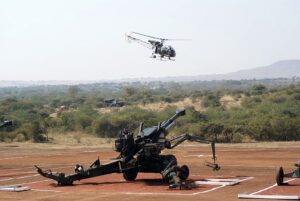
- Air Force Modernization: The Indian Air Force is inducting 156 LCH Prachand helicopters and has approved the AMCA (stealth fighter) execution model.
- Additionally, 56 C295 transport aircraft are being manufactured indigenously under a Tata-Airbus partnership.
- Army Technological Absorption: The Army designated 2024 and 2025 as the “Years of Technology Absorption”.
- It has already indigenized 159 out of 175 ammunition variants, reaching a 91% success rate.
- Space and Cyber Warfare: The Joint Military Space Doctrine released in 2025 outlines a roadmap for satellite-based surveillance and secure communications.
- The DRDO launched a Quantum Technologies Research Centre to protect national security data.
- FDI Liberalization Policy: Foreign Direct Investment (FDI) limits were eased to allow 74% via the automatic route and 100% via the government route. Total FDI in defence has reached ₹5,516 crore since April 2000.
- Strategic Border Infrastructure: The Border Roads Organisation (BRO) received a ₹7,146 crore allocation for 2025-26, a 9.74% hike.
- Focus remains on high-altitude projects like the Nyoma Air Field and Shinku La tunnel.
- Military Diplomacy Reach: The Indian Army is now engaged with 118 countries through various cooperation activities.
- Defence wings have been expanded to 52 missions worldwide, including new wings in Poland and Algeria.
Significance
- Net Security Provider: India’s rise in defence spending strengthens its emergence as a “net security provider” in the Indian Ocean Region.
- By securing vital sea lanes that carry 66% of global oil supplies, India provides maritime domain awareness to 35 littoral states, positioning itself as a central guardian of regional stability and open trade.
- Reliable Regional Anchor: As a “First Responder,” India has strengthened its role as a reliable regional partner through frameworks like the Colombo Security Conclave.
- Its robust spending ensures a credible presence to counter regional threats while providing immediate humanitarian aid and disaster relief to neighboring nations.
- Elevated Global Influence: Ranking just behind the US, China, Russia, and Germany increases India’s bargaining power in international forums.
- This fiscal resolve translates into high-level military diplomacy, allowing India to lead major multilateral exercises like Milan 2026 and shape security architecture of the Indo-Pacific.
- It elevates India’s voice in global governance, security dialogues, and multilateral forums.
|
Also Read: Indian Army Declares 2026 as the Year of Networking and Data |