



MP HC Declares Bhojshala Complex A Temple
|
General Studies Paper I: Indian Heritage Sites, Indian Architecture |
Why in News?
Recently, the Madhya Pradesh High Court declared the disputed Bhojshala-Kamal Maula complex in Dhar a temple dedicated to Goddess Vagdevi, relying on scientific survey data.
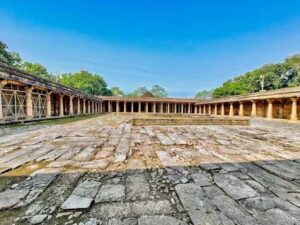
What is Bhojshala Temple-Kamal Maula Mosque Complex?
- Location: The Bhojshala Temple–Kamal Maula Mosque Complex is situated in Dhar district of Madhya Pradesh, an important medieval cultural centre of central India.
- The monument stands within the historic urban core of Dhar, once the capital of the Paramara dynasty.
- It is officially protected as a Monument of National Importance under the Archaeological Survey of India (ASI).
- Association: The complex is traditionally linked to Paramara King Bhoja (1010–1055 CE), one of medieval India’s greatest scholar-kings.
- Historical traditions describe Bhojshala as a major centre of Sanskrit learning, philosophy, grammar and literature established during his reign.
- The name “Bhojshala” literally means “Hall of Bhoja.”
- Several Sanskrit and Prakrit inscriptions have been discovered at the complex. Some inscriptions mention Paramara ruler Naravarman (1094–1133 CE) and provide evidence regarding medieval educational traditions, donations and temple culture in Malwa.
- Goddess Saraswati: The structure is historically associated with Goddess Vagdevi/Saraswati, the Hindu deity of wisdom, learning and arts.
- Medieval literary references describe the site as an educational and spiritual institution where scholars studied Vedas, poetics, astronomy and Sanskrit grammar.
- Architectural Character: The monument displays a blend of late Paramara temple architecture and later Indo-Islamic structural additions.
- Sandstone pillars, carved ceilings, latticed windows and ornate brackets dominate the complex. Many architectural components date mainly to the 12th–13th centuries.
- The wider campus includes pillared halls, prayer spaces, courtyards and later-period domed structures. Islamic tomb structures were added mainly between the 14th and 15th centuries.
- Conservation: The monument is maintained by the Archaeological Survey of India under the Ancient Monuments and Archaeological Sites and Remains Act, 1958.
- Archaeological Investigations: The ASI conducted a major 98-day scientific survey using ground-penetrating radar, GPS mapping, carbon dating, excavation, photography and architectural analysis.
- The investigation generated a detailed 10-volume report exceeding 2,000 pages.
- ASI documentation records around 106 carved pillars and 82 pilasters within the structure. These contain depictions of Ganesh, Brahma, Narasimha, Bhairava, animals and floral motifs, reflecting advanced medieval stone craftsmanship.
Bhojshala Complex Dispute
- Claims: Hindus identified Bhojshala as an ancient Saraswati temple and Sanskrit learning centre, while Muslims regarded the structure as the Kamal Maula Mosque.
- These parallel religious claims gradually transformed the monument into a sensitive heritage issue.
- Administrative Confusion: During British rule, authorities recorded conflicting descriptions of the site in official documents.
- Different surveys referred to it alternately as a temple, mosque, or mixed monument, creating long-term ambiguity over ownership and religious identity.
- Organized Mobilisation: From the late 20th century, several Hindu organisations launched campaigns demanding restoration of Bhojshala as a dedicated Saraswati temple.
- Muslim groups simultaneously defended continued namaz rights, intensifying public mobilisation in Dhar and nearby Malwa regions.
- ASI’s Formula: In April 2003, the Archaeological Survey of India (ASI) introduced a compromise arrangement.
- Hindus were permitted worship mainly on Tuesdays, while Muslims were allowed Friday namaz, making Bhojshala one of India’s rare officially shared religious sites.
- Flashpoints: Tensions peaked whenever Basant Panchami, associated with Goddess Saraswati, coincided with Friday prayers.
- Competing schedules over worship timings repeatedly created law-and-order concerns and heavy security deployments in Dhar.
- Major confrontations occurred in 2013 and 2016 during overlapping religious observances. Authorities frequently deployed heavy police forces, surveillance systems and restricted movement near the site to prevent unrest.
- In 2026, over 8,000 security personnel were reportedly deployed around the monument zone.
- Petition: The Hindu Front for Justice initiated writ petitions challenging a 2003 Archaeological Survey of India (ASI) rule that older arrangements split access, allowing Hindus to pray on Tuesdays and Muslims to offer namaz on Fridays.
Landmark High Court Judgment
- On May 15, 2026, a Division Bench consisting of Justices Vijay Kumar Shukla and Alok Awasthi delivered a definitive 242-page judgment. The Madhya Pradesh High Court officially declared the entire disputed complex a Hindu Temple.
- The bench held that the religious character of the area belongs to Bhojshala, an ancient center of Sanskrit learning. It recognized the monument as a temple dedicated to Goddess Vagdevi Saraswati.
- The court explicitly quashed the 2003 ASI circular to the extent that it restricted Hindu worship. This legal reversal completely revoked the permission for Friday namaz previously granted to the Muslim community.
- The judgment relied extensively on an exhaustive scientific ASI survey report. Excavations uncovered 97 Hindu murals and deities, validating a pre-existing temple base.
- The bench noted that the existing mosque walls and mihrab were constructed later using dismantled temple pillars.
- Defaced Sanskrit inscriptions were found recycled into the floors and walls of the Kamal Maula Mosque structure.
- Judicial records traced the temple’s destruction to Alauddin Khilji at the turn of the 13th-14th century.
- The Kamal Maula Mosque was subsequently erected over the ruins during Mehmood Khilji’s regime around 1514 AD.
- To balance community needs, the High Court directed the Madhya Pradesh State Government to intervene.
- It stated that representatives of the Maulana Kamaluddin Welfare Society may seek alternate land in Dhar district to build a mosque.
- The High Court explicitly incorporated 10 principles laid down by the Supreme Court in the 2019 Babri Masjid case.
- It ruled that multidisciplinary archaeological evidence holds strong evidentiary weight in civil title determinations.
- The court declared the complex a Centrally Protected Monument monitored under the 1958 Act.
- It ordered the ASI to retain strict supervisory control over preservation and pilgrim security.
|
Also Read: The Piprahwa Relics |