India First Satellite-Tagged Ganges Soft-Shell Turtle
|
General Studies Paper III: Environment & Conservation |
Why in News?
Recently, the government released India’s first satellite-tagged Ganges soft-shell turtle in Kaziranga National Park and Tiger Reserve in Assam.
About Ganges Soft-Shell Turtle
- Classification: It belongs to the family Trionychidae, a distinct group of reptiles recognized globally for their lack of hard, bony scutes.
- It was first described by French zoologist Georges Cuvier in 1825.
- The species is among the largest freshwater turtles of South Asia and represents one of five species under the genus Nilssonia.
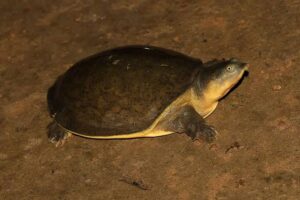
- Characteristics: This species features a flat, oval carapace reaching lengths up to 94 centimetres.
- Its dorsal skin is typically olive-green, complemented by prominent black reticulated lines on its large head.
- It possesses a distinct, tube-like proboscis snout that acts as a snorkel while submerged.
- Distribution: The species inhabits major river basins including the Ganga, Brahmaputra, Indus, Mahanadi, Meghna and Narmada systems.
- In India, it is reported from Assam, Bihar, Rajasthan, Uttar Pradesh, Madhya Pradesh, West Bengal and Odisha.
- The turtle is also distributed across Nepal, Bangladesh and Pakistan.
- Habitat Preferences: It exhibits a strong preference for deep, turbid river channels, large canals, lakes, and mud-bottomed ponds.
- It utilizes sandy or muddy substrates to bury its large body, allowing it to stay concealed from predators and ambush passing prey.
- Diet & Behavior: Operating as an omnivorous scavenger, its diet comprises fish, molluscs, frogs, waterfowl, and aquatic plants.
- It functions heavily as an ambush predator, using its highly flexible, long neck to rapidly strike passing organisms from beneath the riverbed sediment.
- Reproductive Biology: The breeding window predominantly spans from August to November.
- Females construct safe nests along clayey banks and river islands, laying clutch sizes ranging anywhere from 8 to 47 eggs.
- The incubation process is heavily regulated by surrounding temperature variations.
- Bio-Indicator: As an ecological indicator, the presence of Nilssonia gangetica directly reflects the biological health of a river system.
- High populations correlate with stable, oxygenated waters, whereas sharp declines alert biologists to escalating heavy-metal pollution and severe habitat degradation.
- Water Indicator: They serve as vital natural water purifiers within the Ganges ecosystem.
- By aggressively consuming carrion and decaying organic matter, they effectively clear toxic debris, check bacterial proliferation, and directly halt downstream disease transmission.
- Conservation: The species is categorized as Vulnerable on the IUCN Red List.
- To combat rampant illegal poaching and shell trade, it is protected under Schedule I of India’s Wildlife Protection Act and Appendix I of CITES, making unauthorized possession a severe statutory offence.
- Threats: Key threats include illegal wildlife trade, poaching, river pollution, sand mining, dam construction and habitat fragmentation.
- Religious waste dumping and accidental capture in fishing nets further reduce populations across northern Indian rivers.
- Increased cyclone frequency and rising sea levels cause severe beach erosion and nest inundation.
India’s First Satellite-Tagging Initiative
- Conservation: India released its first satellite-tagged Ganges soft-shell turtle (Nilssonia gangetica) in Kaziranga National Park and Tiger Reserve, Assam, on 15 May 2026, coinciding with Endangered Species Day.
- Implementing Institutions: The project was executed by the Wildlife Institute of India (WII) under the Ministry of Environment, Forest and Climate Change (MoEFCC).
- The ministry collaborated with the Assam Forest Department and Kaziranga authorities.
- Funding support came from the National Geographic Society.
- Objective: The initiative aims to study seasonal migration, home range, river connectivity, and critical nesting habitats of the species across the Brahmaputra river basin.
- Technology: Researchers attached a lightweight satellite transmitter to the turtle’s shell under veterinary supervision.
- The device transmits real-time geolocation data through satellites, enabling non-invasive monitoring of movement and behavioural patterns in natural habitats.
- Kaziranga Landscape: Kaziranga is globally recognised as a priority freshwater turtle landscape.
- Assam hosts nearly 21 turtle species, while five of India’s eight soft-shell turtle species occur within the Kaziranga ecosystem, making it crucial for aquatic biodiversity conservation.
Significance of This Initiative
- Scientific River Conservation: The initiative represents India’s transition from traditional wildlife monitoring to data-driven freshwater conservation.
- Collected telemetry data will support evidence-based conservation planning, identification of protected breeding zones, river restoration strategies and future species recovery programmes.
- The project demonstrates growing adoption of space technology, GIS mapping and wildlife telemetry in India’s environmental governance.
- Brahmaputra Basin Management: Tracking movement patterns will help identify critical aquatic corridors, seasonal refuges and river stretches requiring protection within the Brahmaputra basin.
- This supports integrated river management amid increasing pressure from embankments, hydropower projects and erosion-driven habitat loss.
- Climate Change Research: Freshwater turtles are highly sensitive to temperature variation, altered river flow and flooding patterns.
- Satellite-based monitoring can generate long-term evidence on how climate change affects breeding cycles, nesting success and habitat selection in Himalayan-fed river ecosystems.
- Freshwater Biodiversity Policy: India’s freshwater ecosystems receive less policy attention compared to forests and tiger reserves.
- Scientific data from this initiative can support dedicated policies for riverine biodiversity conservation, including habitat zoning, anti-poaching surveillance and sustainable fisheries management.
- Global Significance: The programme enhances India’s contribution to international freshwater conservation efforts under the Convention on Biological Diversity (CBD) and CITES.
- It may become a model for monitoring other endangered Asian soft-shell turtles facing rapid population decline across South Asia.
|
Government Measures for Turtle Conservation:
|
|
Also Read: Tamil Nadu Allocates ₹1 Crore for Wildlife Protection |