India Rejects China-Pakistan Joint Statement on Jammu & Kashmir
|
General Studies Paper II: India and its Neighbourhood, Groupings & Agreements Involving India and/or Affecting India’s Interests |
Why in News?
Recently, India firmly rejected China-Pakistan’s joint statement on Jammu and Kashmir, reaffirming J&K and Ladakh as integral territories of India.
What does China-Pakistan Joint Statement Say?
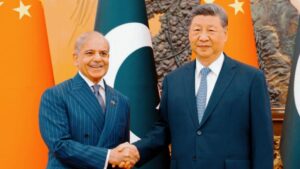
The China-Pakistan Joint Statement was issued during Pakistani Prime Minister Shehbaz Sharif’s May 2026 visit to Beijing after meetings with Xi Jinping and Premier Li Qiang. Key pillars of the agreement include:
- Economic and Connectivity Ties: Both nations committed to boosting the China-Pakistan Economic Corridor (CPEC) and establishing the Gwadar port as a regional connectivity hub.
- They plan to expand cooperation in trade, energy, the digital economy, and artificial intelligence.
- Security and Counterterrorism: Pakistan pledged to take targeted measures to ensure the safety of Chinese personnel, projects, and institutions in the country.
- Both countries emphasized joint counterterrorism efforts and the need to prevent militant groups—such as the Tehrik-i-Taliban Pakistan (TTP) and the East Turkestan Islamic Movement (ETIM)—from using regional territories for attacks.
- Kashmir Issue: The statement addressed the Kashmir dispute as a “dispute left from history,” calling for its resolution through peaceful dialogue, diplomacy, and in accordance with the UN Charter and relevant UN Security Council resolutions.
- China reiterated support for Pakistan’s position on Kashmir, while Pakistan briefed Beijing on regional developments.
- Regional Stability: China and Pakistan agreed to coordinate closely on Afghanistan, advocating for diplomatic approaches to regional tensions.
- Both nations also condemned unilateral actions and expressed support for a fair, multipolar world order.
India’s Diplomatic Response on This
- India’s Ministry of External Affairs (MEA) issued a sharp diplomatic rebuttal after the China-Pakistan Joint Statement mentioned Jammu & Kashmir.
- MEA spokesperson declared that Jammu & Kashmir and Ladakh are “integral and inalienable” parts of India and emphasized that no external country has any “locus standi” to comment on India’s internal affairs.
- India strongly objected to renewed Chinese backing for the China-Pakistan Economic Corridor (CPEC) because major infrastructure projects pass through Pakistan-occupied Kashmir (PoK), especially Gilgit-Baltistan.
- New Delhi described such projects as violations of India’s territorial sovereignty and integrity.
- India also criticized what it called Pakistan’s “illegal and forcible occupation” of Indian territory.
- India dismissed the mention of “trans-boundary water resources cooperation” as baseless and emphasized that China and Pakistan do not share a border.
- The rivers in question pass through sovereign Indian territory. India reiterated its long-standing refusal to recognize the 1963 boundary agreement between Pakistan and China, under which Pakistan illegally ceded 5,180 Sq.km. of territory in the Shaksgam Valley.
India’s Stand on Jammu and Kashmir
- Legal Foundation: India’s official position is based on the Instrument of Accession signed on 26 October 1947 by Maharaja Hari Singh.
- Through this legally binding document, Jammu & Kashmir acceded to the Dominion of India during the tribal invasion backed by Pakistan.
- India maintains that the accession was final, constitutional, and identical to accessions signed by other princely states after Independence.
- Constitutional Integration: India asserts that Jammu & Kashmir became an inseparable part of the Union under Article 1 of the Constitution, which lists it as Indian territory.
- New Delhi argues that constitutional sovereignty rests fully with India regardless of external claims or international commentary.
- India officially regards Gilgit-Baltistan and Pakistan-occupied Kashmir as illegally occupied Indian territories. Parliament’s 1994 unanimous resolution reaffirmed reclaiming these territories as a national objective.
- Article 370 was introduced as a “temporary provision” granting J&K a semi-autonomous status and its own constitution. India always maintained that this was an internal arrangement subject to change by the Indian Parliament.
- On August 5, 2019, the Government of India revoked the special status under Article 370. The region was reorganised into two distinct Union Territories: Jammu & Kashmir and Ladakh.
- The Supreme Court of India constitutionally validated this move in December 2023, ruling that Article 370 was temporary and J&K held no internal sovereignty after its accession.
- Rejection of Third-Party Mediation: Under the 1972 Simla Agreement and the 1999 Lahore Declaration, India maintains that all outstanding issues with Pakistan must be resolved purely through bilateral dialogue.
- India completely rejects any third-party mediation, international arbitration, or interference by groups like the United Nations or the Organisation of Islamic Cooperation (OIC).
- India argues that early UN Security Council resolutions became obsolete because Pakistan failed to fulfill preconditions requiring withdrawal of forces from occupied territories.
- India therefore considers the matter legally settled through accession and constitutional integration.
China-Pakistan Ties: Challenges for India
- Occupied Territories: The biggest challenge is the China-Pakistan strategic nexus in disputed territories linked to Jammu & Kashmir and Ladakh.
- India also opposes Chinese infrastructure expansion through Gilgit-Baltistan, PoK, and CPEC corridors, considering them violations of sovereignty.
- These areas connect strategically with Aksai Chin, Karakoram Pass, and the Siachen region, increasing India’s security vulnerabilities.
- Two-Front Military: India faces simultaneous pressure from China along the Line of Actual Control (LAC) and Pakistan along the Line of Control (LoC).
- Joint military exercises, intelligence cooperation, and defence coordination between Beijing and Islamabad complicate India’s strategic planning and increase defence expenditure requirements.
- Indian Ocean: China’s growing presence at Pakistan’s Gwadar Port expands Beijing’s reach into the Arabian Sea and Indian Ocean Region.
- India fears long-term dual-use military access that could challenge Indian naval dominance and maritime trade security.
- Defence Cooperation: China remains Pakistan’s largest defence supplier, supporting fighter aircraft, submarines, drones, missile systems, and surveillance technologies.
- This cooperation strengthens Pakistan’s military modernization and reduces India’s conventional advantage in certain sectors.
- Diplomatic Coordination: China and Pakistan frequently coordinate positions in international forums including the UN Security Council and OIC.
- Beijing has repeatedly shielded Pakistan diplomatically on terrorism-related issues, limiting India’s global diplomatic leverage.
- Economic Competition: Through the Belt and Road Initiative (BRI) and CPEC, China is expanding regional trade routes bypassing India.
- India fears strategic encirclement and declining influence in South Asian connectivity and Eurasian trade networks.
- Internal Stability: China-Pakistan technological cooperation raises concerns regarding cyber espionage, digital surveillance, and information warfare.
- China has systematically upgraded Pakistan’s Intelligence, Surveillance, and Reconnaissance (ISR) networks using space-based assets.
- India worries that strategic coordination may indirectly strengthen extremist networks and destabilize activities affecting internal security.
India’s Strategy to Counter China-Pakistan Challenges
- Strengthening Border Infrastructure: India is accelerating strategic connectivity through the Border Roads Organisation (BRO), India-China Border Roads Programme, and Vibrant Villages Programme.
- Projects like the Sela Tunnel, Zojila Tunnel, and the proposed 1,840-km Arunachal Frontier Highway aim to ensure faster troop mobilisation and year-round logistics near the LAC and LoC.
- Rapid Defence Modernisation: To counter simultaneous threats from China and Pakistan,
- India raised defence expenditure to nearly ₹7.84 lakh crore in Budget 2026-27, including ₹2.19 lakh crore for military modernisation.
- Investments focus on drones, Rafale aircraft, missile systems, submarines, and integrated surveillance capabilities.
- Technology-Based Warfare: India’s Defence Forces Vision 2047 prioritises cyber warfare, AI, space command, drone forces, and integrated theatre commands.
- The Indian Army is also planning induction of nearly 30,000 drones for border surveillance and anti-drone operations across China and Pakistan frontiers.
- Strategic Partnerships: India is deepening cooperation with the QUAD (India-US-Japan-Australia) to balance China’s regional influence.
- In May 2026, QUAD launched initiatives on critical minerals, maritime surveillance, energy security, and Indo-Pacific port infrastructure, directly strengthening India’s strategic position.
- Maritime Security: India is executing a counter-encirclement strategy in the Indian Ocean Region (IOR) to neutralize China’s “String of Pearls,” which includes the Gwadar Port.
- India is developing a $10 billion deep-water transshipment port, airport, and military base at Great Nicobar Island. It is located just 14 nautical miles from the Strait of Malacca, allowing India to closely monitor Chinese energy shipping.
- India utilizes the Information Fusion Centre – Indian Ocean Region to integrate radar networks and share actionable intelligence in real-time with global partners.
- Internal Security Measures: India introduced the PRAHAAR anti-terror policy in 2026 based on intelligence-led operations, terror financing disruption, border monitoring, and international cooperation.
- It unifies a whole-of-government approach aimed at dismantling modern hybrid threats, cross-border infiltration, and extremist networks.
- The framework aims to reduce Pakistan-linked cross-border terrorism and extremist networks.
|
Also Read: India Rejects OIC Remarks on Kashmir |